The scale of defeat suffered by U.S. President Donald Trump in Iran is difficult to overstate. The steady regression of his demands and stated objectives, combined with the now-released 14-point memorandum of understanding, clearly shows that the President was forced to make concessions that are miles away from the “total surrender” he was originally demanding. Trump’s June 17 press conference on the sidelines of the G7 summit was a case in point. He revealed that the U.S. was on track to “run out of [oil] reserves at about four weeks,” after which it would be “bedlam.” He said that if the war were to have continued, the strait may “never be open,” noting: “The one thing I didn’t want to see, is I didn’t want to see economic catastrophe. If you kept this going, that could have happened.”
There are also growing admissions of how much Iran stands to gain from the “deal.” In addition to the lifting of the U.S. blockade, U.S. officials confirmed during a June 17 phone briefing that Iranian sanctions relief would occur immediately and was not dependent on future behavior, as had previously been stated. Additionally, the MOU clearly approves Iran to work with Oman to define “future administration and maritime services” for the opened Strait of Hormuz, and proposes a $300 billion fund for Iran’s reconstruction. Trump also walked back demands about Iran’s ballistic missile arsenal and civilian nuclear power program.
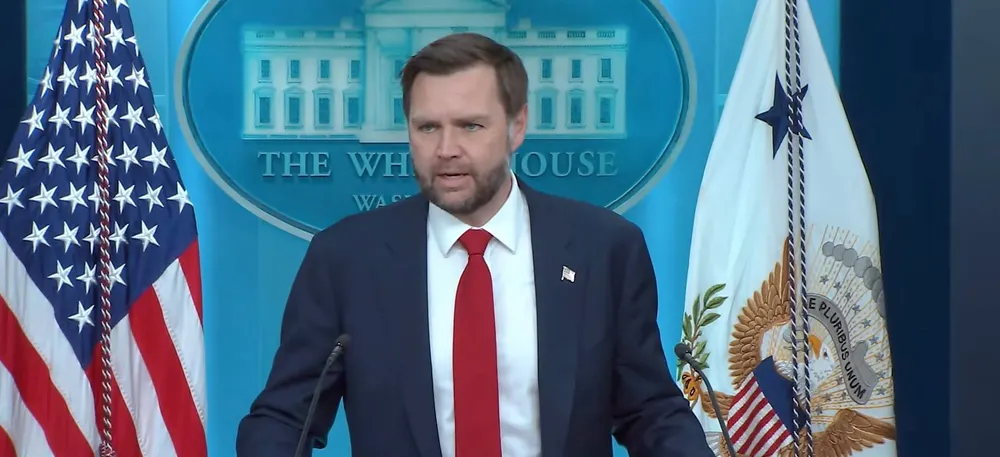
Not surprisingly, these developments are causing shockwaves throughout Israel, and the Trump administration is widely being accused by Israeli hardliners of capitulating to Iran. However, what is surprising is the strong and public rebuttal from the administration. In a White House press briefing on June 18, Vice President Vance gave what was possibly the strongest dressing down of Israeli officials by an American official in years: “If I was [sic] in the cabinet of the Israeli government, I might not be attacking the only powerful ally that I have anywhere left in the entire world…. Donald J. Trump is the only head of state in the entire world who is sympathetic to the nation of Israel at this moment in time.” The strength of this response is clearly reflective of Israel’s stated refusal to withdraw from Lebanon, thereby threatening to blow up the deal entirely.
We’re in a moment of profound transition. While Israel’s and President Trump’s defeats are on full display, this is also a defeat for an entire worldview of inhuman and racist geopolitics—one that long precedes Trump and that has been past due for extinction for a long time. But the failure of this policy is not enough—it only opens the door to something different in its wake. Now is the moment to push through a fundamentally new policy that is capable of taking this fragile peace and transforming it into a new security and development architecture for the entirety of Southwest Asia.
In this context, the speaker of Iran’s Parliament and special representative for China affairs, Mohamed Ghalibaf, gave one indication of where Iran is looking. Speaking at the Iran Chamber of Commerce on June 17, Ghalibaf proposed that Iran work with China to develop new forms of cooperation, and even proposed the formation of new regional groupings with its neighbors. “Our main priority with China is the economic sector,” he said, adding, “We are truly a partner in every sense with China.”
The full perspective of this needed solution is that laid out in the Schiller Institute’s Extended Oasis Plan proposed by Helga Zepp-LaRouche. Rather than relying on this region’s gas and oil reserves as the primary economic driver, it should draw on its central position as the crossroads between Asia, Europe, and Africa—and all the cross-continental infrastructure and economic activity that that implies. China is a key player, whose involvement can bring in rapid economic development as well as real-world experience in greening arid deserts—something desperately needed in Southwest Asia.
Seen from this standpoint, an alternative to war and geopolitics is imminently possible. But only if real workable solutions are brought to the table—and fast. On June 18, Ukraine launched a massive drone attack on the city of Moscow, damaging several oil refinery installations and sending black smoke across the sky. The move was a major escalation, and underscores why an exit from continued geopolitical madness is more urgent than ever.
Join the mobilization and work with the LaRouche movement to inject this policy into the discussion while we still have the chance. Friday’s meeting of the International Peace Coalition will take up this topic in full. Tune in and get involved.