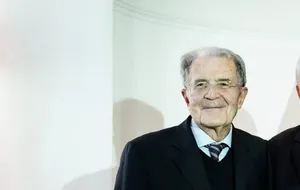
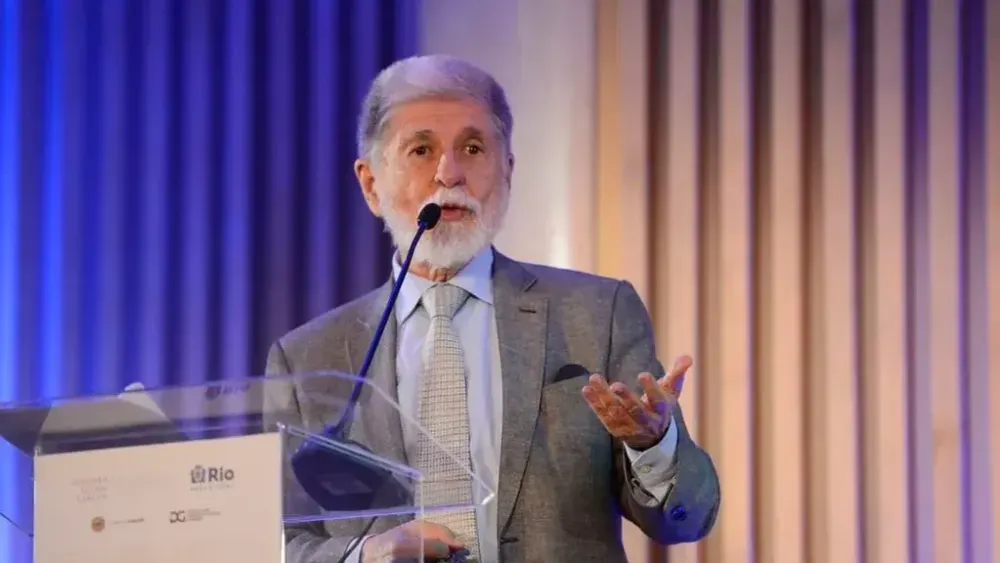
The following is a slightly edited transcript of a July 24, 2026 interview with Ambassador Celso Amorim, Special Advisor to Brazilian President Luiz Inácio Lula da Silva, conducted by EIR’s Ibero-America Editor Dennis Small in the course of a visit to Brazil. Subheads have been added. The video is available here.
Dennis Small: This is Dennis Small with Executive Intelligence Review and the Schiller Institute, and I am talking with Special Advisor to the President of Brazil, Ambassador Celso Amorim. I want to thank you for taking a few minutes from your very, very busy schedule to talk to us today.
The first question I’d like to raise with you is: Pope Paul VI is very famous for having talked about, in Populorum Progressio, the idea that development is the new name for peace. Similarly, the Schiller Institute and Helga Zepp-LaRouche have emphasized that we need a new international security and development architecture. And you, in a recent speech in Russia, spoke about the inverse of that, a complement of that, that peace is also the new name of development. Could you explain that thought a little bit further, please?
Amb. Celso Amorim: Well, let me say, in my opinion, both are true. I’m not at all diminishing what the Pope said; and I, of course, totally agree with that. Even at that time, we quoted him very often in defense of Brazilian development and other countries’ development. But what we see today are so many points in which war is going on, and how much that makes the continuation of development so difficult. For instance, in our case, the price of oil, the price of fertilizer—I’m just mentioning one case; I could also mention food for Africa. The money that goes to the defense budget normally is not taken out of some internal thing—it may be also, but mostly it is taken away from development cooperation. Because today, we are discussing how the abandonment of South Africa by the United States’ USAID—the termination, the end of USAID—how much that has been reflected in the health and the health institutions of South Africa.
So, in that respect, why? Because the money is all going to some kind of war, even if it’s between third countries. But anyway, its participation is very strong.
Small: Right. And on the question of war, now the danger of nuclear war is very much on the world agenda. There have been many comments from Germany itself, opposing voices warning about the danger of war, and so on. What can a nation such as Brazil do in the concert of nations internationally on this urgent issue of nuclear warfare?
Amorim: This is a very complex question because, of course, nuclear weapons are not only held by one or two states, but by states of different ideologies, working in different directions. But Brazil, as you know, has somehow renounced the possibility of having nuclear weapons; it’s in the Constitution of Brazil. And of course, we thought that would also be an encouragement for nuclear disarmament. Brazil was very active in the New Agenda Coalition, which insisted very much—I was personally involved in that as well—in the full application of an Article, I believe it’s Article 6, of the NPT, which has to do with total disarmament. I mean, it’s part of the actual balance of the treaty, nuclear disarmament.
However, this has not gone ahead, because some of the nuclear powers didn’t want it, of course. But we think it’s fundamental. And of course, it’s not only, let us say, a desire or wish, but it’s also what happens in reality. I mean, you cannot—it’s very difficult. The other day I read a statement by some European countries or the G7, I don’t remember exactly which, saying that Iran cannot have a nuclear weapon. I am totally in agreement—but other countries also cannot and should not. I mean, that’s the problem. No country should have nuclear weapons. And the ones that have them should have a reliable commitment on disarmament.
Small: There is a phrase we have in English for that: “What’s good for the goose is good for the gander.” In other words, it should be applied equally across the board.
My next question is somewhat more philosophical, which is: There has been discussion that security, to be real security, has to be indivisible. There must be security for all sides or there isn’t any. The question is, can development also be indivisible, i.e., development for all sides? In other words, is this world a Hobbesian world, as in Thomas Hobbes, of war of each against all? Or is it possible to develop a system which is win-win to benefit all sides?
Belief in the Future Is What Keeps Us Alive
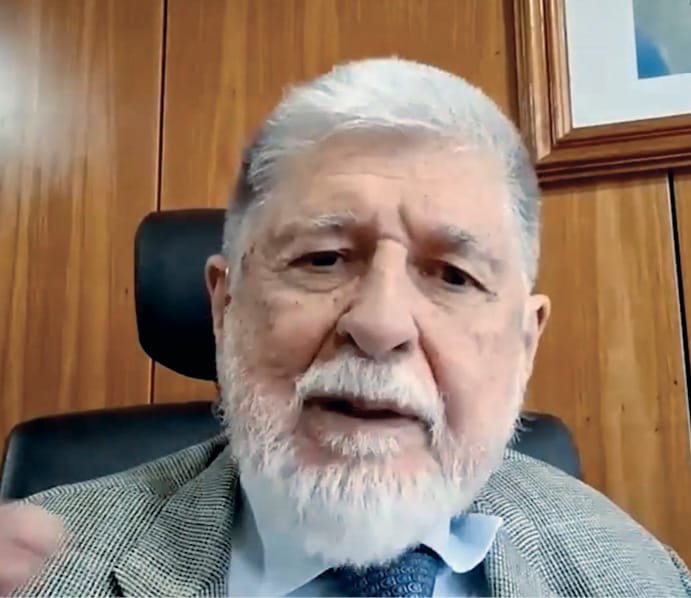
Amorim: Well, I mean, what I desire is one thing; what is possible in the short run is a different thing. But I think we should all work for that, even if it looks like a far-fetched objective. But it should be. I always say— I had a discussion once with Noam Chomsky. I had a debate with him and that was part of a film. And then someone asked me, “How do you see the future?” This was before Lula was elected for the first mandate. And I said, “You know, if you are in a room which is almost totally obscure, dark, you can’t be only focused on that. If there is a small split, or—I don’t know exactly how to say it in English; in Portuguese it would be a brecha—a small leak through which you see some light, you should concentrate on that point, and then try to enlarge it.”
It’s not simple. Maybe it’s a task for generations. But I think we have to have that task. If you don’t believe in the future—and I have read some headlines saying that the future is dead—so, if you don’t believe in the future, what’s the point of life? Our children, our grandchildren and the grandchildren of other people, have to have a good life. So, that’s what keeps us alive, I think, especially for someone of my age.
Lyndon LaRouche Pays Tribute to Pope Paul VI
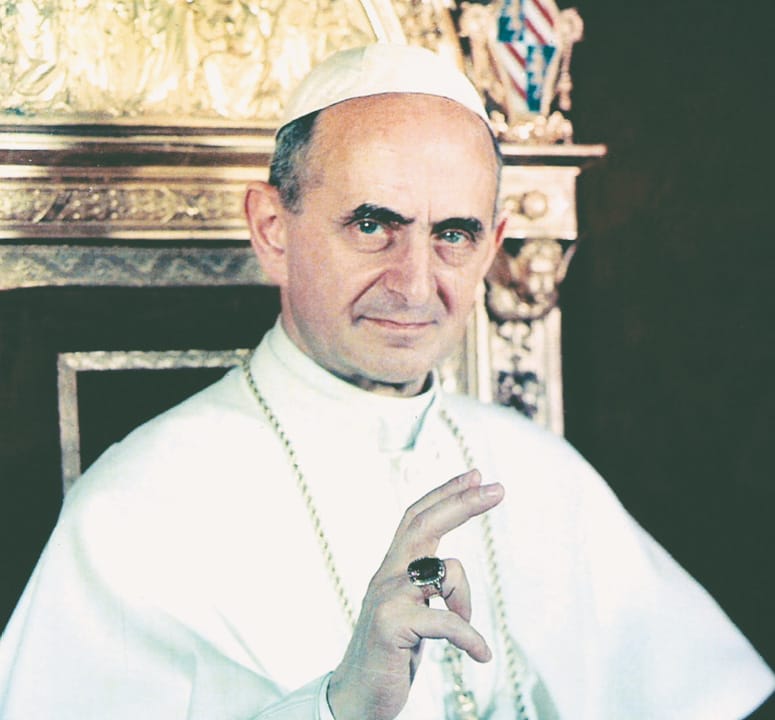
The following is a message by Lyndon LaRouche on the passing of Pope Paul VI, written on the day of his death, August 6, 1978.
During recent times I have been privileged to know of the work of a truly great person, Pope Paul VI. It must be fairly said that if humanity escapes unprecedented horrors during the period immediately before us, Pope Paul VI has provided an indispensable part of the leadership which has benefitted all humanity today and future generations. My personal feeling, in these first hours after learning of his death, is inexpressible. Later, after this awesome moment has passed, I hope to find the words to say what must be said. In the interim we must rally to fulfill the great ecumenical task with which his leadership has been associated.
Small: Well, I think that’s what all human beings are. We are able to shape our present by what we desire of the future and fight to make it happen. We’re a future-oriented species. So, I share your approach on this, and the search for the little ray of light, even if it’s little, to make it broader.
This now, I guess, is a related question. The Pope, Pope Leo XIV, will be in Peru in November. What can you say about your view, your thinking of the visit of the Pope, and the importance of this for Brazil and the entire region?
Amorim: The Pope is inspired by the Holy Spirit, so it’s not up to me to make any judgment. But I have great sympathy for everything the Pope has already said on several subjects, like artificial intelligence, and many other subjects as well. I mean, he’s always stressing the human side and the need to respect, I wouldn’t say human rights in the abstract, but the human being, the people who are really, let us say, the ones that have to conduct history.
And as for Peru—and I’m not speaking about the Pope now—as for Peru, of course, it’s a very important neighbor of Brazil. It’s natural in our work for diversification of relations, and very important also for our relations with the countries on the other side of the world, through the Pacific Ocean. But of Peru itself, we have a large border with Peru, and so I think Brazil has always—or at least we, the Lula government, but to some extent, some of the other democratic governments as well, but with Lula there’s more emphasis—have emphasized the need for South American integration.
And this is based on a simple reason. In a world in which you have powers with nuclear weapons, with other means of destruction, sometimes, we have to work in a way that has a balance. And Brazil is very important, but it’s not big enough, if you consider the European Union or China or the United States. So, you need South American integration. That’s why we signed the agreement between Mercosur and the European Union. I’m not discussing the details, but I mean, the whole idea. That’s why we look for very strong relations with China. But it would be ideal if you could have more countries in one way or another—Mercosur is one way, because it’s a customs union; very imperfect, but anyway, it is a customs union—but more broadly with other countries of South America, and Peru, of course, is very important in many aspects. But I’m mentioning one, which is the integration of South America.
And let us say we have to do in the 21st Century what was done in North America in the 19th Century, which is to have a real link, an actually usable link, between the Atlantic and the Pacific.
Small: Yes, and that was, of course, under our great President Lincoln, who had a vision of exactly that kind of development based on infrastructure development.
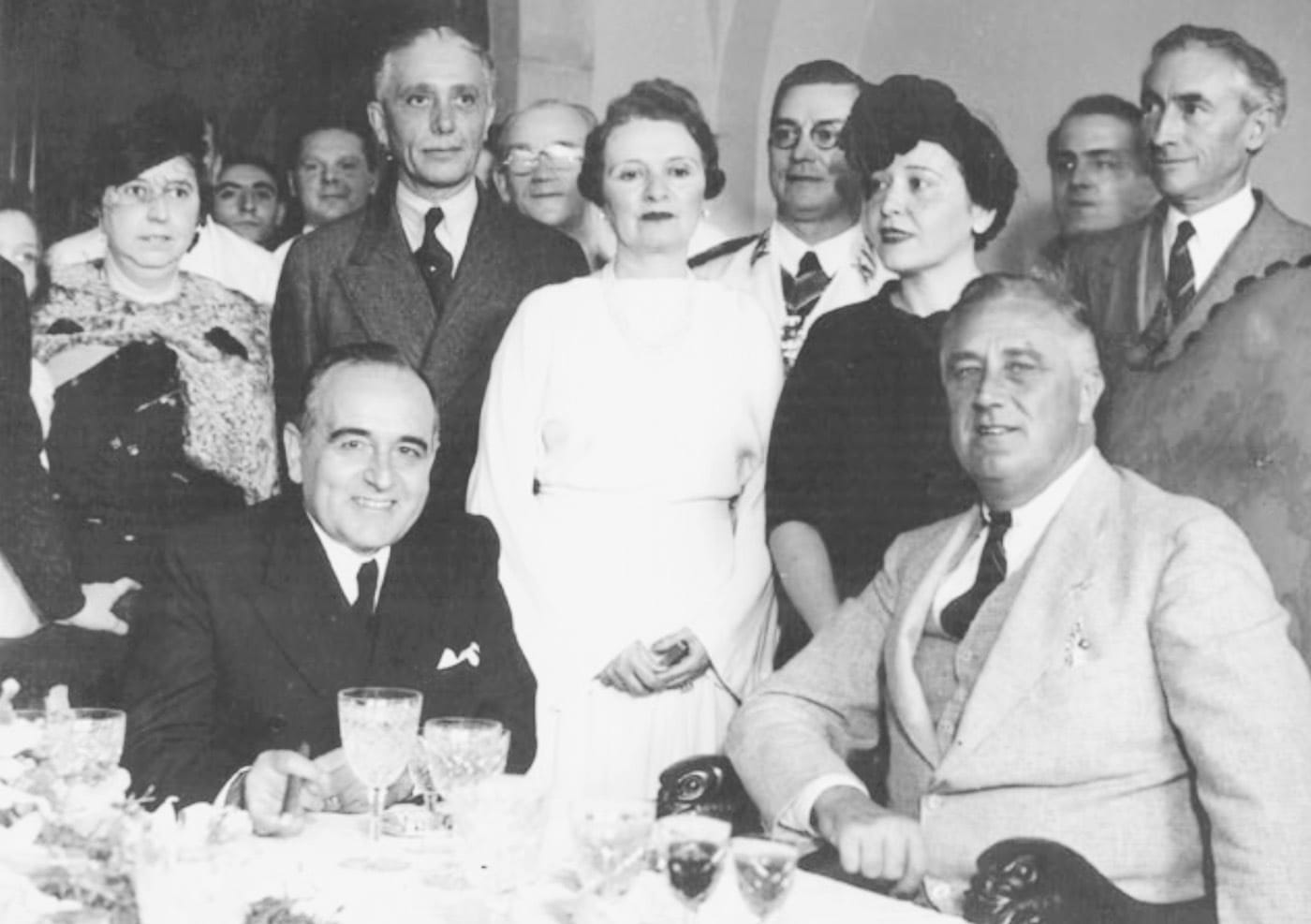
My final question to you is, I guess, related to your answer, which is: In the United States, many of us are not at all happy with the current foreign policy of the United States; and we think that we could have a much better approach to important sovereign countries like Brazil. And some of us have looked back to the period of Franklin Delano Roosevelt and his relationship with Getúlio Vargas in Brazil. What does that kind of approach mean? Is it possible? How can we help develop a return to those kinds of relationships which both respect each other’s sovereignty and help each other’s development?
The Lessons of Roosevelt and Vargas for Today
Amorim: Well, you told me that you are in the house of a good friend, Roberto Amaral, and I fear to say anything that he knows much better than I do! But anyway, I would say that there are two aspects, I think, in spite of differences, also. Vargas was for a long time not a democratic government in the full sense of the word, to say the least. Of course, even communists were persecuted. But he was very much conscious of two things: The importance of having a policy towards the working class, in general to the poor people. That’s very much true. And that’s true of Roosevelt as well. So, this is one kind of affinity that there was.
But more than that, I think they were also two pragmatic men who had ideas, but also understood the importance of working together. You know, if you speak only, let us say, from an ideological or theoretical point of view, the United States would not favor Brazilian industrialization, because it would be a competitor, especially not favor the intervention of the state in the economy, perhaps. And in spite of that, Roosevelt and Vargas were able to agree not only on the Brazilian participation in the Second World War—which, of course, was very important in terms of our own democracy—but also, Roosevelt and Vargas were able to agree to have financing from the United States for our first big steel mill, which would be state-run—Volta Redonda, as you know.
So, I think when you have this combination of pragmatism, and some affinity—which is ideal—but when you don’t have affinity, you have to have at least pragmatism. And I think—I don’t want to mention anyone—but this is what’s lacking in the present. Brazil very much favors multipolarity; but multipolarity cannot be confused with areas of influence. I think we want independence; we want relations with the United States, of course, a very old friend of Brazil, despite differences sometimes, but what you mentioned is very important. And also, we’re able to have relations with China, India, Russia, South Africa, whatever.
And then I also, in that respect, want to mention the importance of BRICS. Brazil together with Russia, China, India, and South Africa—and now it’s expanded—were able to found this, I wouldn’t call it an alliance, but this group which very much changes the way the world deals with most important things. All five of them are members also of the G20.
You didn’t ask me, but I’ll just venture another thing. I’m very much worried with this tendency to bring back [the G7]—because the G20 in a way didn’t replace, but it was, let us say, a counterweight to the G7. And now there is a tendency to bring back to the G7 the most important decisions. And in this respect, and I will finish with that, let me just, I don’t want to mention names, but you mentioned Roosevelt, and I’ll mention Bush. President [George W.] Bush was not acting out of, let us say, an ideal of multipolarity; but he was at least pragmatic. And in this respect, he understood that you could not deal with world problems, recession, and at the time, of course, as you know, the great big financial crisis [2007-2008] started in the United States, but spread all around. So, it was impossible to deal with that if you didn’t have China, Russia, Brazil, India, and others inside. Also, it’s not ideological, so South Korea and others.
So, I think when you see the G7 speak of global imbalances, really meaning the Chinese surplus in trade, we won’t be able to advance. So, I think that this backtracking towards a world government, although with some appearances—we invited Brazil, we invited India, we invited some other developing countries—but without China (Russia also, but Russia might even to some extent understand, although they don’t agree), but China? How can you deal with important problems like climate, or trade, if you don’t have the country that has all the characteristics that we know about China?
You know, the Chinese are very important. They perceive very clearly, in a way, because I think this is, in a way, like a backfire for the developed countries of the so-called Western world. So, the Chinese have perceived that.
And if you think about it, one of the most important events that took place recently was the conference on artificial intelligence that took place in Shanghai. And the speech of President Xi Jinping, but also the conclusion of the conference, point to a more cooperative world in that respect. And very importantly, Xi Jinping mentions very often in that respect—in his speech, he speaks a lot about the Global South. And this is not just an abstraction, because it’s very much, as I understand it, based on the idea of open-source artificial intelligence, which is the contrary to what is done in the United States. So, let’s see how this goes. We don’t know.
So, peace and development go together, whether it’s one way or the other.
Small: Well, if open-source were not only applied to AI, but to the whole idea of technological and scientific thinking and cultural classical advances, I think the One Humanity would be in much better shape. I won’t ask you if there’s anything I forgot to ask; this discussion could clearly have gone on for hours. But is there any final word that you would like to say, especially given that many of the viewers of our publications are located in the United States and in Western Europe? Any final thoughts?
Amorim: Well, there are several battles in the world today that are taking place, battles in a more general sense. And one of the battles, is the battle for democracy. I think Brazil is living in a crucial moment. And I very much hope, of course, and I expect, that we’ll consolidate democracy in the next election.
Small: Thank you very, very much, Ambassador Celso Amorim. He is Special Advisor to the President of Brazil, Luiz Inácio Lula da Silva. Thanks again for taking time out of your very busy schedule to have this conversation with us. Até logo.
Amorim: Thank you.