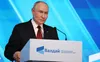
The following speech was delivered by video at the July 5, 2026 U.S. presidential campaign event held by independent LaRouche candidate Diane Sare near Philadelphia, titled “America 250—A Rededication.” Subheads have been added.
Hello. I full-heartedly greet all of you, and I congratulate you as true Americans, as the true representatives of the Republic of America, which has its 250th birthday today. And I want to thank in particular you, Diane, for running as an independent presidential candidate representing the vision and the program of my late husband, Lyndon LaRouche, and for having organized this event, which, without any exaggeration, is for sure one of the handful of outstanding celebrations upholding the true principles of the American Revolution, and that in an ocean of travesties and banalizations of that historic watershed. To set the record straight of what this American Revolution was and what happened to its tradition and memory, in order to revive its principles not only for the United States but for the entire world, we are conducting this event today.
The year 2026 marks the 250th anniversary of the Declaration of Independence by what would soon become the United States of America. That instrumental document laid down the principles of an anti-oligarchic republican form of government, and would go on to be the inspiration for countless other peoples around the world, forever changing the shape of history. Today, this history is either misunderstood or intentionally misconstrued, and the U.S. has nearly abandoned the outlook of its Founding Fathers. Over the course of this year, EIR will be publishing key articles on the true anti-oligarchic history of the United States in the hopes of contributing to the widest possible discussion of these principles, the rediscovery of which has enormous implications for whether the world can get out of its current state of turmoil today.
And indeed, the revival of the principles of the American Revolution, or the effort to try to do so, comes not one moment too early, because the world is truly on the edge of the abyss. The danger of a global nuclear war has never been so close—much more dangerous than the Cuban Missile Crisis—with two regional theaters of war in danger of spinning out of control. The world as it was created in large part also by the United States in the post-war period, the period of the Cold War, when there were two blocs, and the post–Cold War order—all of this has disintegrated. The attempt to create a unipolar world order, the illusion that the United States could forever be the world hegemon, which in reality was from the beginning based on the Anglo-American special relationship, suffered a gigantic blowback. As a result, the world is now in complete disarray and chaos. The famous quote by President Donald Trump that international law is not needed, has indeed helped to shatter the entire order.
Now, the problem is that when the Soviet Union disintegrated in 1991, it did so amazingly peacefully—no tanks, no shooting, just a transformation with little incidents, but essentially peaceful, including the German reunification. I don’t think anybody believes that if the United States would disintegrate—which it is very close to indeed, in terms of the financial bubble blowing out—I do not think that the United States would dissolve equally peacefully as the Soviet Union did. So therefore, the candidacy of you, Diane, is of the utmost strategic importance.
Now, the big question many, many people are asking themselves, in part desperately around the world is, where is there a way out? Because the role and the future of the United States is the most important, maybe the only important factor, maybe one of the most important factors, to decide this question. Now, on the 14th of April of this year, an open letter was published in response to the renewed, unprovoked war of aggression against Iran by the U.S. and Israel, which was signed by many excellent people—many of them have been working with us in the IPC [International Peace Coalition]—whose moral and intellectual integrity is without any doubt. The text goes in part:
To the peoples of the world, to thinkers, to scholars, and to those who believe in justice. For 249 years, spanning the entirety of its existence since 1776, the United States built a record of atrocity that belonged to a darker, pre-civilized age. The predatory empire erected on the corpses of nations from the genocide of nearly five million indigenous people, to the brutal enslavement of four million Africans, to the lynching of more than four thousand black citizens under Jim Crow.
Well, if that orientation, calling it the entirety of its [the United States of America’s] existence, were accurate, then there would be very little hope for the planet, if any at all.
A Mysterious July 4th
The problem is that the real history of America is not known. There was a recent poll of Americans by the Cato Institute, which admittedly is not exactly a humanist institution, but nevertheless, they found in this poll that only 39% of Generation Z linked the celebration to the Declaration of Independence. Nearly half—46% of the entire population—did not know what the 250th birthday is actually celebrating; 53% linked it to the Declaration of Independence, however. Seventy-seven percent knew that George Washington was the first President, but 58% said that they do not know what the main purpose of the U.S. Constitution is all about.
Now, these figures are probably worse for the two houses of the U.S. Congress, because otherwise it would not have been possible that they gave 12 standing ovations to the UK’s King Charles III when he recently addressed the two houses of the Congress. He claimed that American constitutionalism grew out of an older Anglo-British constitutional tradition; and even if he did not mention the philosophers, it was clear who were behind the argument—John Locke, Thomas Hobbes, [Bernard] Mandeville, and others. Though King Charles just stole the entire American history, he ironed out the American Revolution altogether, and these Congressmen and Senators did not even realize it.
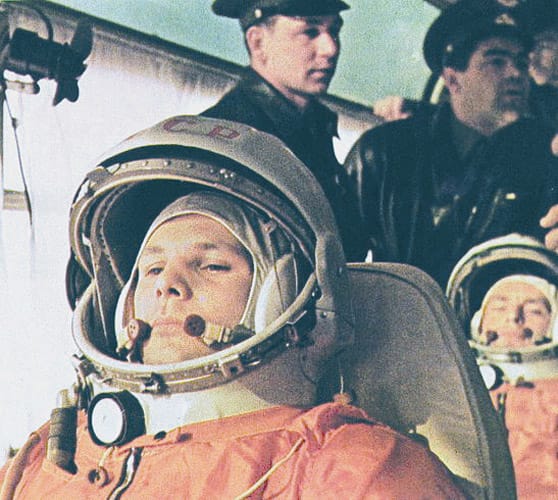
Now, I want to state here in all clarity—because this is not a self-evident truth, unfortunately—that the American Revolution was an absolute break with the oligarchic system of Europe at the time, with the monarchies, with feudalism. And if you look at the long arc of human history, I would compare it not with the first landing on the moon by the Apollo mission in 1969, but an event a little bit earlier, the ascent of Yuri Gagarin, when on the 12th of April, 1961, he left Earth for the first time for 108 minutes. It was the first step of mankind into space. And this was a total revolution, because it was not clear before if the human body could cope with weightlessness, and if the technology to lift man into space would actually function.
Now, the Declaration of Independence is in that sense a revolutionary non-linear phase shift. And even if it was mentioned already, let me repeat again: In the Declaration of Independence it says:
We hold these truths to be self-evident, that all men are created equal, that they are endowed by their Creator with certain unalienable Rights, that among these are Life, Liberty and the pursuit of Happiness.—That to secure these rights, Governments are instituted among Men, deriving their just powers from the consent of the governed, —That whenever any Form of Government becomes destructive of these ends, it is the Right of the People to alter or to abolish it, and to institute new Government, laying its foundation on such principles and organizing its powers in such form, as to them shall seem most likely to effect their Safety and Happiness.
This was an absolute watershed. The idea that all men are created equal, that they have God-given unalienable rights, that government is legitimate only with the consent of the governed, was regarded as a complete outrage. Most accounts of the American Revolution only mention that it was somehow about tea and taxes and that the Americans wanted to take the rightful income away from the British. No, it was the first time that the sovereign was we, the people. For the British colonial powers, this was an absurd idea.
Tony Chaitkin, whom we will hear from in a little while, quotes in his book Who We Are, the British response, which was an answer to the Declaration of the American Congress, namely a four-page essay written by Jeremy Bentham, who became in the following years the most important intelligence operative for Lord Shelburne, who was later the British Prime Minister from 1782 to 1783. Bentham called their theory of government absurd and visionary. He wrote, “What they call self-evident truth, all men, they tell us, are created equal. This rarity is a new discovery. Now for the first time we learn that a child at the moment of its birth has the same quantity of natural power as the parent, the same quantity of political power as the magistrate.”
Now the reason for this hysterical reaction was that the Declaration of Independence went at the core of the oligarchical imperial and colonial system. When all men are created equal, then there is nobody who is a king or a princess or a lord or an earl or any other of these superfluous positions. The whole idea of nobility is not just a matter of opinion. The idea was that most people are slaves, underlings, subjects, and that only the nobility has privileges, that the whole society is organized in such a way as to serve the privileges of a few. Now, Joseph de Maistre, who was a writer for the oligarchy in the 19th Century, basically had the most outrageous description, in his letter to a Russian prince. He wrote that nobility are the only ones who are good by nature; they have God-given rights, while the masses are evil. They tend to commit crimes and therefore must be controlled and suppressed by a strong state run by the monarchy. He famously said that the executioner is the actual fundament of the order of society.
The Destruction of Education
Now, the problem is, people do not appreciate what a watershed the American Revolution really was, because they are not educated in history. And that they are not educated is intentional, because if people don’t know history, they can’t judge the present. Until the 15th Century, maybe all over the world but for sure in Europe, all forms of government were oligarchical; that is, that only a small elite had their privileges, and they kept the masses of people deliberately backward, because the more stupid people were, the easier it would be to run the government. It was actually an enormous and long and difficult process of shedding that system of oligarchy and arriving at the nation-state, establishing sovereignty. It actually took centuries before, out of these supranational structures of empire such as the Roman Empire and the papacy, came a long and very tedious evolution then to the notion of the sovereign state.
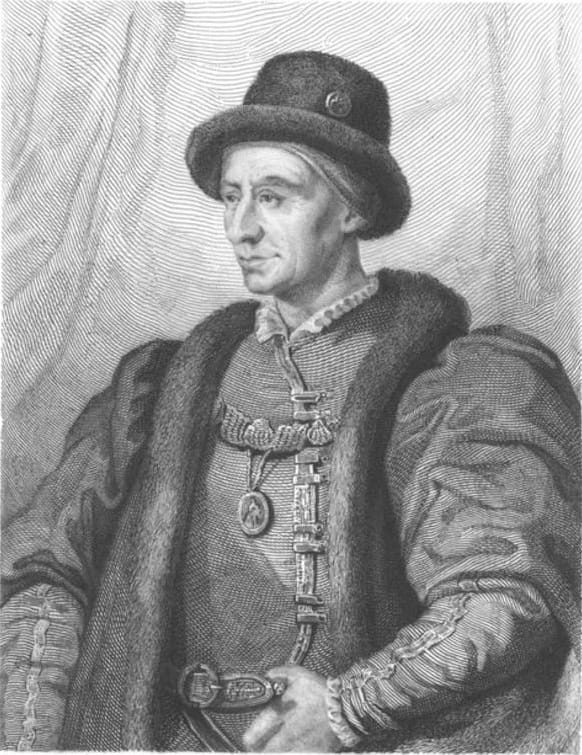
This happened politically for the first time in France with the government of Louis XI from 1461 to 1483, and in that reign of Louis XI, the income of the population in 20 years actually doubled. Now, at the same time, there was Nicholas of Cusa, who is without any question the greatest thinker of the 15th Century. His revolutionary writings in many fields—in natural science, in law, in philosophy—actually mark the beginning of modern times. And his first major work was the Concordantia Catholica. Now, in Book 2, Chapter 14, he wrote—and the headline of that chapter is, “The Basic Ideas,” which contain the basic ideas which later come out in the Declaration of Independence. [Cusa writes]:
All legislation is based on natural law. Since by nature we are all equally free, all coercive power is derived from the election and consent of the subjects. The jurisdiction so created is not valid in itself unless it is in accordance with the law and the canon. For since we are all by nature free, every governance, whether it consists in a written law or is a living law in the person of a prince, by which subjects are compelled to abstain from evil deeds and their freedom directed towards the good through fear of punishment, can only come from the agreement and consent of the subjects. For if by nature men are created equal in power and are equally free, the true properly ordered authority of one common ruler who is their equal in power cannot be naturally established except by the election and consent of the others, and law is established by consent.
Now, this was an absolute revolution. This was the first time this was written in such clarity, and it is one of these watersheds. Because without Nicholas having said these things and written them down, the long road to the American Declaration of Independence would have been impossible. He continues that idea in Book 3 of the Concordantia, and in Chapter 4, where the idea of the representative system of government appears for the first time:
Summarizing what has been said above, all legitimate authority arises from the elective concordance and free submission. There is in the people a divine seat by virtue of their common equal birth and the equal natural rights of all men, so that all authority which comes from God as does man himself, is recognized as divine when it arises from the common consent of the subjects. One who is established in authority as representative of the will of all may be called a public or common person, the father of all, ruling without haughtiness or pride in a lawful and legitimate established government. While recognizing himself as the creature, as it were, of all his subjects as a collectivity, let him act as their father, as individuals. This is the divinely ordained marital state of spiritual union based on a lasting harmony by which a commonwealth is best guided in the fullness of peace towards the goal of eternal bliss.
Now, this idea of representative government is a key characteristic of the republic. Then, in Book 3, Chapter 12, he actually describes for the first time a system based on meritocracy. That’s extremely interesting, because one can think, where in the world today are actually governments based on meritocracy? He writes:
For the king ought to preside over a council in which matters pertaining to the government of the commonwealths are discussed, and he ought to decide each matter by consent with the council of the nobles and bishops subject to him. For this purpose, the ruler should have the best qualified of all the subjects chosen from all parts of the realm to participate in a daily council with him. These councilors ought to represent all the inhabitants of the realm in the same way as it was described above concerning the cardinals who assist the Roman pontiff. These councilors ought to constantly defend the good of the public which they represent, giving advice and serving as the appropriate means through which the king can govern and influence his subjects, and the subjects on proper occasions can influence him in return. The great strength of the kingdom comes from this daily council. The councilors should be appointed to the tasks by agreement in a general meeting of the kingdom, and they should be publicly bound legally by oath to speak openly for the public good.
Now, that is really a watershed and it is not generally known. I mean, it is attributed that Nicholas of Cusa was generally described as far ahead of his time by developing ideas which later became known; but the true significance of what he developed in terms of the development of a true republic must be emphasized much, much, much more. Because these ideas of natural freedom, consent of the governed, representation through election and meritocracy, took actually 343 years and travelled through many thinkers, scholars, and writings to become politically effective in the Declaration of Independence. Together with the idea of the peaceful coexistence of religions, which he develops in this beautiful Socratic dialogue De Pace Fidei, about peace in religion, and the absolutely breathtaking revolutionary concept of the Coincidentia Oppositorum, the Coincidence of Opposites; namely that the One is of a higher magnitude than the Many, as a method of thinking and conflict resolution, represents the watershed to modernity.
It is actually a beautiful historic coincidence that, with Pope Leo XIV, the first American Pope in history, these ideas have been powerfully highlighted when the Pope received the 38th Medal of Liberty two days ago in Philadelphia, where he actually quoted the Declaration of Independence and told people that they absolutely have to make a commitment to uphold these ideas again.
The Columbus Connection
So, that is the idea content by Nicholas influencing the Declaration of Independence and de facto the Constitution. But Cusanus was also indirectly involved in another way related to the American Revolution. He had a lifelong friendship of over 40 years with Paolo Dal Pozzo Toscanelli, who was a very famous doctor in medicine, astronomer, mathematician, and cartographer. They basically studied together, overlapping four years, from 1417 to 1423, in the great university town of Padua, which was both the center of the network of scientists and philosophers who had a great influence and created an incredibly creative climate around the Italian Renaissance and the Council of Florence. Toscanelli significantly influenced the mathematical ideas of Cusanus and, vice versa, Nicholas totally influenced Toscanelli’s overall method of thinking. Out of that came the idea which was discussed by all educated Europeans in the 15th Century, to possibly reach Asia, the land of spices and many other goods, by ship sailing westward. There were many famous maps by, especially, Toscanelli, who reflected Nicholas’s method of thinking of the infinity and the coincidence of opposites as the crucial context to develop such new ideas of the world order.
Toscanelli wrote to Fernando Martinez, who was the canon of law in Lisbon, in 1474, 10 years after Cusa had died. Toscanelli actually was at the deathbed of Nicholas and had a big influence in his testament. So, 10 years later, in 1474, Toscanelli wrote to Fernando Martinez who was a close ally and collaborator of the Portuguese king, Alfonso V, and he also wrote to [Christopher] Columbus in 1480, urging them to realize this project by financing sailing to the west to reach the east, with the idea that this would be a much faster route. Here you can see the different maps of Toscanelli.
Now, one difficulty when you are researching this, is that many of the records have disappeared, especially almost all of Toscanelli’s life’s work. But Nicholas definitely mentioned Toscanelli in his dialogue on the quadrature of the circle, and he referred to Fernando Martinez at least as a background figure in the dialogue De Li Non Aliud (On the Not-Other).
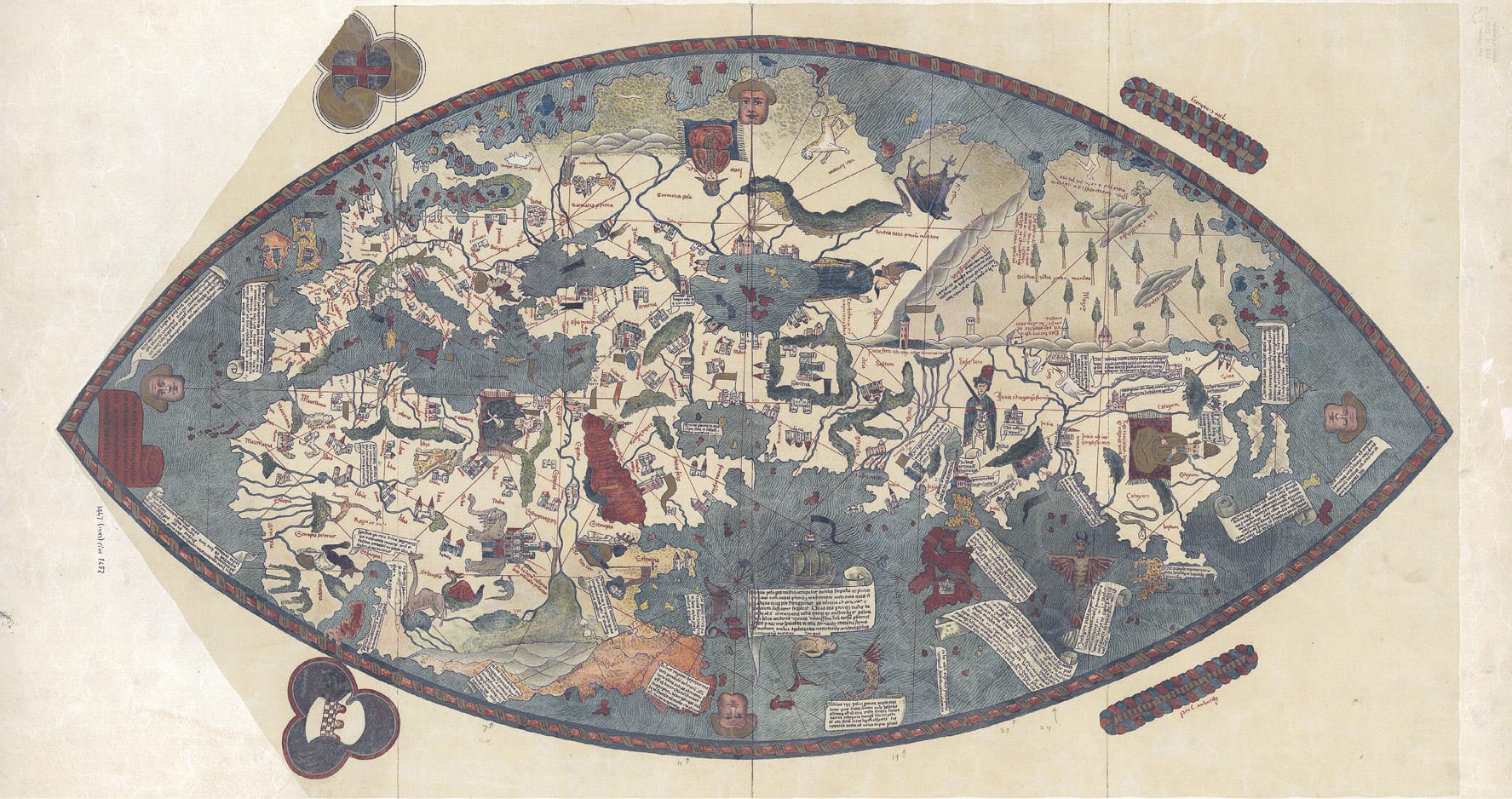
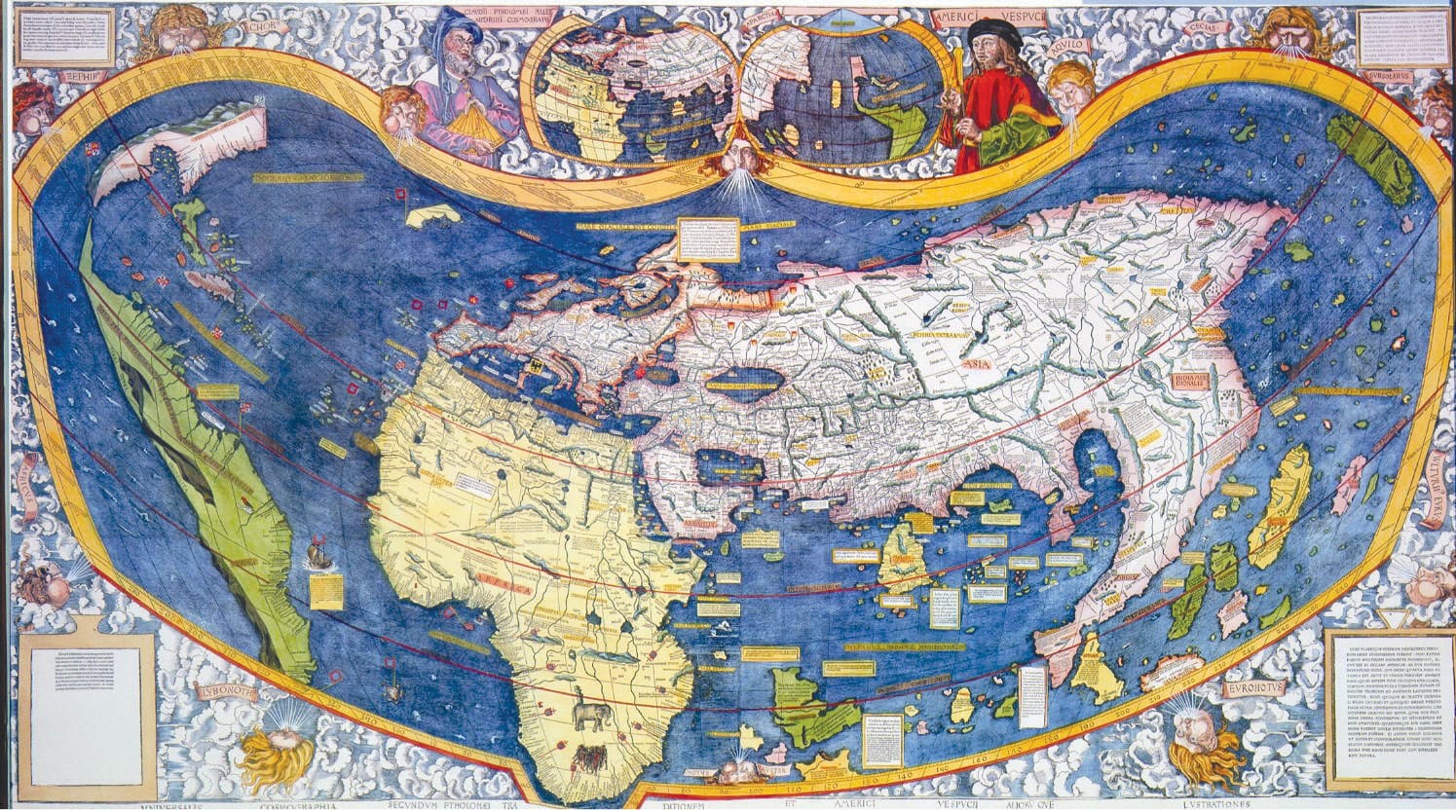
When Columbus arrived in the Americas, actually on an island in the Bahamas, on the 12th October of 1492, he believed that he had reached islands near the Indies. Now, the early Spanish and Portuguese reports are the same; they all report that these were islands close to India. And only with Amerigo Vespucci [voyages 1499-1502] there came the doubt—because Vespucci realized that the coastline of what was found was actually much too large for it to be Asia, so in his letters he called it Mundus Novus, the New World. And you all have a memory of the beautiful Symphony from the New World by Antonín Dvořák. And you remember the incredibly beautiful poem by Friedrich Schiller, “Columbus,” which has the idea that it is the intuitive idea, sort of prescience, which led Columbus to discover America. It was only in 1507 that the German cartographer Martin Waldseemüller published a world map which he labeled for the first time the new continent America, after Amerigo Vespucci.
We will hear from other speakers what other ideas and fights shaped the history of this America. For example, if King George III went crazy over the loss of the American colonies, or if he had only “recurring episodes,” remains to be researched more fully. In any case, the British never gave up the idea of undoing the American Revolution. They did that first militarily, with the War of 1812. They supported the Confederacy in the Civil War against the Union. And then, when they realized that the American colony could not be reconquered militarily, they decided to try to do that through subversion, by convincing the American establishment to adopt the model of the British Empire as the basis of their common rule of the world—the “special relationship.” H.G. Wells, in his Open Conspiracy, describes that very clearly. And unfortunately, one has to say this conspiracy has been pretty successful.
Today, the collective West is run by a financial oligarchy which is modeled on the British Empire, and it tramples on the principles of the Declaration of Independence. Therefore, Diane Sare’s presidential campaign will—must succeed to restore the core ideas of the Declaration of Independence, the American System of the economy of Alexander Hamilton, the foreign policy of John Quincy Adams, and above all, the vision of Lyndon LaRouche of a just new world economic order, of cooperation with the Global South as equal partners, echoing the policies of Presidents Franklin D. Roosevelt and John F. Kennedy.
Therefore, the dialogue of the best contributions of all great cultures and civilization is an integral part of Diane’s campaign. Therefore, we have to work with Diane internationally to correct the mistaken characterization of America as 250 years of an unbroken chain of atrocities, by bringing the United States back to the high ideals which were declared among other things in the First War of Independence, the first anti-colonial war in history.
Now, the Declaration of Independence declares the rights of all people in the world. When I created the Schiller Institute, I deliberately chose the text of the Declaration of Independence by only changing five or six words to make it applicable to the whole world. And in that sense, it becomes the constitution and the platform for the entire new order we are creating.
So I, as a world citizen and patriot, but first world citizen, full-heartedly endorse Diane for President. And I call on all people of goodwill from all over the world to do likewise. Thank you.