
An earlier version of this article was originally published in Leonore, the cultural magazine of the Schiller Institute, Vol. 2, No. 1, 2022, pp. 28-44.
Introduction
There is an arrow to time—but there is more than one, and they do not all point the same way. The arrow the physicist draws, the one defined by the second law of thermodynamics, runs from order toward dissipation, from energy that is available toward energy that is used up. The history of life and of human thought traces the opposite course: from the simple toward the complex, from what now is toward what had been impossible, from a world merely inhabited toward a world reshaped. This essay asks why the thermodynamic arrow cannot be laid over the living and the human world, and what kind of time governs there in its place.
Humanity is unique among known physical and living processes: it has characteristics that differentiate it absolutely from lower domains, including an absolutely unique quality of time. Singular expressions of human time are brought into sharper relief by examining specific inabilities of lower forms of time to comprehend human activity. One example is the concept of time embodied in the laws of thermodynamics, whose misapplication to domains outside their legitimate scope have resulted in such extrapolations as the “heat death of the universe” and a supposed tendency of the entire universe towards “disorder.”
Problems arise when a term or concept developed in one context is applied in other contexts without sufficiently reconsidering the term’s suitability, or its meaning. While this is particularly common when the terms have everyday meanings in addition to scientific ones (such as “action”), the laws of thermodynamics, particularly the second one, are inappropriately applied in fields in which their application is in doubt until they were developed anew as required principles in that field. A frequent error is in the explanation of the second law of thermodynamics as mandating a universal increase in “disorder” and then committing the error of illustrating this for students through discussions of chaotic dorm rooms and messy desks. While “disorder” is a poor word to use even when discussing the physical concept of entropy in abiotic micro-contexts, it has absolutely no meaning when applied to macro-scale objects.[1]
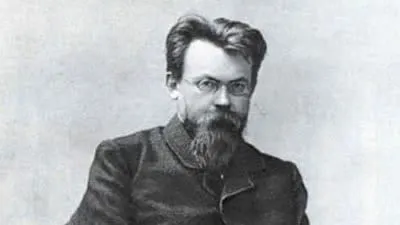
Clear examples of concepts whose meanings change with the development of later insights are given by the Ukrainian-Russian biogeochemist Vladimir I. Vernadsky in his 1930 “The Study of Life and the New Physics,” in which he directs particular attention to the errors of the Newtonian conception of the Cosmos—in which the investigating mind is separated from the investigated world—and to the changing meanings of space, time, energy, and matter, four concepts which he points out have a different meaning to the scientist of 1929 than they had in 1900.
The development of new concepts, inexpressible in terms of the former language, is the most powerful expression of human creativity: an action which cannot be performed by logic or by any form of artificial intelligence. This uniquely human ability to create metaphors (concepts which can be conveyed only through specific inabilities to express them in the previous language) is the basis of modern science, and is an increasingly powerful, and ultimately the most powerful, force of nature.
In this article, several failures of mis-applying concepts in inappropriate contexts (the laws of thermodynamics, and the arrow of time) are addressed in light of Vernadsky’s calls for biology and cognition to serve as bases for new developments in physics. This article pursues three lines of inquiry. It shows that space, time, energy, and matter do not carry the same meaning in the abiotic, biological, and cognitive domains, and do not have the same meanings they held in 1900; it examines what goes wrong when the laws of thermodynamics are projected onto living and human systems, or onto the universe as a whole; and it applies Vernadsky’s outlook to novel kinds of time, and above all to the uniquely human, in order to ask what a principle must satisfy to be called “universal” at all.
Vernadsky’s Context
In his 1930 essay “The Study of Life and the New Physics,” Vladimir Vernadsky wrote: “Space, time, matter and energy are clearly distinguished for the naturalist of the year 1929, from the space, time, matter and energy of the naturalist of 1900.” The work of Max Planck and Albert Einstein on the quantum world and relativity dramatically changed the meanings of these four terms. Although the same words were used, the concepts behind them were incompatible with those laid down by Newton, who wrote that “absolute space, in its own nature, without regard to anything external, remains always similar and immovable,” and that “absolute, true and mathematical time, of itself, and from its own nature flows equably without regard to anything external.”
Under Einstein’s theory of relativity, space itself was no longer indifferent to objects in space, and no longer always similar to itself: instead, it scaled along directions of motion, and it curved gravitationally. Although the concept of location had not disappeared, changes arose in the distances between locations, and space now had a measure of curvature, rather than being flat.[2]
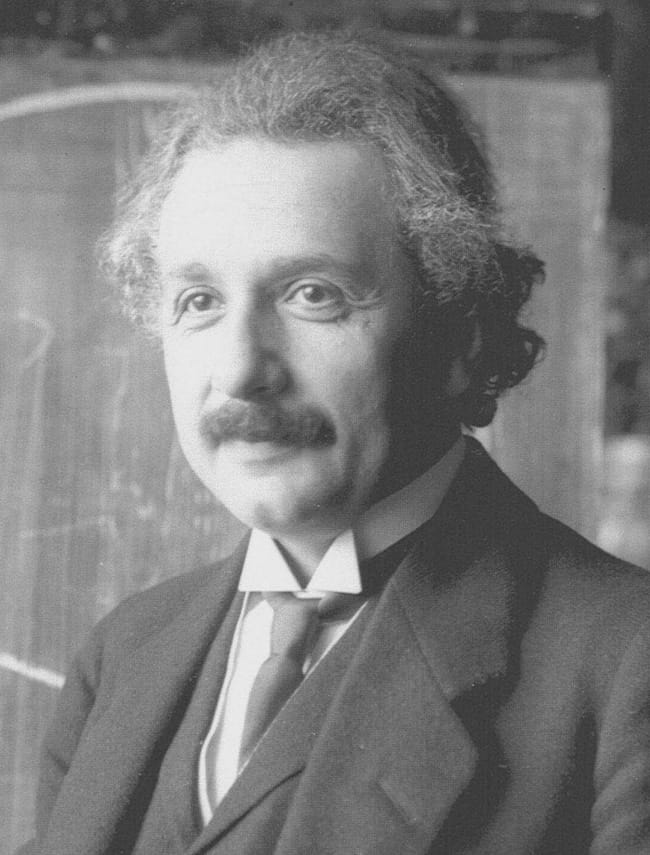
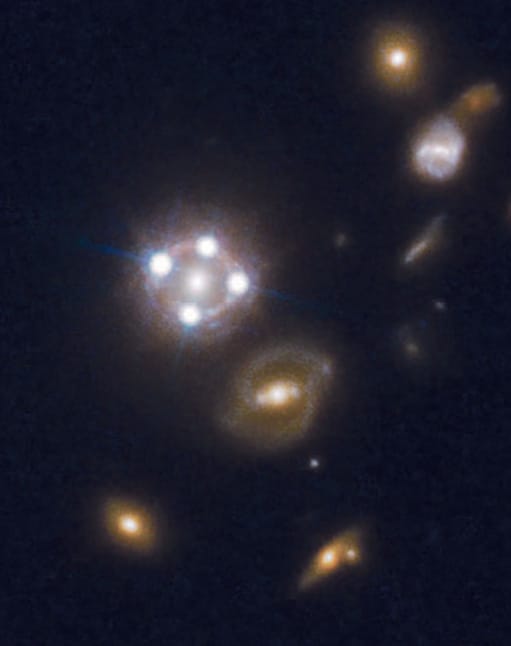
According to Einstein’s general theory of relativity, the gravity-induced curvature of space-time affects the propagation of light. Here, the Hubble Space Telescope photographed an “Einstein cross” in the direction of the Pegasus constellation, which is a bright quasar that has a galaxy in between it and our galaxy, causing the light from the quasar to “bend” around it, making it appear as though there are four objects in addition to the one in the center.
Similarly, Einsteinian time is considerably at odds with Newtonian time. Rates of flow of time now varied with relative motions and with gravitational fields. The very notion of “moment” was shown to be different for different observers: to one observer two events might appear simultaneous, which, however, would not appear to be simultaneous to another observer. The very notion of a particular “moment” in time now only had meaning with respect to a particular observer in space (and motion). Space and time were no longer separable, or devoid of local characteristics.
Matter and energy were considered distinct in 1900; separate conservation laws of matter and energy held that all physical changes maintained the same amount of matter and the same quantity of energy, before and after the change. Yet, according to Einstein, these two concepts did not refer to wholly separate domains, but rather were related through the equation E=mc², which relates energy (E) to mass (m) times the speed of light (c), squared. This implies the possibility of mass vanishing, and becoming energy, or energy turning into matter. Work in the nuclear field confirmed that an astonishing amount of energy—in the form of radiation and fast-moving particles—was released from radioactive materials, along with a slight decrease in their mass, in accord with E=mc².
Another concept that saw a total transformation in the early years of the 20th Century was the conflict between continuity and discreteness in physics. A magnitude is continuous if between any two values there can always be more; a discrete concept has a smallest possible change. For example, a violin can change pitches continuously by moving a finger along the neck, whereas the notes on a piano are discrete—there is no key between B and C. There is no smallest possible change in pitch on a violin, whereas the musical half-step is the smallest change in pitch on a piano. (A pianist can play wrong notes, but they’re still identifiable notes. A violinist can emit pitches that aren’t specific notes of the scale at all.)
This distinction was famously seen in physics in two areas: that of matter and of light.
The concept of the atom, that there is a smallest component of matter that cannot be further divided while maintaining its character, goes back to Democritus, nearly 2,500 years ago. But without actually seeing or being able to measure individual atoms, it was not a hypothesis that could be demonstrated. In the latter decades of the 1800s, there still remained physicists who denied the existence of atoms, believing that carbon (for example) was a simple substance that could be divided into smaller and smaller pieces without limit. But a few decades later, essentially no one doubted the existence of atoms. The ability to measure specific numbers of atoms, and the advent of nuclear science, had transformed the parameters of the continuous-vs-discrete debate.
Although Isaac Newton insisted that light was composed of particles (and gave a famously absurd explanation of such phenomena as refraction), the work of Christiaan Huygens and, later, Augustin-Jean Fresnel, gave conclusive support to understanding light as a wave, based on their explanations of interference, diffraction, and polarization. The corpuscular (particle-based) theory of light was abandoned.[3]
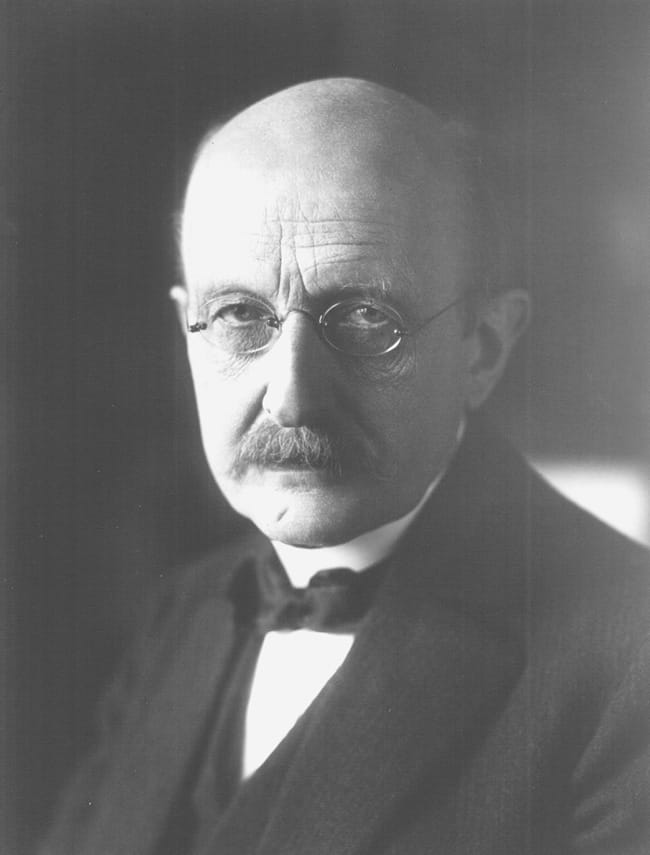
In 1900, Max Planck developed a new hypothesis to explain the spectrum of light emitted by hot bodies (such as light bulb filaments). The new hypothesis—which astonished Planck himself—required that light be emitted and absorbed by bodies in discrete amounts. Light of a given wavelength (color) comes in minimum units, now called photons.[4]
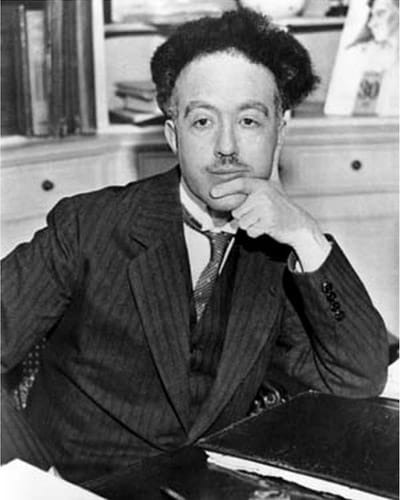
Thus continuity became a paradox for light. Its wave nature explained interference, diffraction, and polarization; but the black body radiation studied by Planck, and, later, the photoelectric effect studied by Einstein in 1905, required that light exist in discrete particles. In 1924, Louis de Broglie hypothesized that matter itself had wave characteristics, a hypothesis demonstrated experimentally in 1927.[5]
Over the course of only three decades, these four basic concepts of physical science—space, time, energy, and matter—were radically transformed, by work on the domains of the very small (Planck) and the very large (Einstein). How might work on the domain of life further transform these basic concepts? Vernadsky poses the question:
“Cannot the life sciences effectively change the fundamental representations of the scientific universe—the representations of space, time, energy, matter—in a radical way? And is this list of fundamental elements of our scientific thought complete?”[6]
A Brief History of Thermodynamics
Up to the First Law
Before the 1800s development of thermodynamics, heat, matter, and mechanical energy were considered quite differently. In the 1700s, heat was related to a substance known as phlogiston. But the great chemist Antoine Lavoisier (1743-1794) demonstrated, by careful measurement, that when metals were burned (or rusted), their mass increased, thus contradicting and invalidating the previous theory, which held that the phlogiston was liberated in these cases. Lavoisier introduced the concept of caloric, a “fluid” of heat, which flowed into bodies being heated.[7] By this theory, caloric was a substance, and its total quantity was conserved as it flowed from hot bodies to cold ones, or was released from them chemically. As the economic potential of heat-powered engines became apparent in the early 1800s, Sadi Carnot sought to understand the potential power output of such machines. He derived the first relationships between heat flow and the work a machine could extract, including an engine’s maximum theoretical efficiency.
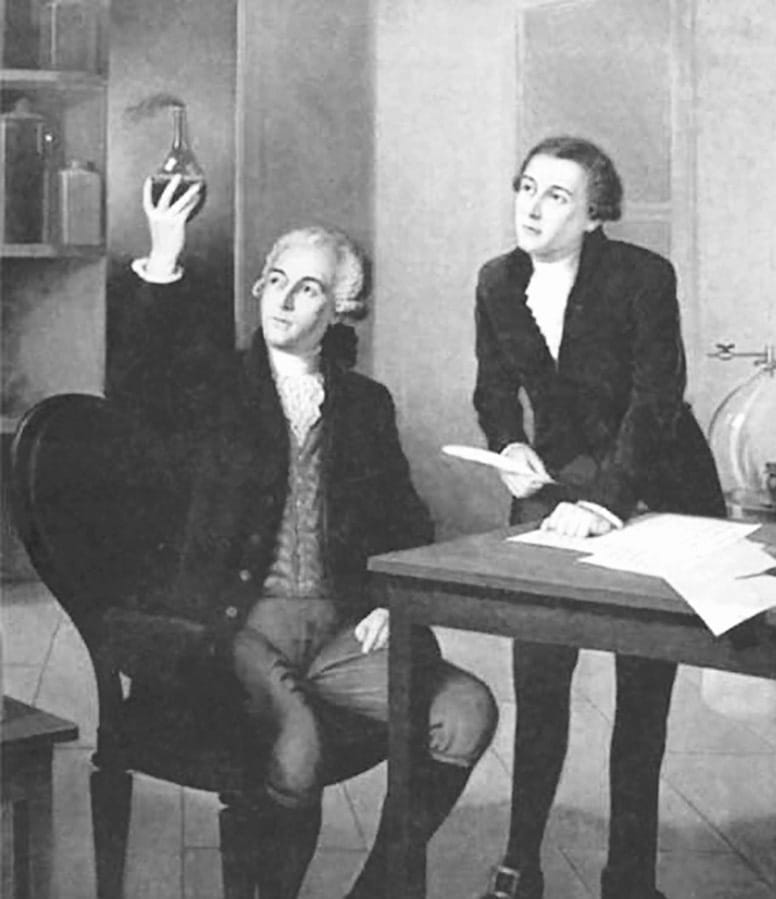
Heat and mechanical work came to be unified under a common understanding called thermodynamics. In the 1840s, James Prescott Joule performed experiments in which a falling weight caused paddles to agitate and heat a reservoir of water; mechanical work was transformed into heat, meaning that caloric (if it were a real substance) was being created, and mechanical energy was disappearing. Joule unified heat and mechanical energy, by determining a mechanical equivalent of heat, relating the calorie (a measure of heat) to mechanical energy (measured today in joules).[8] The principle of the conservation of energy could now be expanded, in a rigorous way, from the domain of mechanical dynamics to the field of thermodynamics. Processes could involve a transformation between (mechanical) energy and heat flow, but never the creation or destruction of total thermodynamic energy, a concept embracing both domains.
Further research on the relationships between heat and mechanical work revealed that heat did not exist as a substance. Although a gas under certain conditions and at a certain temperature could be said to contain a certain quantity of energy, it could not be said to contain a definite quantity of heat, of caloric. The reason is that the amount of heat exchanged in passing from one state to another depends on the path taken between them, not on the two states alone—so, unlike energy, “heat content” is not a property that a given state can be said to possess. The caloric theory of heat faded, and heat was considered not as a substance which would flow between bodies, but only as a measure of flow itself. That is, heat flow could be measured, but heat content no longer existed as a scientific concept.
The results of this research were expressed in what are known as the laws of thermodynamics, which encompass both heat and mechanics (hence the name).
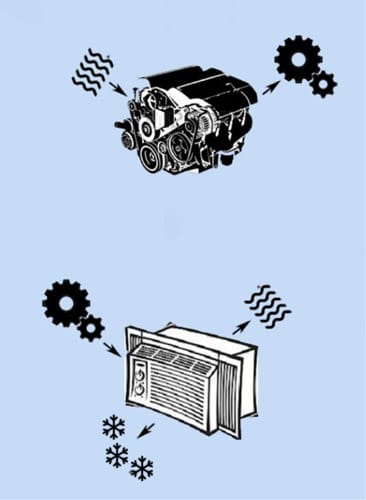
The first law of thermodynamics states that the total quantity of energy in a closed system is conserved. The energy may exist, and be transformed, into various forms, such as mechanical work performed, mechanical and gravitational potential, chemical potential (the ability of a fuel to give off heat when burned), heat flow, and the state-energy of a gas under different volume, pressure, and temperature conditions. Among all such forms of energy, transitions could be made, but no process would result in energy being created or lost.[9] For example, a truck’s engine transforms the chemical energy of its fuel into heat and mechanical energy of its motion, applied then to the wheels. In none of these transformations is the total quantity of energy changed.
A specific possible efficiency of the transformation of heat-flow into mechanical work was developed, furthering Carnot’s work. Given two heat reservoirs of different temperatures, one hot (TH) and the other cold (TC), the maximum ratio of heat from the hot reservoir converted into work, rather than that lost in simply heating the colder reservoir, is (TH−TC)∕TH, known today as the Carnot efficiency.[10] Considered in the opposite direction, this relationship also gives the maximum possible efficiency of a refrigeration cycle, of the amount of work required to cause heat to flow from a colder reservoir to a hotter one: the mechanical work of the motor drives a compressor with the result of causing a flow of heat from the (cool) interior of a refrigerator to the (warmer) air of the kitchen. This maximal efficiency follows from general considerations of systems of gases, and the conservation of energy.[11]
When the principles of mechanical physics are combined with this law of thermodynamics, it is possible to describe how a thermomechanical system will change. At each moment, given the state of the system and how it is currently changing, the state and nature of change it will take in the next moment can be determined, as can the state and nature of change it must have had in the preceding moment.[12] For these principles, the past and the future are equivalent, differing by being in opposite directions according to time, but having no fundamental difference otherwise.[13] The future can be determined just as accurately as the past. In this way, past and future, forward and back in time, are analogous to left and right: they can be described as opposites, but there is no fundamental distinction between the two directions themselves.[14] These physical principles can be said to be time-symmetrical, or reversible. Nothing in the phenomena described by physical dynamics or the first law of thermodynamics serves as a basis for intrinsically differentiating the past from the future, or before from after—there is nothing to define a particular direction of time beyond their simply being opposites.[15]
The Second Law Is Developed
Based on the common observations that heat was never seen to flow of its own accord from a cold object to a hotter one, that gases would tend to diffuse rather than to concentrate, and that friction, found in almost every process, gave rise to a definite direction in time by converting motion into heat, a new concept was born. What is now known as the second law of thermodynamics was developed in the mid- to late-1800s by Rudolf Clausius, Ludwig Boltzmann, Josiah Willard Gibbs, and Max Planck, among others.
This new hypothesis required a new concept for its expression: “entropy”—a term which can roughly be understood as measuring the amount of energy in a system unavailable to do work. Clausius understood entropy as a function of the state of a gas—a new function of its mass, volume, temperature, and pressure—and noted that, in a closed system (without external work or heat-flow), this quantity was never found to decrease.[16] Of the total energy in a system, the amount that was “free” to do work would decrease over time, and the entropy increased. Entropy made it possible to define the direction of time: the entropy of a closed system can never be lower “after” than it was “before.” Rather than before and after simply being opposites, a specific concept, entropy, now defined an arrow of time. After has a higher entropy than before.[17]
Under the second law, reversible and irreversible processes are distinguished. Reversible processes involve no change in entropy. Examples include the swinging of a pendulum in a vacuum (without friction), the motion of a planet around a star, or the ideal compression and expansion of a gas shock-absorber.[18] Reversible processes do not have an intrinsic time or a final state that they head towards. Such a theoretical pendulum would go back and forth in the same way forever. Watching a short video of the pendulum, you wouldn’t be able to say whether the video was from today, a week ago, or a thousand years in the future. It would never stop swinging, and its past would be just the same as its future.
Irreversible processes, however, do involve a change in entropy, always moving towards higher entropy as time moves forward. Examples of irreversible processes are the creation of heat by friction, the expansion of a gas without doing work, or heat flowing from a hotter body to a cold one.[19] For example, if you put an ice cube in a cup of tea, it is clear that that cooler cup of tea without the ice cube came after the hot cup of tea with the ice cube. Since irreversible aspects are present in almost any process, the concept of a truly reversible process has a meaning which is mostly theoretical.
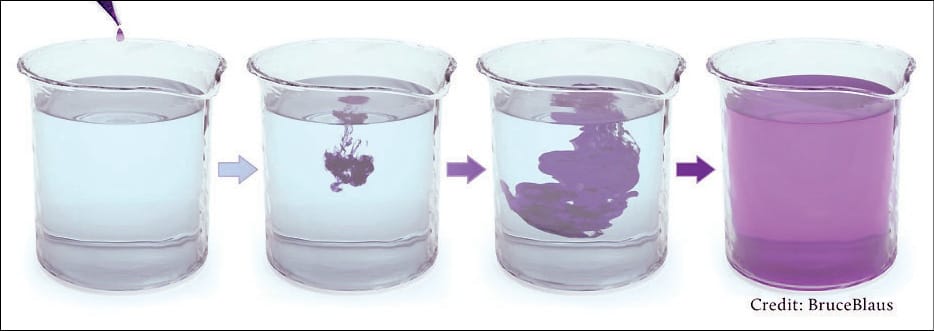
The atomic theory of matter made for a complication in the understanding of entropy, which was resolved through the use of statistics. On the micro-scale, the individual atoms and molecules making up gases were considered to behave according to dynamic (reversible) physical laws, and thus the difficulty arose of reconciling an increase in entropy (irreversibility) on the macro-scale, with the reversible nature of the components which made up those macro-states. How could there be an intrinsic direction of time, if the behavior of all the particles making up irreversible processes could individually be time-reversed?[20] For example, a gas allowed to expand (say by opening the valve on a compressed air tank) will do so. Yet, even though the motions taken by its individual particles could be reversed without violating laws of physics, we do not see gas spontaneously contract and rush into a canister. Why?
Very briefly, Boltzmann developed statistical mechanics to explain entropy from another standpoint. Rather than being a function of the conditions of a gas as a whole, it could be understood as a function of the number of possible configurations a gas’s particles could take that would correspond to a given macro-state.[21] For example, the number of ways for gas particles to exist in equal numbers in two connected gas tanks, is immensely greater than the number of configurations in which they are all found in only one of the tanks. Therefore the even distribution of the gas, with more possibilities, has a higher entropy. Boltzmann would argue that the existence of so many more ways for the gas to be equally divided into the two tanks is what explains its expansion over time to fill both. With these refinements, the disparity between reversible micro-phenomena and irreversible macro-phenomena was bridged.[22]
The laws of thermodynamics, combined with all the other laws of mechanical physics, unify heat and mechanics, and provide an arrow of time. While the physics of reversible processes have before and after only as opposites, the physics of irreversible processes give a definite direction in time for the evolution of the systems they apply to. The second law gives an intrinsic metric to differentiate before from after: entropy increases over time.
The First Law of Thermodynamics Is Not Universal
The first law of thermodynamics states that in all physical processes, energy is neither created nor destroyed. While Einstein’s demonstration of the interrelationship of matter and energy shows this principle to be untrue, because energy and mass can be interconverted (as in nuclear processes), the changing nature of “energy” will be the focus here, in two respects: (1) energy is actually created by human beings, and (2) in a case of re-contextualized meanings, economic “energy” is distinct from the energy of physics, as seen when we consider energy flux density.
In the 1800s, as the laws of thermodynamics were developed, any attempt to measure the total energy of our planet would have erred dramatically. Such an estimate would have included such factors as sunlight, chemical compounds (such as that in living matter, and in hydrocarbons in the crust), elevations of physical structures (gravitational potential), the flow of wind and water, and the high temperature of the core of the Earth. While making such an estimate of the total energy available on the planet as a whole would be quite difficult, this is not the greatest problem with undertaking such an endeavor. Rather, consider what would not have been included at all. Such a survey in the 1800s would not have included the nuclear fission energy potential of the planet’s uranium and thorium, or the fusion potential of its deuterium. The estimate of global energy would have been wildly off, not only due to an inadequate understanding of the composition of the body of the Earth, but because the domain of possible sources of energy was incomplete: nuclear processes were unknown.
Through the development of nuclear science, did the human species increase the amount of energy on Earth, or only discover already-existing energy?
Resisting the urge to answer the question in physical terms which would exclude a specifically human response, the honest answer can be given: we have increased the energy available to the human species and expanded our economic capabilities. We have created what could be called economic energy. A useful distinction can be made between the two natures of “energy”: it both refers to something we have discovered about the external physical world, and at the same time refers to a mental tool that we use to advance our thought and power. Human beings create resources, including energy.[23]
Another example illustrates the importance of considering the quality of energy. Rather than only the quantity of energy, consider the energy flux density, the concentration of the power applied to a process. Take the example of heating a home. We will consider two ways of providing the heat. The first is using fuel to directly create heat in the home through combustion (say of natural gas), and the second is using fuel to produce electricity in a power plant, and then using that electricity to power a heat pump. In the first case, the efficiency of the furnace or boiler would be measured by the annual fuel utilization efficiency (AFUE),[24] which is around 85% for a typical modern unit. This means that 85% of the heat in the fuel is delivered to the air in the home.
Now, consider the case of using the natural gas to produce electricity, to then run a heat pump. A typical natural gas power plant converts only about 42% of the gas’s heat into electricity. Yet, the electricity, being a higher quality, more dense form of power than mere heat, is able to accomplish much more than heat can: electricity can run motors, power electronics, produce metals, etc. And even in heating a home, electricity is more efficient than heat itself.[25] By using a heat pump, which moves (“pumps”) heat into the home from the outdoor air, electricity from the power plant is multiplied by a coefficient of performance (COP) for the heat pump, a measure of the heat supplied to the home as a ratio of the energy supplied to the pump. For common heat pumps, the COP is in the range of 2-4, meaning that several times more heat is delivered into the house than the energy used to operate the heat pump. Multiplying the electricity conversion rate (42%) by the COP, gives a value of 84-168%. This means that the home has received heat equal to 84-168% of the heat energy in the natural gas fuel. Recall that directly burning the natural gas in a home furnace would have provided 85% of the gas’s heat to the home.
Therefore, converting natural gas to electricity and using a heat pump powered by that electricity can provide up to roughly twice the home heating (168% compared to 85%) provided by the direct use of natural gas as a source of heat. And this is only a case where the effects are comparable: supplying heat. Without transforming it into electricity, natural gas cannot be used to power a telephone, a robot in a factory, or a traffic light system. No amount of natural gas as a chemical can produce an x-ray image of a broken bone.
This is a simple example of what Lyndon LaRouche refers to as a “curious feature” of technological development in his economics textbook, So, You Wish to Learn All About Economics?, whereby “we tend to accomplish much higher rates of work with the higher energy-flux density of a fraction of the total power supplied to the machine, than with the entire power supplied at relatively much lower energy-flux density. It appears that less power accomplishes more work than a greater amount of power.”[26]
The “energy” of electricity can be measured in the same physical units as the “energy” of heat, or the chemical “energy” of molecular structure, but these units do not fully express the economic usefulness (power) of that energy. By considering the intensity of the energy, we can differentiate among levels of energy potential, such as the possibilities of: (a) a wood-powered economy, in which energy can be used for heating, cooking, some material treatments, and some metallurgy, (b) a coal-powered economy, in which steam engines can economically be used to transform heat into motion, allowing dramatic changes in production and transportation, (c) an electricity-using economy, where energy can be moved along a wire rather than by transporting fuel, where the potentials for production are increased by motors, metallurgy is transformed by electrolysis, communication changes fundamentally, and computer automation transforms the nature of productive work, to (d) a quantum-physics and nuclear economy of dramatically increased power capabilities,[27] laser and electron-beam technologies, and, with fusion, the potential to develop control over the inner solar system.[28],[29]
While the first law of thermodynamics does apply on the physical level, where energy is neither created nor destroyed (excepting subatomic processes, where energy and matter are related by E=mc²), the “economic energy” available to human economy, as qualified by the type of energy, most certainly does increase, through the human process of creative discovery. This increase is seen both in absolute terms, and even occurs when less total energy is recovered from fuel sources, by using that more concentrated power to greater effect.
When considering the universe as a whole (including the biosphere of life and the noösphere of human cognition), the first law of thermodynamics is not a universal principle.
Misapplications of the Second Law

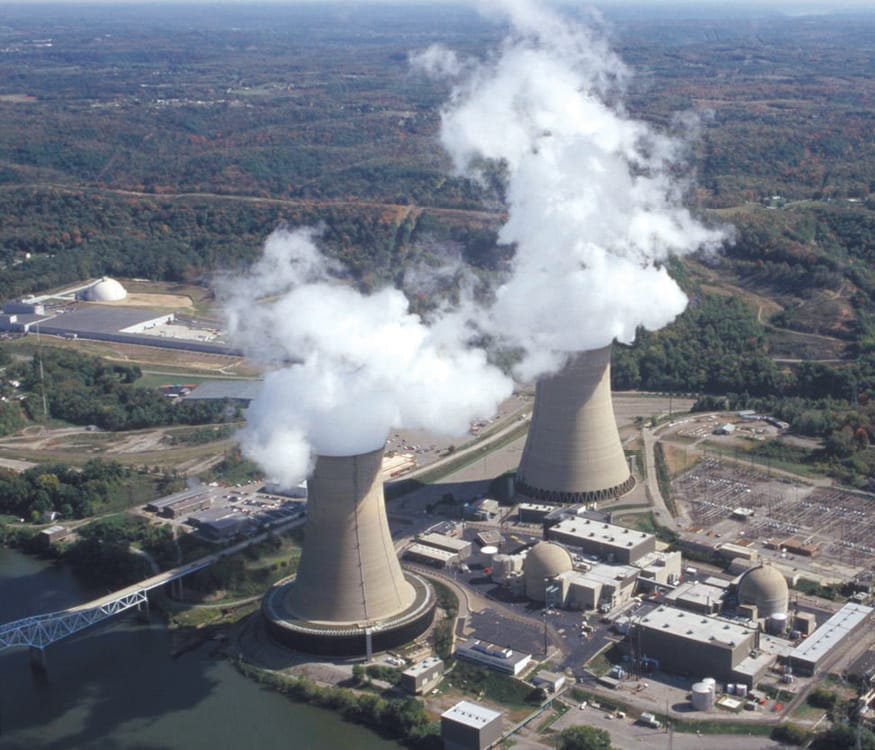
The meaning of the second law of thermodynamics has been greatly simplified and the field of its application dramatically extended, giving it an entirely foreign pop-science meaning. Two major misapplications are in the concept of the “heat death of the universe,” and in the notion that the second law indicates a universal increase of “disorder.”
It was William Thomson (later Lord Kelvin) who is credited with first expounding on the inevitable dissipation of all forms of potential energy into mechanical motion and heat, with a result that “would inevitably be a state of universal rest and death, if the universe were finite and left to obey existing laws.” His colleague Hermann von Helmholtz wrote of the “heat death” of the universe as the ultimate state it would reach, in which no more energy would be available for any processes to make use of. This is the ultimate extrapolation: to apply current knowledge (which at the time, did not include nuclear processes[30]) to the entire universe, about which it will always be presumptuous to assume anything approaching a complete understanding. Since human discovery changes our relationship to the rest of the universe, and since the number of discoveries remaining to be made is always infinite, the “laws of nature” will never be fixed.
The other problem plaguing the second law, disturbing its repose as a legitimate and useful physical principle (in its proper domain), is the notion that it insists that the universe will become more “disorderly” over time. Although Boltzmann did indeed use the word “disorder”[31] in his discussion of entropy, it was in the context of expressing a characteristic of aggregates of gas molecules, of the number of states in which the gas particles could be said to be within a certain range of a given macro-scale condition, such as temperature, pressure, and volume. For example, a higher state of temperature allowing a greater diversity of particle motions, was thus a state of higher entropy. This use of the word “disorder” applies to aggregates of microscopic particles, moving about and interacting of their own accord. It manifestly does not apply to objects on a desk, dirty clothing heaped on the floor, etc. Clothes do not move around in large groups, colliding with each other and imparting kinetic energy according to statistical rules. The books in a library do not unshelve themselves and become disorderly at night while the librarians are not supervising them. These objects move due to outside causes: people. They do not spontaneously move of their own accord towards states characterized by a greater diversity of possible distributions.
There is no universal commandment that “disorder,” in whatever context anyone might wish to apply the word, increases. The second law of thermodynamics is, as its name indicates, a law of thermodynamics: not of biology or human society. The only legitimate application of the second law to larger-scale processes can be in discussing their thermodynamic changes, based on their component parts.
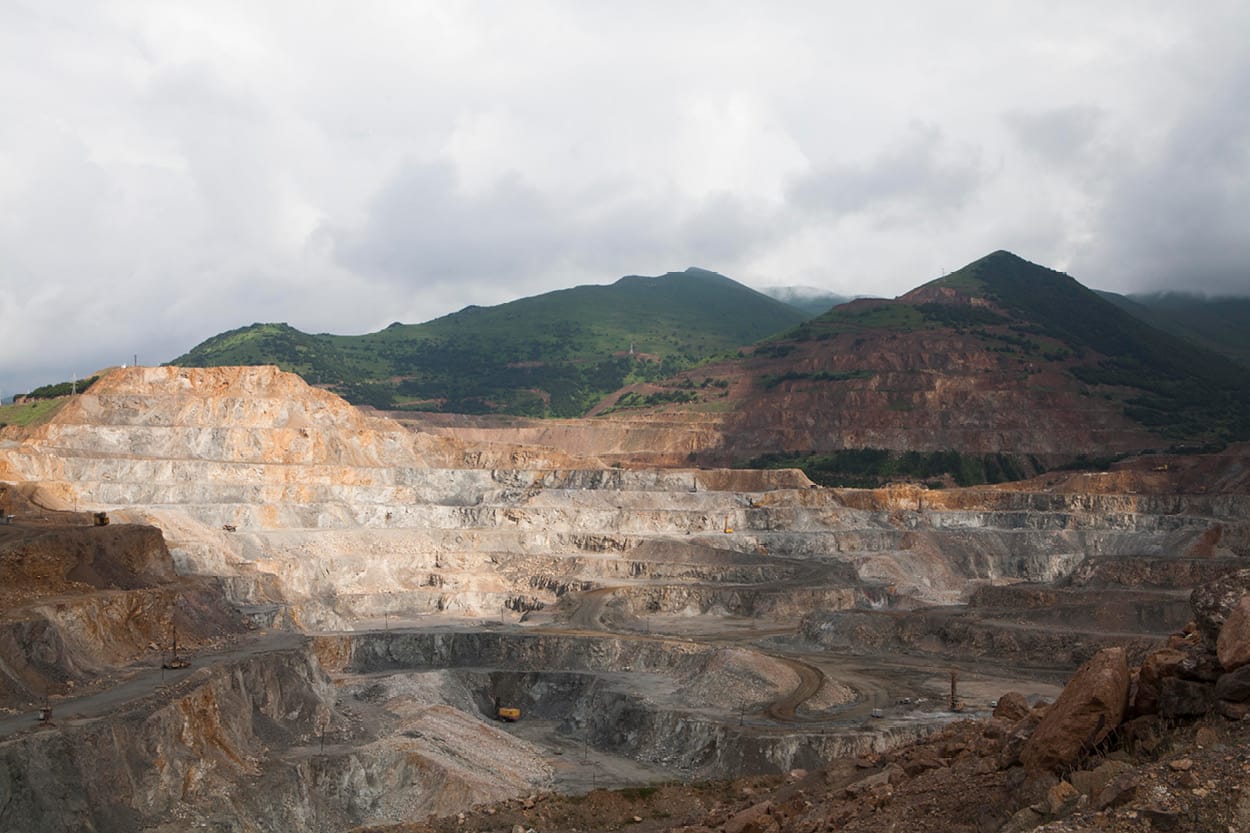
The Second Law of Thermodynamics is Not Universal
Beyond these unwarranted, and frankly irresponsible extrapolations of logic and linguistics, processes of life and human cognition provide further examples of the second law not being universal in scope. Although the second law cannot actually be applied to macro-scale processes to which it has no relevance, the prevalence of thoughts about universal “entropy” makes it worthwhile to address order and complexity on larger scales, with the caveat that this discussion is of the commonly used notions of entropy and disorder, rather than the actual physical concept.
A powerful economic concept helps make this clear—the concept of the necessity of progress. In his economics textbook,[32] Lyndon LaRouche develops a global measure of economic progress: the potential relative population density of a society, as a function of that society’s scientific and cultural practice. Relative to the level of human improvement of the land, how many people could potentially be supported per land-area? This is, roughly speaking, the potential relative population density (PRPD). Economic value lies in increasing the rate of increase of PRPD. LaRouche writes that while it is obvious that technological regression necessarily implies a decrease in PRPD, the implications of simply ceasing to progress are less clear. By the drawdown of more concentrated resources (energetic and raw material, for example), LaRouche reasons that the physical cost of providing the base resources will necessarily increase over time in a technologically static society (through the necessity of more difficult mining, etc.), and this increasing cost will lead to a reduction of economic capabilities overall. Without continued technological improvement, society will regress; it is impossible to stay still.
From this context, the increasing entropy, and decreasing free thermodynamic energy of physical systems, can be thought of as analogous to the relative, local regression of a system characterized, more universally, by its discontinuous advancements. Clear examples are seen in the very similar domains of life on evolutionary scales of time, and of human economics.
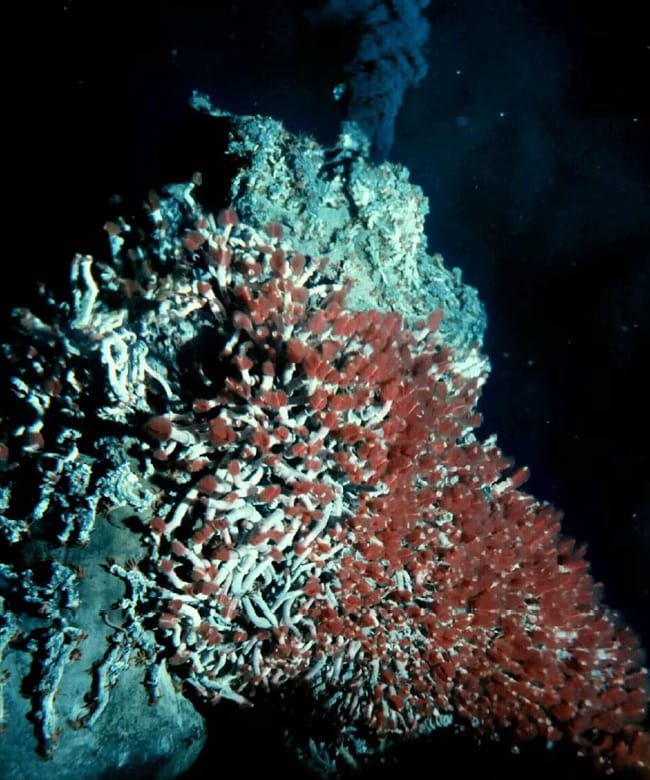


Before photosynthesis, the early, deep biosphere was powered chemically, by emanations from the earth itself. The high-energy molecules would not last forever. But they were not a limit to growth! The development of photosynthesis allowed life to tap into an extraterrestrial power source: sunlight. The oxygenated atmosphere created by photosynthesis allowed much more concentrated forms of life to emerge, such as warm-blooded mammals, which have an extremely high rate of biogenic migration of atoms and of energy use. With human civilization, the biosphere is becoming the noösphere. As photosynthesis unlocked solar power, humanity unleashes the power of the atomic nucleus to bring the Earth into a nuclear era and beyond.
Consider the development of photosynthesis. Before the development of life capable of using the energy of sunlight, terrestrial life depended on chemical energy, such as that utilized by organisms living around deep-sea vents emitting high-energy molecules such as hydrogen sulfide. The total energy available to life was small, and was generated from deep-earth processes. From the thermodynamic standpoint, the energy potential of these molecules (and the processes generating them) would eventually be used up as the gases escaped the Earth’s crust, and the Earth’s cooling temperature produced less of them. While a modern-day environmentalist may have called for the conservation of scarce hydrogen sulfide, and for measures to be taken for its more efficient use, a different route was taken by life. The development of photosynthesis meant that an entirely new, and immensely vast energy source—the Sun—now became available to life, capable of supporting a great deal more biological material and energy flow, and an increase in the biogeochemical energy of living matter. Later, the move of life to land, and the new structures and processes required for it, unlocked additional photosynthetic capability.
While the local tendency may appear to be towards decreasing free energy when examining small physical systems, the characteristic of life as a whole, and of developing human society, is in precisely the opposite direction. Or rather, not precisely opposite, in that the upward shifts occur as leaps, rather than the continuous decrease of free energy expressed by the second law of thermodynamics. An anthropomorphized system of hot gas may look with dismay and dread at the locally decreasing free energy, but life and cognition are not constrained by the abiotic concept of free energy.
Vernadsky demonstrates that the biogeochemical energy of life has increased over time. In a 1928 speech on evolution,[33] Vernadsky developed what he called his “second biogeochemical principle,” which states that the evolution of species has an intrinsic direction, moving towards species which increase their chemical and energetic effect on the surrounding environment (in Vernadsky’s terms, increasing the biogenic migration of atoms): “The evolution of species, leading to the creation of new stable, living forms, must move in the direction of an increasing of the biogenic migration of atoms in the biosphere.” More recent studies strongly support Vernadsky’s second principle, indicating that the evolution of life (as far as currently observed) defines an arrow of time, always moving in one direction: towards greater energy use per species and greater corresponding effects on the biosphere.[34]
Looking at a larger (cosmic) scale, we see the irrelevance of physical entropy in understanding the development of the universe. As an example, consider the big bang theory, according to which the lowest-entropy, highest free-energy state the universe was ever in, occurred some billions of years ago, and everything has gone downhill since (from a thermodynamic point of view). Again, any increase in this physical quantity of entropy is absolutely irrelevant to cosmological “disorder” when we consider the manifest increase in order and complexity: the development of galaxies, stars, planets, and, around our Sun, life and cognition. Perhaps a galaxy does have higher entropy than a collection of cosmic dust or the subatomic soup hypothesized to have existed within the first microseconds after the big bang, but this does not in any way indicate that it has more disorder, or is less interesting in its characteristics.
A human being, turning food into bodily motion and biological upkeep, is thermodynamically a drain on free-energy,[35] and yet is the source of creative developments that qualitatively increase the mental tools and the useful energy available to the species: human free-energy increases, without paying any regard to locally decreasing thermodynamic free-energy.
Even the statistical mechanics interpretation of entropy, according to which the increasing entropy is measured as an evolution towards states of greater likelihood, of greater means of possibility, is opposite to the changes seen in life and humanity. Far from moving towards states of greater probability, evolutionary changes in life, and economic changes in humanity, move to states of zero probability, of previous impossibility. A future comes to be, which the physical past could not have created. Bronze Age humanity had available to it an entire array of processes and materials that simply did not exist in the Stone Age, just as mammals have molecules and biological processes that never existed in earlier life, such as reptiles, and which could not, because earlier life did not regulate its temperature.



As Vernadsky indicated, the evolutionary development of the biosphere is accompanied by an increase in the biogenic flow of material and energy. Reptiles have an energy use of 230 kJ per gram per lifespan. For mammals, which maintain their body temperatures, the average is 1,600. Birds, with their mastery of the air, use an average of 5,280.
In sum, we need not lose sleep about a physical quantity—entropy—getting larger, fretting that the future will be a disorderly heat-soup; rather we can instead look at the actual development over time of the universe and of our species, and see that they are characterized by contrary processes. Our understanding of the universe must include these phenomena of life and cognition, or it is fundamentally incomplete. Increasing complexity, increasing biological energy, and increasing economic energy may be coherent, locally, with the second law of thermodynamics, but are certainly not explained by it. The second law of thermodynamics is not universal.
A defender of the universal application of thermodynamics will grant all of this and still object that nothing we have said here violates the second law: the living cell purchases its internal order only by discharging a greater disorder into its surroundings, and the biosphere as a whole runs on the entropy budget of the Sun. This is correct, yet it is beside the point. The claim here is not that entropy locally decreases in defiance of the second law; it is that entropy is not the quantity that tells us anything about what life and cognition are doing. To measure the biosphere by its entropy is to measure a symphony by its total air pressure—the bookkeeping balances, and it records nothing of interest. The variables that carry the meaning—the biogenic migration of atoms, the energy-flux density a species commands, the potential relative population density a culture can sustain, and above all the appearance of states that were previously impossible—are orthogonal to thermodynamic entropy: neither forbidden by it nor explained by it. That the second law is never broken is precisely why it cannot be the governing principle of these domains: a law obeyed by every possible outcome singles out none of them.
Reflections on Time
Comprehension of the characteristics of time in thermodynamics and physics gives a greater pungency to the different kinds of time seen in the biosphere and noösphere. To review: Dynamical laws of physics, with the first law of thermodynamics, govern reversible processes, for which before and after are opposite directions in time, but lack any inherent difference. The irreversible processes covered by the second law of thermodynamics, have a direction in time, an inherent distinction between before and after, based on the concept of physical entropy increasing in the direction of the flow of time.
The times of life and of human thought differ from abiotic time in at least three ways: they show a new and stronger kind of irreversibility; they are quantized; and they depend on context. A higher form of irreversibility is seen in the development of biological and human “technologies,” such that before and after are distinguished not by a scalar quantity increasing in the direction of time-flow, but by the fact that after cannot be reached from before. That is, humanity in the nuclear age creates states of matter which could never have been created in earlier ages of human development, because the requisite technologies did not exist.[36] The time of human development is characterized by increasing our dimensions of action, rather than any (scalar) measure which has a meaningful value in all contexts.[37] The development of endothermy (warm-blooded life) is a relatively specific biological “technology” that allows these animals to support new biological processes that depend on a certain temperature range, and to expand the types of territories they can inhabit. Evolutionarily speaking, endothermy is after exothermy.
The progress of evolution is seen quantitatively in the increase of characteristic metabolic rates over evolutionary development. To use a single metric, we consider the average energy use per gram of body mass per lifespan. This value is chosen in preference to metabolic rate itself because metabolic rate scales with body mass in a roughly three-fourths power relationship.[38] Since a number of characteristic times (lifespan, time to reach reproductive maturity, heart rate, and respiration rate, for example) follow something like a one-fourth power of a species’s mass, their product—energy per mass per lifespan—provides a value that is broadly characteristic of a specific class of animals.[39]
The data reveal a clear development over evolutionary progress. Using a database[40] for lifespan data of non-aquatic vertebrates, we find that amphibians have an average energy use per gram per lifespan of approximately 210 kJ/g/lifespan. Reptiles are slightly higher, at 230 kJ/g/lifespan, while for mammals it is 1,600 kJ/g/lifespan, and for birds, 5,280 kJ/g/lifespan.[41] The increasing values, roughly characteristic of each class, follow the temporal order in which the classes arose—amphibians, reptiles, mammals, and, latest of all, birds—so that although the figures are drawn from living species, they trace a real direction in evolutionary time, in accord with Vernadsky’s principle of an increasing biogenic migration of atoms.
Vernadsky had the insight that biology would shed unique light on the subject of time itself. In his 1938 “Problems of Biogeochemistry II,” Vernadsky writes:
We are presently living through an extremely important epoch in the development of science. For the first time, the object of scientific investigation is time, which for centuries remained outside its scope. This circumstance characterizes the science of our time and distinguishes it from the science of the 19th century. It is now becoming clear, that time is an extremely complex manifestation of reality, and that the content of this concept is extremely rich.
Speaking about space-time, we merely indicate the inseparability of one from the other. For science there is no space without energy and matter, nor, in exactly the same sense, without time. The conception of Minkowski and his predecessors, about time as a fourth dimension of space, is a mathematical abstraction having no logical grounding in scientific reality; it is a fiction, which does not correspond to the real content of science, nor to a true scientific conception of time. Time is not a dimension of metric geometry. Of course, time can be expressed in geometry by a vector, but it is obvious that such a representation of time does not subsume all of its properties in the natural phenomena studied by the naturalist; it provides him nothing real by way of knowledge. He has no use for it.
Twentieth-century science is now at a stage, when the moment has arrived to study time, in the same way as we study the energy and matter filling space. Minkowski’s time, considered as the fourth dimension of Euclidean space, does not correspond to the time, which is actually observed in physical space. We should not forget, that in concrete scientific work, we, generally speaking, are not dealing with the abstract absolute space of geometry. At every step, we are dealing with the much more complex real space of Nature.[42]
Human Time
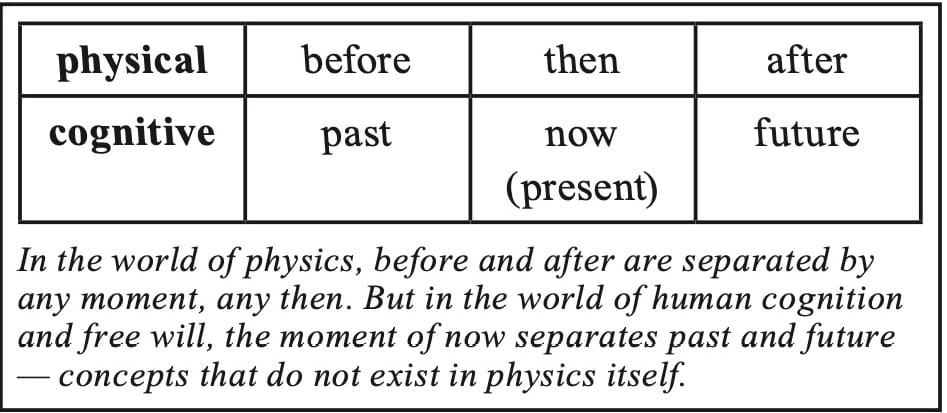
An entirely new characteristic of time exists when considering the process of human cognition: the characteristic of now. Recall that the first law of thermodynamics distinguishes before and after only as opposites; the second law of thermodynamics gives an inherent direction to time; living processes give a quantized nature of time (as in the cyclic nature of generational time); and evolutionary changes in life give an incommensurable direction of time, where after is distinguished from before by the existence of processes that could not have existed before (rather than the progress of some scalar value, such as entropy). While the meanings of before and after have developed, none of these kinds of time has yet required a now.
Now is a particular kind of moment, distinguished from a then. While thens exist in physics, and can be distinguished from each other, now does not exist; it is not a concept required by phenomena. Now is not the moment between before and after; it is the moment between the past and the future. The laws of thermodynamics give a distinction between before and after, but these befores and afters can be before or after any particular moment, any then. Before and after are not the same as past and future. When is “right now,” physically? What differentiates, fundamentally, now from an hour ago?
Furthermore, under Einstein’s relativity, the concept of a universal time, of the possibility of a shared moment in time for different observers, has vanished with the disappearance of simultaneity. Recall that one event may appear to follow another to one observer, while both events could appear to be simultaneous to another observer. Therefore, a single moment in time, a universal simultaneity, cannot exist. There can be no universal “now.” In what way, then, can now have meaning?
What sort of phenomenon requires the existence of a “now”?
It is by the nature of free will that human beings have a now, the time of decision. The opportunity to willfully create incommensurable shifts like those seen in life only over evolutionary time, is present at every moment to the human individual: the opportunity in each now to make choices that are not predetermined, and which, when creative, are choices which distinguish the future fundamentally from the past, by dramatically transforming the possible domain of human action. These nows of discovery, these moments of creative insight, are the reason for the existence of economy as a characteristic of the human species, not seen in other life.
Seen this way, the human now is not a small thing appended to physics but the sharpest expression of the oldest process in nature. What life accomplished slowly across evolutionary time—its climb toward states of matter and biological processes that could not have existed before—is, in the human now, gathered into a single act and made deliberate. What natural selection did to the descendants of reptiles over epochs, a mind can do to the human condition in an afternoon of discovery.
The course of humanity does not inexorably “tend” in any direction; it is a series of nows, of constant opportunities for decision. When human time is used to make a fundamental discovery, the truest substance of the universe is made visible to the human mind: the substance of incommensurable development itself.
What are ‘Universal’ Principles?
If extending principles beyond the domains of their discovery is fraught with danger, can any truly universal principles ever be known? Consider this warning from Vernadsky:
In one case, in 1824 the young French engineer Sadi Carnot founded thermodynamics. Carnot’s principle defines the unidirectional course of a process in time. Thirty years later, Rudolph Julius Clausius, then a professor at Zürich, in the principle of entropy, generalized this unidirectional process (which is expressed geometrically in space-time by a polar vector of time) to all of reality, as defining the “end of the world.” In this form, this was an extrapolation of a logical thought, but not a phenomenon of reality.[43]
If universal “phenomena of reality” exist, how can they be sought? What could be the basis of potentially valid insight into universal principles, if extrapolations from scientific principles cannot be counted on? What can we say about the universe, if our knowledge is always incomplete?
Nicholas of Cusa, in his work De Docta Ignorantia (On Learned Ignorance), which inspired Johannes Kepler and made modern science possible, begins by setting his sights on what he saw as the most universal of universals, God, and then goes on to discuss the universe in the context of his insight on the Creator. The central concept of knowledge employed by Cusa, that of educated ignorance, informed by a coincidence of opposites, does not use small parts or small ideas to build up to great ones, but details the specific way that a lack of knowledge is itself an appropriate means to express new concepts. For example, Cusa states that God is that maximum to which nothing is opposed, including the minimum, and that He is the light which is not opposite of darkness.[44] These are contradictions, specific unspeakables, to lead the reader towards an incomprehensible concept, by making the incomprehensibility more specific.
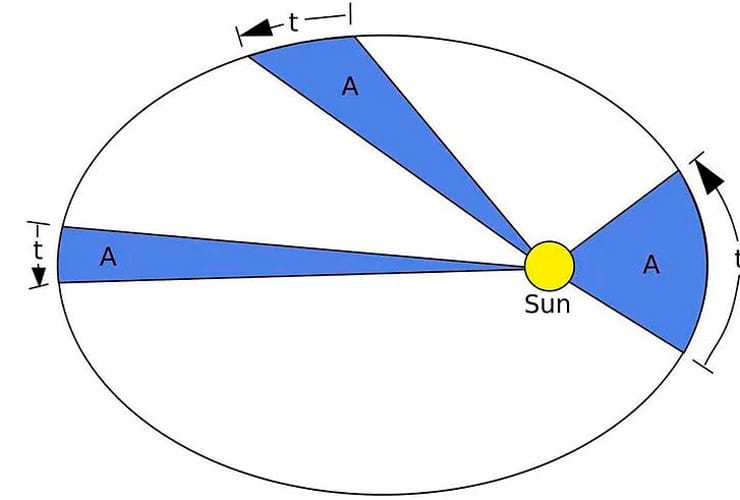
Cusa then takes up the universe, again communicating his thoughts in the form of impossibilities arising from attempts at understanding which are below the level required for comprehension. He reasons that that which is less than truth cannot measure truth precisely, and applies this insight to astronomy. Cusa maintains that no planet can move in a circle, as a perfect circle, embodying absolute perfection, cannot exist in the created world, and could not be a cause of motion.[45] Similarly, perfectly uniform (circular) motion was impossible: How could two motions be so equal, as not to be capable of still greater equality? Thus, circles and uniform motion were both rejected as true means of understanding the planets. What remained? Nothing, in the language Cusa sought to surpass. His follower, Johannes Kepler, applied physics to astronomy, providing an affirmative higher level of thought that resolved the impossibility of understanding astronomy geometrically, as brought forth by Cusa. Kepler’s use of physics, of a physical principle whose application varied in every moment, shocked his contemporaries, laid an entirely new basis for astronomy, and opened the path to modern science.
A general conclusion can be drawn from this astronomical example. Contrary to Aristotle’s view that opposites could not co-exist, or the logician’s view that all derivable conclusions exist inherently in the original premises, Cusa maintained the primacy of the process of discovery itself, whereby contradictions drive the mind to hypothesize a new concept, not derivable from the past—a conclusion that defies the premises, rather than following from them. Cusa held that it was through this process, of knowing through specific ignorance, that one could come the closest to seeing God. Resolving paradoxes through developing new metaphors for understanding is more than a technique for arriving at physical truths: this process is the truest substance of nature.[46]
We are now able to answer the question posed when this section began. If no scalar carried beyond the domain of its discovery can be trusted as universal—not energy, not entropy, not any conserved quantity of the bookkeeper—then what deserves the name “universal” at all? Here, we have been tracing not a quantity but a tendency: the recurrent appearance, in every domain we know, of states, processes, and principles that could not have been produced by what came before. Abiotic nature shows it weakly, in the self-organization of galaxies, stars, and the chemistry that preceded life; the biosphere shows it more strongly, as an arrow of rising biogenic energy and unceasingly novel form; and in man it becomes, for the first time, conscious of itself and free—exercised on purpose, in the now of discovery. That a principle should be universal not by being everywhere the same but by being everywhere the source of what is new is exactly the coincidence of opposites Cusa taught us to expect. The most universal thing in the universe is its refusal to be finished.
Every human being is born with the potential to apply this process of discovery: to exist in the efficient immortality of discovering principles and applying them for the betterment of society, where betterment is seen in increasing the capability of fellow human beings to participate in this most characteristically human of behaviors.
This is why the argument does not end in physics. A society can be arranged to multiply these moments of discovery or to suppress them, to widen the number of minds free to create or to narrow it; no choice a people makes is more consequential. The political task that follows is thus not simply an opinion appended to the argument, but is its direct consequence.
The creation of such a society, free from the oligarchism that currently threatens global thermonuclear warfare, is the most beautiful, the most human, and the most urgently pressing task facing mankind today.
Notes
- Entropy, a measurable physical concept developed to explain the quantity of energy available to do useful work, was found to increase (or remain constant) in all processes of closed systems. This increasing entropy, which gives a time-direction for physical processes, has frequently been inaccurately described as representing an increase in the “disorder” of a system. This concept of disorder has been applied to domains far afield from physics and physical chemistry. Many students learn of entropy through analogies of the increasing disorder of a desk or room, unless effort is made to tidy things up. But the objects on a desk do not move on their own or “tend” towards any new configuration of their own accord; they are moved by human beings.
- For more on “flat” versus “curved” space, see Bernhard Riemann: The Habilitation Dissertation.
- The wave theory of light prompted a new question: what is the medium that is undulating? An ocean wave is based on water. Sound waves are based on compression of air. What about light?
- This did not eliminate the wave understanding of light: while some experimental contexts seemed to demand the particle nature of light, others (indeed, most) required that light act as a wave.
- In 1905, Einstein discovered that reality demands a connection between energy and matter. Additional discoveries made over the following two decades demanded a new concept to overcome the separation between the discreteness of matter and the continuity of (light) energy.
- V. I. Vernadsky, “The Study of Life and the New Physics,” 1930, available in English, translated by Meghan Rouillard, 2015.
- Lavoisier also developed a powerful conservation principle: that in all chemical and mechanical changes, the total quantity of matter would not change, and that the total mass of each element, considered individually, would also not change.
- Before the derivation of the mechanical equivalent of heat, the calorie—a measure of the heat required to change the temperature of a body—was considered as relating to a different domain of nature than the joule (or the foot-pound, used by Joule before the unit bearing his name existed)—which measured mechanical work. Joule determined that there was a direct measurable equivalence between quantities of heat energy and mechanical energy: a calorie is about 4 joules. The Calories in food (often written capitalized) are actually kilocalories, and are about 4 kilojoules each.
- This concept finds its origins in the work of Leibniz, who wrote of the connection between vis viva (living force—today’s kinetic energy) and vis mortua (dead force—today’s potential energy), as in his 1695 Specimen Dynamicum.
- For example, a combustion engine operating at a temperature of 1,000 K (727°C or 1,340°F) as TH, in an environment of temperature 300 K (27°C or 80°F) as TC, would have a maximum efficiency of (TH−TC)/TH or (1,000 K−300 K)/1,000 K = 700 K/1,000 K = 70%. Thus, at most 70% of the heat generated in the engine could be converted into mechanical work, while 30% would simply heat the colder surrounding environment. This is the maximum theoretical efficiency of an engine operating at these temperatures.
- Note that it does not require entropy or the second law of thermodynamics, which will be addressed below.
- For example, knowing the position and speed of a swinging pendulum at one moment allows the prediction of its later motion as well as a reconstruction of its previous motion.
- An ideal heat engine, reversed, is an ideal refrigerator. The transformation of heat into work, with some flow of heat into a cold reservoir, can be reversed by the application of work to add the heat back to the hot reservoir, causing a flow of heat out of the cold reservoir. Ideal heat engines and ideal refrigerators are the same process, viewed in opposite directions of time.
- This can help explain the difficulty children have in developing a sense of left and right.
- Max Planck writes, in his Treatise on Thermodynamics, “From the point of view of the first law, the initial and final states of any process are completely equivalent.”
- For readers desiring a more specific treatment, the change in entropy can be briefly stated as ΔS = ∫dQ/T, where the change in entropy (S) is the integral of the heat absorbed (Q) divided by the temperature (T). In his Treatise on Thermodynamics, Planck derives a general function for the entropy of a gas: Φ = M(cv log T + R/m log v + constant), where Φ is the entropy, M the mass of the gas, cv the specific heat of the gas at constant volume (the amount of heat applied to change its temperature), T the temperature, R the ideal gas constant, m the molecular weight, and v the volume per mass of gas, from which he shows that the change in entropy would be ∫dQ/T under certain conditions. Entropy was a new physical concept, not derivable from earlier theories, whose increase accorded with the forward flowing of time.Entropy does not change if a gas is compressed or expanded by outside work, without the flow of heat, as in an ideal gas shock-absorber, making such a process reversible.
- The increase of entropy now gives a direction of time. The dynamical laws of normal physics give rates in time, without defining its direction.
- Ideal, in the sense that the cylinder was so well insulated that no heat flowed to or from the surroundings.
- Two brief examples may be useful. First, consider two bodies at different temperatures, TH (hotter) and TC (colder), and let heat flow from the hot body to the colder one. Using ΔS = ∫dQ/T, we can say that the change in entropy of the hot body, as it loses heat, is −Q/TH, while the change for the colder body, gaining heat, is Q/TC. The quantity Q (heat flow) is the same for both bodies, since we assume that all heat flowing from the hot body went to the cold one. The total change in entropy is therefore ΔS = −Q/TH + Q/TC. Since TH is greater than TC, the negative term −Q/TH will be smaller than the positive term Q/TC, and the entropy has increased.As a second example, consider the expansion of gas without doing any work and without external heat flow. Take two gas tanks connected by a valve, one full of gas, and the other totally empty. If the valve is opened just a bit, gas will flow into the empty tank until both have the same pressure. Experiments revealed that the temperature of the gas would not change overall, and the energy of a gas had been shown to depend only on its temperature, not its pressure or volume. Therefore, this experiment results in no change in internal energy of the gas. But, if we use Planck’s entropy, from endnote 16, Φ = M(cv log T + R/m log v + constant), before and after the motion of the gas, we see that the only term that has changed is v, the volume per mass of the gas, which has doubled from v to 2v. Therefore, ignoring the terms that have not changed, the change in entropy is ΔΦ = M(R/m log 2v) − M(R/m log v). This simplifies to ΔΦ = MR/m × (log 2v − log v) = MR/m × log 2, which has a positive value. The entropy of the gas has increased with this expansion, and this is indeed the direction in which the process is always observed to occur. Gases expand to fill available volumes, rather than spontaneously concentrating, leaving behind a vacuum.
- Consider again the example in the preceding footnote, of a gas concentrated in one tank being allowed to fill both tanks. If this entire process were recorded and played in reverse, and we watched it with an imaginary molecular microscope, the motion of the gas particles in reverse (concentrating in one tank and emptying the other) would not violate any laws of physics. Nothing in the dynamics of the backwards-video would be amiss. Yet, gas is never observed to do this. How can the direction of gas motion be explained by entropy in the large, while examination of its particles reveals a process that could go in the other direction? This was the sort of problem addressed by Boltzmann’s treatment of entropy.
- While the second law is frequently expressed as an increase in “disorder,” with recourse to examples of the disorder of macro-scale objects which do not change on their own (such as messy rooms and disorderly desks), this is the mis-application of the everyday word “disorder” out of its meaningful context of micro-states (where it is still a regrettable word) to the totally different context of macro-states. As Professor Frank Lambert humorously points out, objects in a room do not inherently move or lurch towards disorder. They are not a closed system, since the cause of their motion is the people moving them, and does not lie in the objects themselves. See his excellent sites, available from franklambert.net, for more on the pedagogical disaster of using “disorder” to explain entropy.
- Return to the example of footnotes 19 and 20. If the motion of all the gas particles were instantly reversed once they filled the second tank, they would indeed all move back into the first tank. But among all the ways of starting with the general state of two tanks full of gas, how many among the possible configurations of particle positions and momenta in the two tanks would result in all the particles moving into one tank? Only an exceedingly, incredibly tiny number among the impossibly enormous number of potential configurations. This is why, statistical mechanists would say, we do not observe gases to spontaneously concentrate into smaller volumes. Although it is not strictly impossible from the molecular standpoint, it is incredibly unlikely.
- Before metallurgy, malachite was used as a cosmetic, but became the main ore for producing copper when it became a resource for the new process of metallurgy. Petroleum was not a resource before the chemical era—it was a mess.
- See this U.S. Department of Energy post.
- Except for very cold areas where heat pump efficiencies are too low to be useful.
- Lyndon H. LaRouche, Jr., So, You Wish to Learn All About Economics?, second edition, EIR News Service, 1995, p. 10.
- The power of nuclear changes is five to six orders of magnitude more dense (100,000 to 1,000,000 times greater) than chemical fuel. See Jason Ross, Forging Fusion.
- As in the use of fusion-powered spacecraft to reach any part of the inner solar system within a matter of weeks, rather than years. This is a necessity for planetary defense against asteroids and comets, for example.
- For more on this series of economic platforms, see Physical Chemistry: The Continuing Gifts of Prometheus.
- Resulting in Thomson’s inaccurate estimate of the age of the Sun.
- Or rather, the German word Unordnung.
- See chapter 2 of LaRouche’s So, You Wish to Learn All About Economics?
- This speech, later added as an appendix to the French edition of Vernadsky’s book The Biosphere, was translated by Meghan Rouillard into English as “The Evolution of Species and Living Matter” in 21st Century Science and Technology, Spring-Summer 2012, pp. 32-44.
- See “Biospheric Energy-Flux Density,” 21st Century Science and Technology, Spring 2013.
- Throughout this report, the use of “free-energy” is in the thermodynamic sense, as developed by Gibbs. It has no relation to “zero-point energy,” “vacuum energy,” or any other form of purported energy which is “free” in the sense of having no cost.
- Time, alone, did not bring about the future state.
- Lyndon LaRouche has referred to the work of Bernhard Riemann on Abelian functions, as a means of more directly expressing increasing levels of complexity, incommensurable with the previous level. On this topic, see Jason Ross, Bernhard Riemann: Potential and Abelian Functions, part 1 and part 2.
- For example, a camel (434 kg) weighing 150 times as much as an opossum (3 kg), uses only 42 times as much energy (225 W) as does the opossum (5.3 W). Using the three-fourths relationship, 150^(¾) ≈ 42. This three-fourths power relationship was discovered by Max Kleiber in the 1930s. His empirical finding has been broadly supported by more recent data, and was later given a proposed theoretical basis by G.B. West, J.H. Brown, and B.J. Enquist, “A General Model for the Origin of Allometric Scaling Laws in Biology,” Science (Vol. 276, 1997, pp. 122-126), though no single derivation is universally accepted.
- This combination of metabolic rate (mass0.75) times lifespan (mass0.25), yields a value proportional to mass itself. By dividing it by mass, we have a number that characterizes a class of animals. While the relationship is not exact (regression lines give powers of 0.88 to 1.14 for the classes mentioned), it is at least suggestive of the possibility of a quantization of biological time.
- This is the AnAge Database. Reference: Tacutu, R., Craig, T., Budovsky, A., Wuttke, D., Lehmann, G., Taranukha, D., Costa, J., Fraifeld, V.E., de Magalhaes, J.P. (2013), “Human Ageing Genomic Resources: Integrated databases and tools for the biology and genetics of ageing,” Nucleic Acids Research, Vol. 41, Issue D1, pp. D1027-D1033.
- Distinctly avian life arose more than 100 million years later than did mammals. Their high metabolic rates were, moreover, reached independently: endothermy evolved separately in the mammalian and avian lineages, so the rise in energy use across these classes is a convergent outcome rather than the inheritance of a single line of descent—and a repeated, independent result is stronger evidence for a genuine evolutionary tendency than a single lineage would be. Flight itself is a major component of the high energy use of birds. Among mammals, the energy per mass per lifespan is twice as high for bats than for land-dwelling mammals. And among birds, the lifetime energy use per gram of body weight is much lower—roughly half as great—for flightless birds.
- Vladimir Vernadsky, “Problems of Biogeochemistry II: On the Fundamental Material-Energetic Distinction Between Living and Nonliving Natural Bodies of the Biosphere,” 21st Century Science & Technology, Winter 2000-2001, p. 38. Emphasis in the original.
- Vernadsky, “The Problem of Time in Contemporary Science,” unpublished translation.
- Nicholas of Cusa, De Docta Ignorantia, translation by Jasper Hopkins, Book I.
- Ibid., Book II.
- Jason Ross, Metaphor: an Intermezzo.
