Aug. 7—The 166th consecutive weekly meeting of the International Peace Coalition (IPC) took place on August 7, 2026—81 years after the world’s first use of nuclear weapons laid waste to Hiroshima and Nagasaki, Japan, on August 6 and 9, 1945, killing at least 110,000 civilians, with many more dying later from the impact of the radiation. With the U.S. President Donald Trump Administration now openly “revising” its nuclear doctrine, making the use of nuclear weapons more likely in the proposed wars with Russia and China, the appropriate title of the event was ”The Art of Reversing Our Criminal Course.”
Helga Zepp-LaRouche, the initiator of the IPC and the founder of the Schiller Institute, opened the event by asserting that we are closer to a nuclear war than at any time in history, including the October 1962 Cuban Missile Crisis. She noted that there are no international arms control treaties left in existence; the international trust among nations and parties, even among so-called allies, has completely broken down and the old order no longer exists. In that context, for there to be a discussion by the so-called “U.S. Deputy Secretary of War” Elbridge Colby, as reported by NBC News, that the Pentagon is considering revising its nuclear doctrine to move away from deterrence toward nuclear war fighting, is incomprehensible—particularly at a time when there are already two regional conflicts, in Ukraine and Southwest Asia, with the potential for the use of nuclear weapons, and there is the rising danger that other nations may decide they need to acquire nuclear weapons.
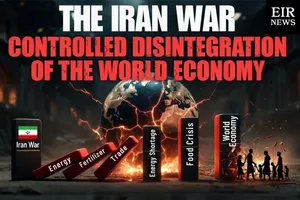
She argued that Iran has not only survived but defeated the most powerful military power in the world, the United States, which is backed by a strong military power, Israel. Despite Trump’s denials, the West is running out of munitions to fight forever wars. The signing of a military agreement between Saudi Arabia, Türkiye (a member of NATO), and Pakistan (a nuclear-power state) demonstrates the dramatic shifts taking place across the region. A new global architecture assuring both security and development for all nations is required, with justice for all, if these wars are to be stopped and no new wars are to be launched, she said.
Malthusian Depopulation Agenda
Behind this crisis is the now over two quadrillion dollars in debt imposed on the trans-Atlantic economies, which is being addressed not by constructing a new system, but by returning to the methods of Hjalmar Schacht, Adolf Hitler’s president of the German Reichsbank and Minister of Economics from 1933 to 1937—diverting all available credit away from the real economy into military production and warfighting. Underlying all of this is the Malthusian mentality of depopulation, as demonstrated by the recent call by the Sustainable Development magazine calling for reducing the world’s population by half—to less than four billion by 2200.
The first guest speaker was Dr. Akiko Mikamo, the author of the book 8:15—A True Story of Survival and Forgiveness from Hiroshima, now reprinted under the title The Hiroshima Boy, and producer of the documentary 8:15 Hiroshima, From Father to Daughter, which describes in vivid detail the impact and the suffering of her father and mother, who were both in the death zone of the Hiroshima atomic bombing, but survived. She said that the annual event in Hiroshima commemorating the Aug 6, 1945 event this year saw 127 countries send representatives, while events were held around the world. She described the events, with pictures of the destruction of buildings and people, and recounted how her father, Shinji Mikamo, refused to simply blame the United States, but blamed war. In closing, she noted that people often respond to being harmed or being fearful, by striking out—which is also used to justify war. This is an endless cycle, she said, “which must be broken.”
Dr. Theodore Postol, professor emeritus of Science, Technology, and International Security at Massachusetts Institute of Technology, a world-renowned expert on the impact of nuclear weapons, began by comparing Acting Ukrainian President Volodymyr Zelensky to Adolf Hitler near the end of World War II. He said, if Hitler had admitted defeat after Operation Bagration (June 1944), when Russian troops, in a three-week period, had destroyed 28 of 32 German army divisions in Byelorussia and were at the Polish border, a clear sign that Germany was doomed to defeat, the lives of 2-3 million Germans could have been spared. So, also, with Zelensky today, who refuses to admit defeat.
On the proposed new U.S. nuclear doctrine, Dr. Postol said neither side could win a nuclear war, but could only unleash global destruction. He noted that he had warned that President Joe Biden’s administration had approved a few years ago the development of “super-fuses” for its “prompt strike” nuclear weapons, which by dramatically improving the targeting accuracy of the warheads, doubles the killing power per warhead against hardened targets—which, he said, would allow the use of lower yield nuclear warheads to destroy Russian nuclear missiles in their silos. The war hawks of today may imagine otherwise, but there is no such thing as a “tactical” nuclear weapon. He warned that many seemingly intelligent scientists don’t understand this, and argue that the United States could “win” a nuclear war.
Dr. Postol added that proliferation is also a serious danger. Iran, he said, is being told by the United States openly that they are threatening to destroy Iran’s society and culture. In that light, Iran may believe that only building a nuclear weapon can prevent this. Iran is not likely to try, but it could build one if pressed to do so by upgrading its 60% enriched uranium. However, Iran could, with only its current armaments, virtually destroy the small state of Israel, and such an operation would leave Israel also in an existential crisis, which could lead to its own use of nuclear weapons.
Even the Saudis are worried about an Iranian bomb, while they also believe they can no longer rely on the United States to defend them, and are therefore reconsidering their own nuclear weapon plans. Acquisition of nuclear weapons may also be under consideration by the Japanese, the South Koreans and Taiwan, Dr. Postol worries, due to their concerns about China’s nuclear weapons.
Zepp-LaRouche responded that China is the only nation with a plan similar to her own Ten Principles of a New International Security and Development Architecture, referring to China’s Four Global Initiatives for development, security, civilization and governance.
Be Thankful for Putin and Xi
Dr. Postol agreed. He also pointed out that the United States has had two successive Presidents pushing us toward nuclear war: Biden, who had essentially forced Russia to do what they did not want to do, launch a military incursion into Ukraine; and Trump, who started (together with Israel) an unprovoked war of aggression against Iran. We should be thankful, he said, that, like Chinese President Xi Jinping, Russian President Vladimir Putin is rational, which is our best hope that neither would use nuclear weapons.
Moderator Dennis Speed asked Dr. Postol about the 1946 U.S. Strategic Bombing Survey, which concluded that Japan would have surrendered even if the U.S. had not dropped the bomb, even if Russia had not threated to enter the war against Japan, and even if the U.S. had not threatened to invade.
Dr. Postol said that he believed the United States was planning to invade, estimating that millions of Americans and many millions of Japanese would die, and thus decided to drop the bomb, believing that the net effect would be millions of lives saved. He added that whether it was right or wrong, it was done, and the horror of the result must serve to help prevent it from ever happening again.
This provoked a discussion amongst participants, in particular from Zepp-LaRouche, who argued that there was absolutely no need for use of nuclear weapons against Japan, as its leadership was engaged in negotiations for surrender. Further discussion will be had.
John Steinbach, of the Washington based Hiroshima and Nagasaki Committee, described the makeup of the 1946 U.S. Strategic Bombing Survey as essentially being the view of the Joint Chiefs of Staff—which included many members who were against the use of the bomb. But, Hap Arnold, who Steinbach said was an asset of President Truman, and was the only one in favor of using the bomb, won the argument. He also described the process by which scientists Albert Einstein and Leo Szilard approached U.S. President Franklin Roosevelt explaining to him that a nuclear weapon was possible with the newly discovered principles of nuclear technology, and that Germany was trying to build such a device, necessitating what became known as the Manhattan Project to beat Germany to the punch. However, when it was discovered that the Germans were not able to do this, rather than dropping the project, the target was switched to Japan.
Jack Gilroy, a leader of Veterans for Peace and Pax Christi, described the open letter he, the IPC, and the Schiller Institute had prepared to send to Archbishop John Wester of Santa Fe, New Mexico, “To Urge Pope Leo XIV to Call for a Peace Conference,” as Pope John XXIII had done in 1962 at the urging of President John Kennedy and his associates to stop the Cuban Missile Crisis. Gilroy called on the moderator Anastasia Battle to read the letter, which she did.
The discussion period was based on a letter sent in by Sister Paz (“peace” in Spanish), a nun in Spain, about how to deal with the darkness coming from the financial and military oligarchy, suggesting that only the Infinite can answer that question. John Steinbach and Dr. Postol basically said “Amen.” Helga Zepp-LaRouche called for the letter drafted by Gilroy to the Pope to serve as a rallying point for people world wide to focus attention on both the danger and the solution, to follow the lead of Mahatma Gandhi, Dr. Martin Luther King, Jr., and Nelson Mandela, and act in the living image of God—imago viva Dei.