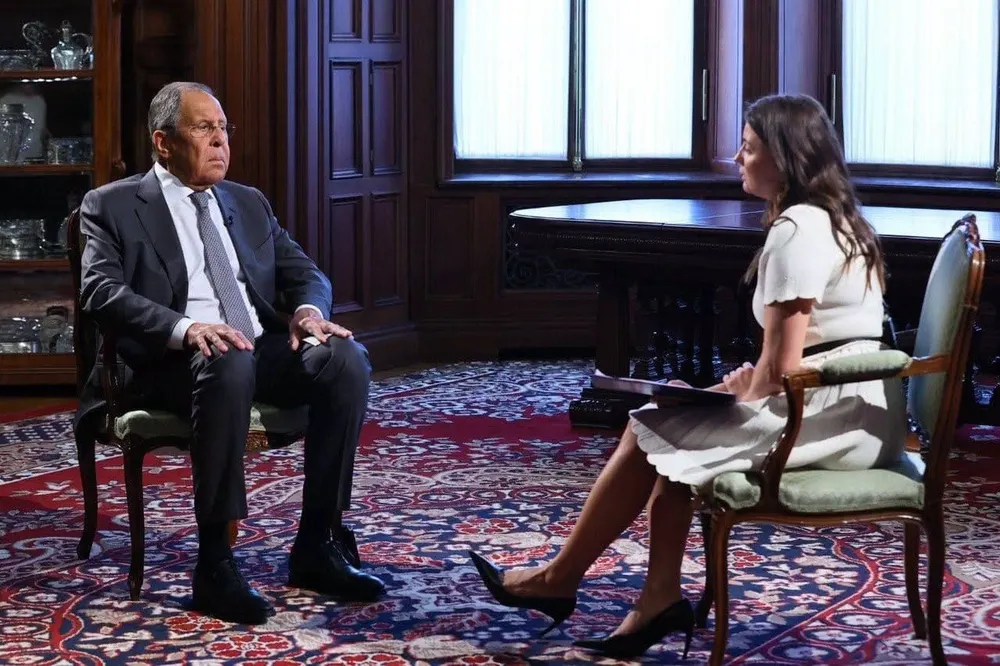
Russian Foreign Minister Sergey Lavrov, interviewed Aug. 13 by VGTRK network, spoke about Russian relations with Japan in the wake of Japanese Prime Minister Takaichi’s pronouncement that Russian President Putin’s visit to the Kuril Islands was “absolutely unacceptable”. Lavrov was asked about Japan’s apparent designation of Russia as its leading enemy. He praised former Japanese PM Abe Shinzo as a statesman, but said that “those who followed him” believe they need to work with the United States in militarizing Japan.
Later, on the subject of the “ceasefire” proposal of Ukraine via Türkiye, regarding Black Sea shipping, Lavrov acknowledged “more voices across our shared space” calling for it, but replied, “But this is not the way things work. You need a lasting, reliable and sustainable settlement to stop…. This is a matter of our responsible attitude towards the millennia-long history of the Russian state.”
Turning to Germany, and the Frankfurter Allgemeine Zeitung journalist who cynically asked Volodymyr Zelensky about “[Europe’s] help in killing more Russians”, Lavrov said that “Nazism has been metastasizing and becoming increasingly apparent in German society under Chancellor Friedrich Merz, who has openly spoken about the need to once again make Germany Europe’s main military force. Does he even understand what the word ‘again’ means in this context?”
The question of Türkiye’s role was raised by the VGTRK interviewer (see separate report for Russian Spokeswoman Zakharova’s formal response). He replied in general terms of Turkish policy: “Türkiye aspires to be both a NATO member with the largest army in the bloc and to maintain relations with the European Union, though it is acutely aware that it will never be admitted to the EU. It also seeks to foster strong relations with Russia, given our many joint economic projects and shared history: the Caucasus and the Black Sea. Türkiye is genuinely committed to ensuring that the Black Sea remains stable.”