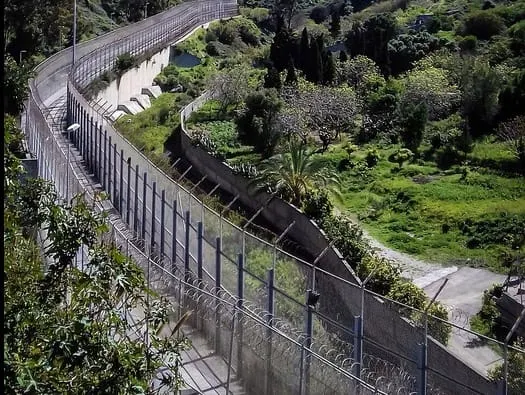
The question of how 60,000 people crossed one of the most fortified borders in Europe in a single day has eyewitness answers. Migrants interviewed by the New York Times described learning through social media on the morning of July 30 that the Ceuta border was open and unguarded. One of them, Mohammed Ahmido, said Moroccan police officers stationed at the crossing urged the crowds forward, telling them to “come to Spain.” Another, 24-year-old Ayoub al-Arout, drew the lesson from experience: “They opened the border and let everyone go by. When there are political problems, Morocco opens the doors and tells us to go.”
The floodgate has been opened before, and its closure comes with a price tag. In May 2021, Moroccan border controls relaxed and more than 10,000 people poured into Ceuta in two days—retaliation, as was widely reported, for Spain’s decision to give hospital care to Polisario Front leader Brahim Ghali. The migrants themselves were mostly back across the border within days—but the surge was one move in a diplomatic rupture during which Morocco kept its ambassador out of Madrid for ten months. The rupture ended only in March 2022, when Prime Minister Pedro Sánchez abandoned Spain’s decades-old support for a UN referendum in Western Sahara, writing to King Mohammed VI that Morocco’s autonomy plan was “the most serious, realistic and credible basis” for a settlement. Morocco’s ambassador returned to Madrid within days of the letter, and the two governments sealed the new terms in an April 2022 joint declaration.
Rabat denies everything. Ambassador Karima Benyaich said the events were “not wanted by the Kingdom of Morocco,” and Moroccan forces did later fire tear gas and water cannon to stop further crossings, cooperating as 48,300 people returned within a day. Madrid, for its part, has not formally accused Rabat; Sánchez blames trafficking networks that exploited a June 29 Supreme Court ruling barring summary returns of migrants arriving by sea—a misreading of which, he said, “spread like wildfire.” But note what each explanation covers. The court ruling explains why tens of thousands of desperate young people came to the fence. It does not explain why the fence stood open, or why the officers assigned to guard it said to “come to Spain.” Those are two different questions. Here we focus on the second.
European press point to a proximate irritant: Sánchez traveled to Algiers in July to sign a cooperation agreement with President Tebboune of Algeria—Morocco’s bitter rival and the Polisario’s patron. No connection has been confirmed.
But the fuse matters less than the building of the bomb. Morocco does not act alone; it acts inside the Washington-Jerusalem-Rabat triangle constructed by the Abraham Accords, in which recognition of Moroccan territorial claims has been the standing currency since Trump recognized Moroccan sovereignty over Western Sahara in December 2020, as the price of Rabat’s normalization with Israel. Israel has paid in the same coin: Netanyahu recognized Moroccan sovereignty over Western Sahara in a July 2023 letter to King Mohammed VI, offering to open a consulate in Dakhla and register the recognition at the UN, and his office reaffirmed the position in 2024.
The campaign to extend that recognition to Ceuta and Melilla is equally documented. Michael Rubin of the American Enterprise Institute demanded March 12 that Washington recognize the enclaves as “occupied Moroccan territory”, then on March 16 urged Morocco to send a mass of unarmed civilians across the border—the very species of event that materialized in July. Congressman Mario Díaz-Balart told El Español on April 1 that the enclaves “are not Spain.” On April 30, the House Appropriations Committee reported that the “Spanish-administered cities of Ceuta and Melilla are located in Moroccan territory"—at page 88 of the report accompanying H.R. 8595, the same bill that funds the Iran war. And Israel’s part was prescribed in print: Amine Ayoub’s April 25 Ynet article, “Abraham Accords Reach the Strait: How Israel Can Help Morocco Reclaim Its North,” urged Israel to amplify Rabat’s claim through “Washington corridors where Israel’s influence is considerable” and to hammer Spain’s “glaring hypocrisy” in international forums—precisely what Israel’s UN Ambassador Danny Danon did on July 31. Ayoub closed by calling Morocco the partner that, “across the Strait of Gibraltar, holds the key to one of the world’s most vital maritime chokepoints.”
Sixty thousand human beings were used as pressure against the western door of the Mediterranean, while its eastern doors—Hormuz and Bab al-Mandeb—are already largely closed by war. In 2021, the price tag for stemming the flow was Western Sahara policy. The bill being drawn up now, on the evidence documented here, is the enclaves and the strait they overlook.