
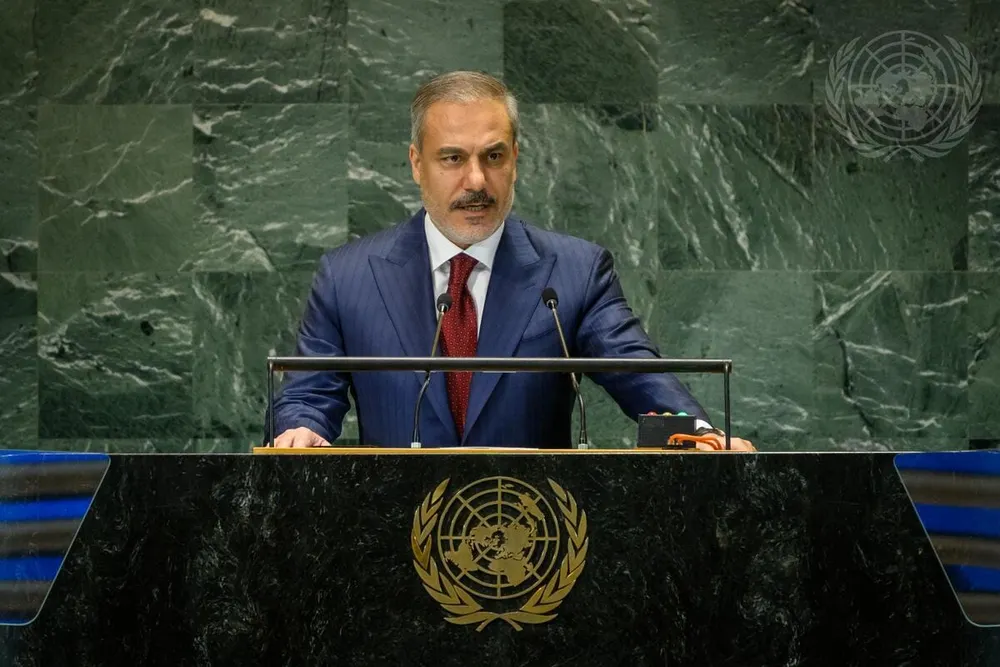
Turkish Foreign Minister Hakan Fidan, speaking to Anadolu Agency on Aug. 9 about the recent Türkiye-Saudi Arabia-Pakistan defense pact, said that the pact identifies no country, including Iran, as a common threat. Rather, it is “the most important step toward bringing lasting stability” to a region that has experienced a century of instability since the end of the Ottoman Empire. Further, Saudi Arabia, Pakistan. and Türkiye “are not countries that have expansionist policies. They are countries concerned with their own borders, their own problems and their development, and, if possible, they want to contribute positively to their environment through good relations and good neighborliness,” he said.
However, the language Fidan chose to use, suggests that the agreement may be a step away from the failed U.S.-led framework for Southwest Asia of recent decades, and toward one that elevates the sovereignty and cooperation of regional nations. “External hegemons coming into the region do not solve the problems; they make them more acute, and the cost becomes very high,” he said, arguing that regional countries should develop more institutional mechanisms through which they can ensure their own security, economic stability, development, and prosperity.
Fidan said Türkiye has strong relations with almost all countries in the region, but that many of those ties had been shaped by prevailing circumstances, political perceptions. and temporary understandings. He spoke about the need for more structural and sustained relations. Lasting economic structures, he said, require security and mutual trust. Fidan cited the European Economic Community, saying that Türkiye seeks to reduce or at least halt instability and eventually foster greater economic and social integration, improving the prosperity of regional populations, reported Anadolu.
“Because we do not approach this with a hegemonic mindset, we need to build this together with the countries of the region,” Fidan said. He referenced the recent agreement between Armenia and Azerbaijan, and noted that Türkiye has a similar “security and economic architecture perspective in mind” for West Asia. Asked whether a similar architecture can be developed in the region, Fidan replied: “These can be built when necessary. At times, there may be a greater need for economic cooperation. But as you know, the Middle East’s biggest problem right now is mutual wars, insecurity, and conflicts, so we need to start with a security architecture. There is also a search for a security architecture in Europe.”
Fidan also said the pact should not remain limited to three countries and that a number of states have already expressed interest in joining.
These remarks underscore the vital importance of Helga Zepp-LaRouche’s call for a new security and development architecture, and in particular that of the LaRouche Oasis Plan for the massive economic development of Southwest Asia to underpin any discussions of peace.