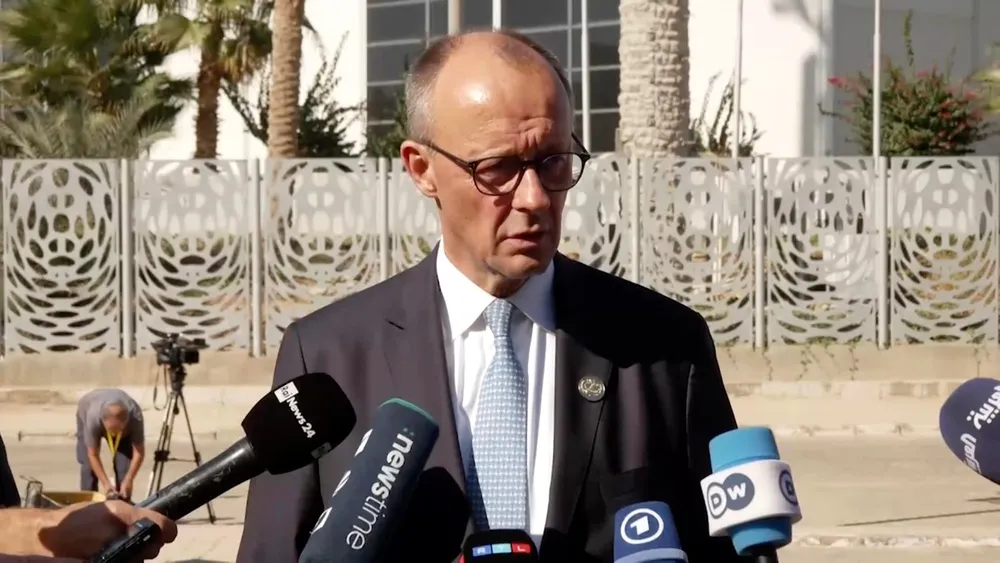
The opinion of much of the Christian Democrat’s political base and many of their leaders is indisputable: Merz and his government are to blame for the disastrous CDU election results in the state parliament elections in Saxony-Anhalt (Sept.6) and in Mecklenburg-Prepomerania (Sept.6)—particularly in the latter where the party lost all seats in the state parliament. If the CDU/CSU were Blackrock, Merz would have been replaced already before these elections, but capitalizing on the fact that no other CDU/CSU leader has so far stepped out to be a candidate to replace him, Merz said on Sunday he wants to stay as Chancellor, calling on party members and voters to be “patient.”
If Merz remains, the situation will only worsen, and no one will stay patient. A substantial number of voters dropped their patience on Sunday and caused an electoral earthquake—giving the AfD more than 38% and the Linke more than 25%. This is more than doubling the vote for the two parties compared to recent elections.
Already before the Sunday election, discussions were in progress in the CDU for a possible replacement of Merz, but it is rumored that none of those that came under consideration volunteered—the present geopolitical situation is said to make the job of Chancellor unattractive. No visible alternative? The name of past Chancellor Angela Merkel has repeatedly come up, though not in recent days–naming her is also an indicator of the CDU’s lack of viable candidates.
It cannot, however, replace an in-depth discussion about a change of party program and decisions on how to get Germany out of this profound crisis—strategically and economically. If Germany does not stop provoking Russia and make a step towards the New paradigm, there is little hope. In Berlin, the election winner Linke will likely find partners for a coalition government; in Mecklenburg-Prepomerania (MVP) none of the other parties wants to talk to the election winner AfD, which will have no partners for a coalition.
Maybe in MVP, politicians will remember that their state once welcomed the New Silk Road, with the prospect of Baltic Sea Ports infrastructure investments, and of Nord Stream – with its terminus in MVP – with similar prospects. More than 38% of the voters there voted for the AfD, which has repeatedly urged the repair of the pipeline and a resumption of natural gas from Russia. Merz and his coalition with the SPD have again and again rejected that. This has to change.