Russian Foreign Minister Sergey Lavrov emphasized today, in two different settings, that the key element that distinguishes Washington from Europe is that one critical element of reality, the willingness to face root causes. First, the Foreign Ministry posted today his answer to a question from Andrew Napolitano on “The Great Game” show: “What I want to emphasize is that the realities on the ground, which U.S. President Donald Trump and his team, as far as we can tell, continue to recognize—as they did in Alaska—concern the people and the views they expressed in referendums. This applies to Crimea, the Donetsk and Lugansk people’s republics and, of course, the Zaporozhye and Kherson regions. The fact that the Americans base their approach on these realities in all their contacts with us, particularly in their discussions with President Vladimir Putin, is something that we naturally view positively and that makes us willing to continue our dialogue with them. They recognize these fundamental principles and are trying to help find solutions based on them. I believe this approach deserves support.”
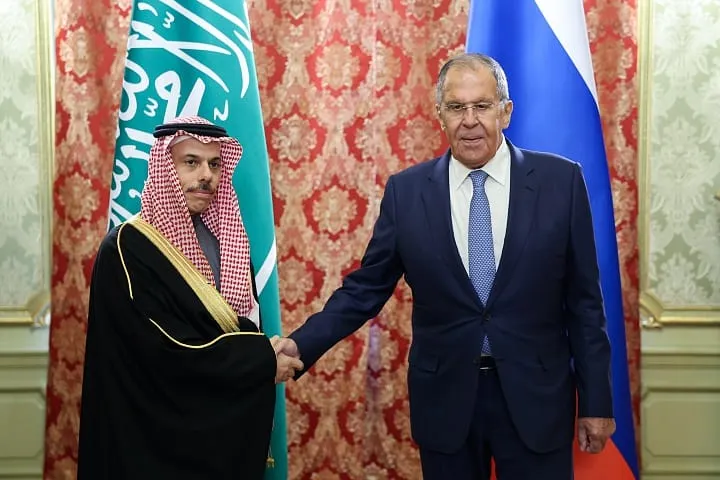
In a second Foreign Ministry posting today, where Lavrov and his guest, Saudi Foreign Minister Faisal bin Farhan Al Saud, held a joint press conference, he explained that negotiations must be held “on the basis of an understanding of the root causes and on the basis of reaching agreement regarding the elimination of the root causes of the current Ukrainian crisis, which was manufactured by the West, primarily by the previous US administration, the European Union, and NATO members, that continue to endeavor, as they themselves state, to secure Russia’s defeat and to support Ukraine in every conceivable way. From the outset, Donald Trump’s administration both desired and was able to discern the root causes of the conflict.” However, “it is the European Union that continues to do everything to prevent the situation from shifting into the framework of examining the root causes and thus moving towards a reliable, long-term settlement based on the elimination of those root causes.”
Otherwise, Lavrov went into more detail with Napolitano: “The substance of the discussions is based—and I can say this with confidence—on the position that President Donald Trump set out on the Ukraine issue immediately after returning to the Oval Office. First, he said that any attempt to draw Ukraine into the North Atlantic Alliance should be abandoned...
“The second element of the US position is the need to recognize the realities on the ground. And I want to emphasize that this is not about territory... When we talk about the realities on the ground, we are talking about people who, immediately after the February 2014 coup, were labelled ‘subhuman,’ ‘creatures,’ and terrorists. When they refused to accept the outcome of an illegal coup, the army, fighter jets, and artillery were deployed against them, in flagrant violation of international humanitarian law. Those were people who were simply not regarded as humans.” So, when the Europeans call for “the restoration of the 1991 borders..., do they want to punish these people for seeking to preserve their freedom, their culture, and their sense of belonging to the Russian world?”