
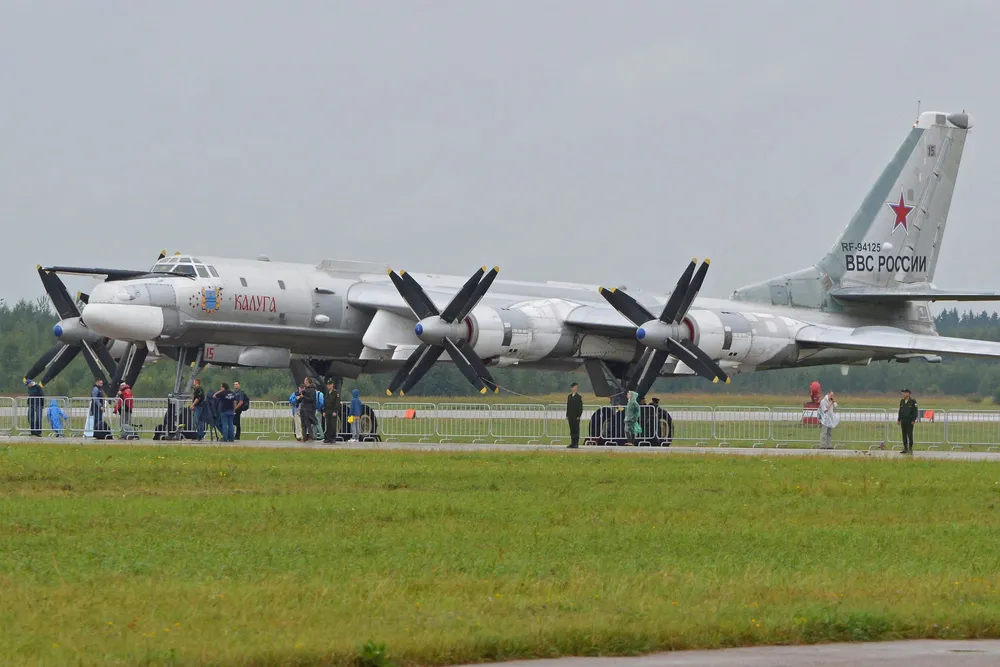
As Ukraine continues to escalate its drone campaign against targets deep inside Russia, one stands out as particularly dangerous: the attacks on Russia’s Tu-95 strategic bombers at the Engels airfield near Saratov on the Volga River. This is exactly what the London Telegraph hones in on in a Sep. 9 article under the title, “Ukraine is quietly destroying Russia’s irreplaceable bombers.” The Telegraph goes on to quote Justin Bronk, a senior research fellow for Airpower and Technology at the Royal United Services Institute (RUSI): “They’re part of Russia’s nuclear triad… Destroying one, especially at its home base, is a politically poignant thing to do.” Russia has, so far, not confirmed these reports of damage to its bombers.
The Telegraph adds that the Tu-95’s “place in Russia’s nuclear triad gives the ageing bombers a strategic weight far beyond their Cold War-era design.” It goes on to describe how Ukraine successfully evaded Russian air defenses to attack these strategic targets at the Engels airbase, although leaving out that this was all done with the help of Western intelligence agencies and defense contractors, such as Silicon Valley’s Palantir. “This summer, a specialized long-range strike unit within Ukraine’s SBU service carried out both strikes. The drone’s journey was engineered by hours of intelligence work mapping exactly where Russia’s defenses thinned out.”
Although these planes are often used as platforms for missile strikes against targets in Ukraine, the Telegraph welcomes their destruction above all because it would hamper Russia’s ability to carry out “massed, near-simultaneous strikes” against targets in Europe. But the scenario of an unprovoked Russian attack on Europe is a false construct. What the article covers up, is the greater strategic implication, which the Engels attacks share with the long-distance drone attacks on early warning radars in May 2024 and the Operation Spiderweb drone attacks on Tu-95 and other strategic bombers a year later. These attacks on the Russian nuclear triad fall under the Russian State Policy on Nuclear Deterrence, which allows for the use of nuclear weapons in the event of an attack on Russia’s deterrent—its ability to retaliate against a nuclear first strike by an adversary