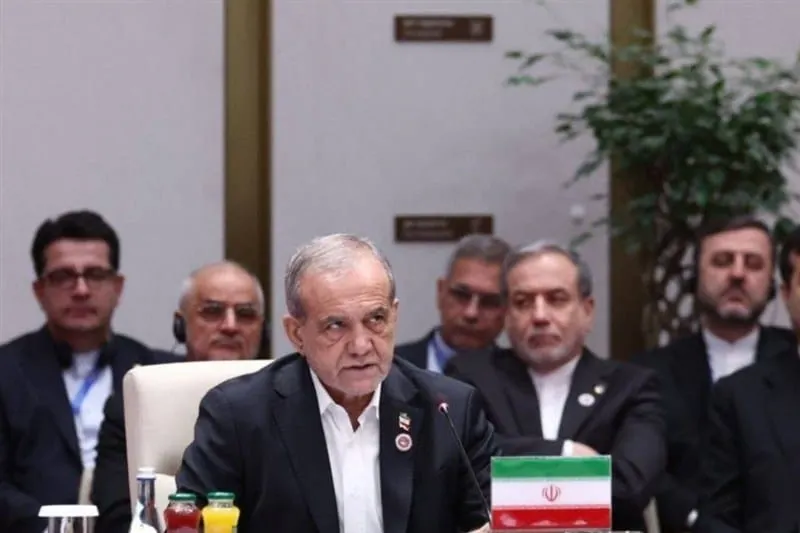
Iran’s President Masoud Pezeshkian was officially cited as presenting several initiatives at the Shanghai Cooperation Organization (SCO) Summit in Bishkek, Kyrgyzstan, which ended Sept. 1, at which he was anything but an “economic outcast.” According to Iran’s Presidential site, “The president presented three Iranian initiatives: deeper financial and banking cooperation, including greater use of national currencies and eventually establishing an SCO bank; creation of an SCO export and investment insurance union; and establishment of an SCO Energy Consortium to strengthen energy security and cooperation in production, supply, transit and consumption.”
But although plans for the SCO Bank were reported by the Sept. 1 Times of Central Asia to have made progress, no final declaration on the Bank was adopted, as Kyrgyz President Sadyr Japarov urged the member nations to do; nor was the general use of national currencies for trade adopted. A Russian expert had written on the eve of the summit that Russia remained the only SCO member nation which has virtually eliminated reference to the dollar in its trade. In addition to Japarov, Kazakhstan’s President Kassym-Jomart Tokayev also proposed that his country host the bank and that it concentrate on credit for development of infrastructure, technology, and industry.
Russian President Vladimir Putin, in his address to the summit, said, “The SCO Business Council and Interbank Consortium make a significant contribution to the implementation of joint, mutually beneficial economic projects. In the future, the Development Bank being established within our organization could also join this work. In my opinion, it should be as independent as possible from the financial systems of those countries that use economic instruments as a weapon to gain unilateral advantage in international affairs.”
Transportation infrastructure was a focus of the Bishkek Declaration summarizing the summit, and seemed to be a major area of progress. The bilateral meeting between Japarov and China’s President Xi Jinping called the $5 billion China-Kyrgyzstan-Uzbekistan Railway, begun last year, the center of their nations’ relationship.
The strongest language in the Bishkek Declaration was, ironically for Washington, in defense of Iran. It condemned military strikes on the country, supported Iranian sovereignty, condoled the death of Iran’s Supreme Leader Ali Khamenei, and—importantly for the “economic outcast”— opposed “unilateral coercive measures that conflict with the UN Charter and International Law.”