Aug. 27—Diane Sare, independent candidate for President of the United States, spent an extraordinary week touring Iowa in August, not only attending the Iowa State Fair, a major event in the Farm Belt, but visiting many towns, and 10 counties in the central and eastern parts of the state. She had in-depth, nearly non-stop discussions with leaders in networks of farmers, veterans, civil rights activists, health care providers, musicians, local government officials, and other circles.
Sare described her purpose in coming to Iowa in a lengthy interview she granted in Des Moines, published in Black Iowa News Aug. 23, conducted by its founder and publisher, Dana James. “What do you want voters in Iowa to know,” James asked. Sare began, “I’d like to say the situation is much worse than people imagine. We are very close to a nuclear war.”
After explaining that carefully, Sare went on, “The other area where it’s far worse than people think is the economy. This [financial] bubble is going to crash, and we can all think it would be nice to be rich, but the billionaires are really panicked, which is part of the reason for fueling more war.” Sare focused on the solutions as well, from urgent intervention against the war drive internationally, to what must be done for the economy of this country, our hemisphere, and globally.
Sare’s website will soon have state pages, with key updates on what needs to be done in each state, and how her program for North American and world development will address this. “I think Iowa is a really important part of the nation, and I think we have to address some of the problems Iowa is facing.”
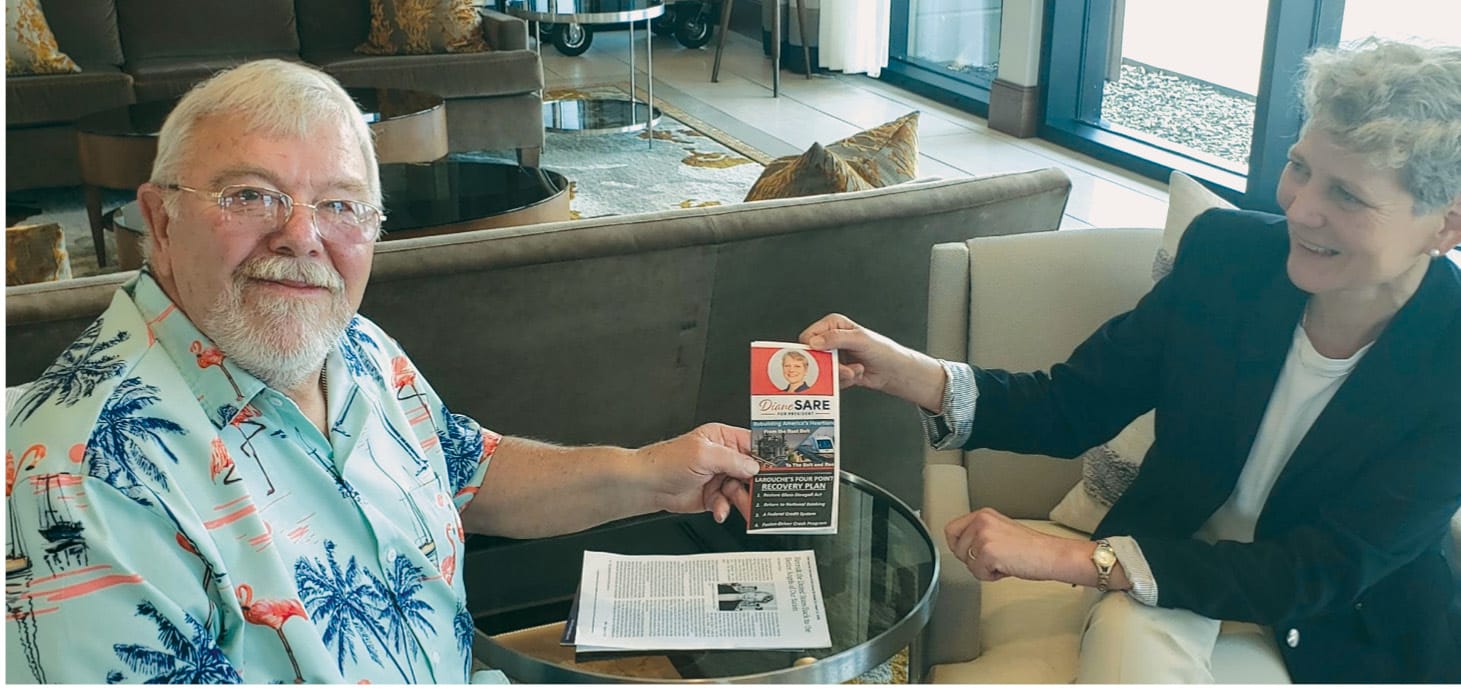
The Sare hand-out brochure in Iowa features on its front panel “LaRouche’s Four Point Recovery Plan: 1) Restore Glass-Steagall Act; 2) Return to National Banking; 3) A Federal Credit System; 4) Fusion-Driver Crash Program.”
Iowa State Fair
In contrast, other political figures did a fly-by to the Iowa State Fair, and several of the messages to the public were grim. Self-styled Secretary of War Pete Hegseth flew in for a few hours Aug. 14, to pump his $1.5 billion defense budget proposal while campaigning for U.S. Rep. Zach Nunn, running to retain his office (C.D. 3). Dozens of state and local candidates made appearances.
Iowa has been traditionally a must-visit location for aspiring national candidates, having been first in the nation for caucuses in the presidential primary and caucuses season for decades. It still carries significance, although the Democratic Party just designated South Carolina to be first in 2028. But the numbers show the Fair’s reach. The number of attendees at the Fair this year, Aug. 11-23, rose to 1.16 million, the largest ever, 80% of whom are residents in the state, whose population is only 3.25 million.
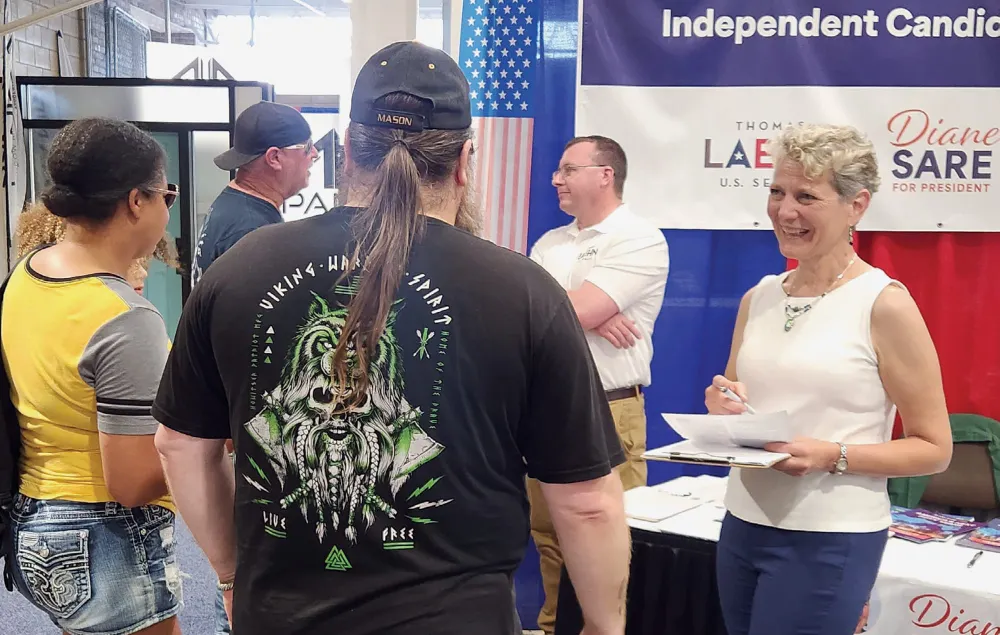
Sare not only visited the Fair, talking to people and seeing its extensive exhibits, livestock, machinery, and other features, and participating in the pork-burger flipping tradition, but she met with visitors at a day-long booth, with two other independent candidates running in Iowa, as a “Coalition of Independents.” The lead banner of the Coalition booth read, “Stop War, End the Uniparty Dictatorship! Independents for Peace,” and thousands received the Sare campaign programmatic brochure.
Farm State Turmoil
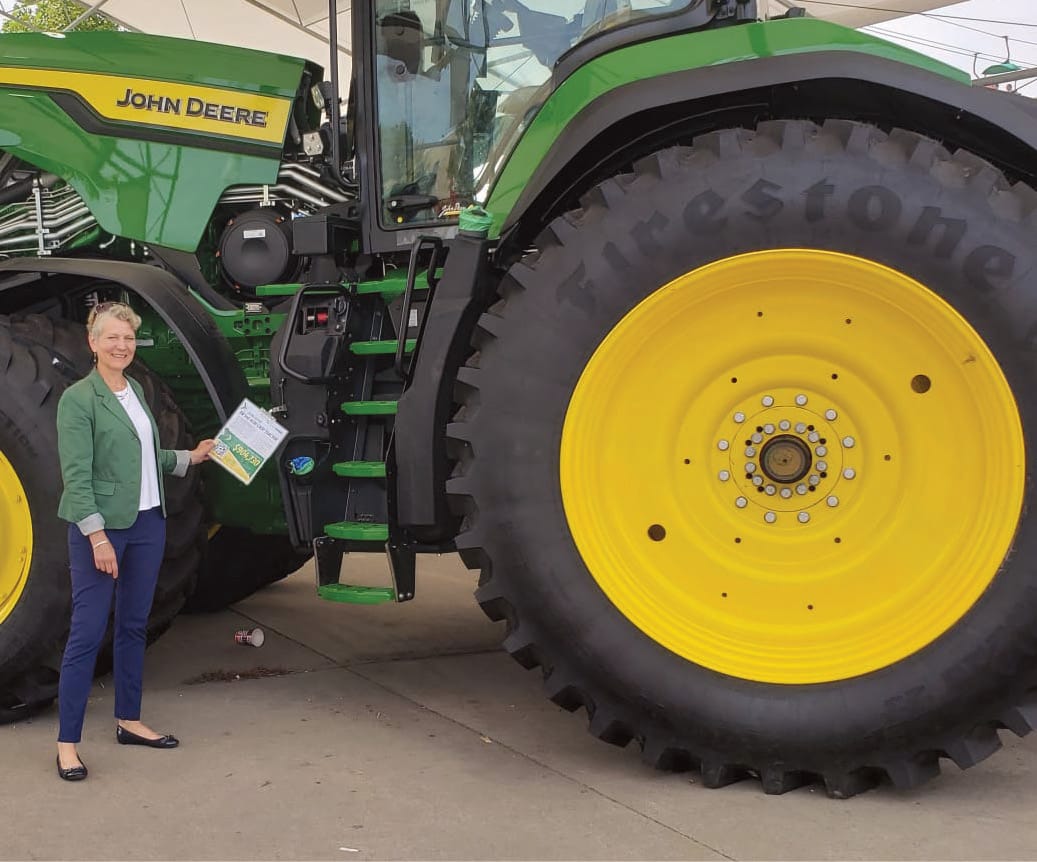
Sare had on-the-farm briefings on cattle, hogs, crops, water, shipping, meat packing, and other fundamentals of Iowa’s economy. The state ranks first in the nation for the share of its land area under active agriculture production—some 85%. It is first in the United States for the volume of production of corn, pork, and eggs, and second in soybean production. It is seventh for cattle; it ranks first in corn ethanol and biodiesel. Iowa is also home to industry, boasting much of the manufacturing of John Deere, the company headquartered in Moline, Illinois, one of the Quad Cities—two in Illinois, two in Iowa.
All of these sectors are in turmoil, from the shock-impacts of the U.S.-Israeli war on Iran, and from the pre-existing dominance of “Big Ag/Big Food”—the agro-financial complex of monopolies (from JBS to Walmart, et al.) and banksters—imposing trade and production distortions in the U.S. Farm Belt. They are suppressing family-farm agriculture throughout all nations in the West, which otherwise could end hunger everywhere. Fertilizer and diesel costs are soaring, while the Big Four meatpacker monopolies are shutting down facilities. John Deere, and its supplier companies, are cutting production.
Even basic utilities, health care and services have been lowered in the state. Iowa and Kansas lead the nation in the share of electricity coming from intermittent wind and solar power, at over 50%. Iowa’s Duane Arnold Energy Center nuclear power plant in Iowa City, which was decommissioned in 2020, is now being restored—but for use by a data center.
The rail grid in the state is minimal, even though Iowa was the eastern starting place for Lincoln’s Transcontinental Railway. Only a single Amtrak passenger line runs east-west across southern Iowa, despite the state’s favorable central location in the nation and continent. It is one of 14 states through which the coast-to-coast Lincoln Highway runs, opened in 1919.
Over the past 20 years, Iowa has lost 170 rural hospitals. Over half of its remaining rural hospitals operate in the red, and there is a shortage of health care workers of all kinds. In just the past two years alone, 2,000 nursing home beds have vanished. While the University of Iowa medical complex and certain other centers are first-rate, institutions of learning are under financial pressure.
Food itself in this farm state is an issue for an estimated 35% of all households, whose income is not enough to cover all basics. The Des Moines–headquartered Food Bank of Iowa estimates that 385,000 people face food insecurity in the state, and that over 15% of children don’t have enough to eat.
A particular concern in Iowa is the relatively high rate of cancer, ranking the state second in the nation, and one of the few where the cancer rate is rising. Getting this out of politics and opinion, into the realm of a full, medical-scientific investigation, remedy for the cause, and full care for everyone, is a priority. A big question mark is: What health impact has come from the monoculture imposed on the Farm Belt by the Wall St.–City of London complex?
What is Washington offering Iowa? Funds for military buildup. In Southeast Iowa, expansion is underway at Burlington, near the existing Iowa Army Ammunition Plant (IAAAP), on the Future Artillery Complex, with a reported intent to produce up to 36,000 rounds of ammo per month.
Sare Presents Solutions
During the Iowa Fair month came new shocking announcements. On Aug. 13 Tyson Foods (one of the Big Four monopolies accounting for 85% of all U.S. beef processing) suddenly shut down its Quad Cities–area beef-packing operation, leaving cattle producers faced with hauling stock hundreds of miles to find a plant, and 2,500 workers jobless. On Aug. 21, U.S.-Canada trade talks collapsed, adding more uncertainty to the already destructive, rigged “free trade” system in place since the 1990s. Plus, the President Donald Trump Administration announced Operation Economic Outcast on Aug. 24, which, while aimed at Iran, will boomerang against the U.S. economy and interests.
Sare got an earful from the locals on all this, as well as expressions of gratitude for what she is doing, looking to create networks ready to steer a course through these dangerous times, including linking up with farm leaders in other countries facing crises.
Sare explained the purpose of her campaign to provide solution paths now. She outlined in discussions the national, continental, and international collaborative projects for development, for example, the North American Water and Power Alliance, to divert a small fraction of major river run-off going to the Arctic and northern Pacific, southward to the parched southwestern part of the continent. Upgrading the national and hemispheric rail grid must become a priority, she emphasized, as part of a national mission for development.
Further, when the economy is crashing, “I think in a moment like that, someone who’s saying, ‘Hey, we can learn from what Franklin D. Roosevelt did in the Depression, what Abraham Lincoln did during the Civil War,’ there’s an American System of credit, the principle of the general welfare and the Constitution. We have to outline the policies, so that’s something I’m very interested in doing. It’s not just a negative campaign, but saying, ‘Okay, reinstate Glass-Steagall, nationalize the Federal Reserve, build 42,000 miles of high-speed rail. You know, very concrete.” (Black America News, Aug. 23.)
The Henry Wallace Approach
In Des Moines, Sare visited the 1890s home of the Henry Wallace family. Henry A. Wallace, like his father and grandfather before him, contributed greatly to the leadership of the nation, especially in agriculture. He was U.S. Agriculture Secretary (1933-1940), and Vice President (1941-1945) under President Franklin Roosevelt, and the Commerce Secretary. He also co-chaired the Board of Economic Warfare (1941-42), and co-chaired the Manhattan Project (appointed by FDR, because, as the President explained, Wallace was the only scientist in his Cabinet at the time).
Wallace was an expert crop geneticist and specialist in other fields. His older associate and house resident was George Washington Carver, the agriculture expert who was the first black student and black faculty member of Iowa State University, later of Tuskegee. Wallace fostered the founding, in Mexico, of the International Maize and Wheat Improvement Center, the research institute that gave the world the original, transformative Green Revolution. He arranged for Iowa-born Norman Borlaug to work there. Borlaug’s crop yield improvements earned him the title, “Father of Wheat.”
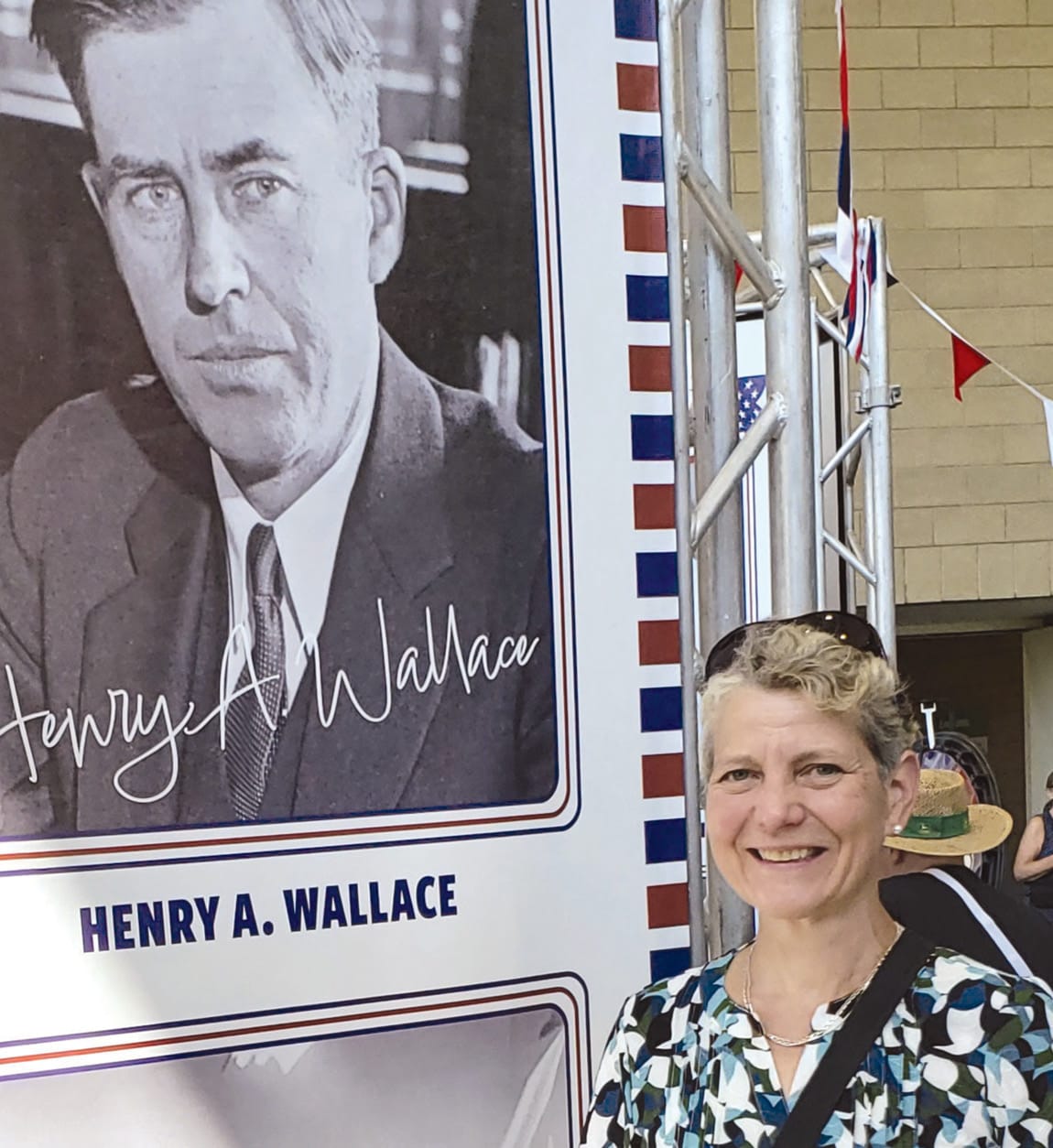
But it was as a proponent of international development and peace that Wallace provided what might be the most important “Iowa legacy of leadership” sorely needed in today’s world. For example, he spoke out for joint campaigns of international infrastructure building after World War II—for “TVA” (Tennessee Valley Authority) approaches with modern technology and full employment, in all river basins of the world, from the smallest—the Jordan River, to the grandest—the Amazon, Congo, and Yellow Rivers.
The Sare Iowa brochure gives a quotation from Wallace’s famous 1942 speech on the right to development, “The Century of the Common Man.” Sare found that many younger Iowans knew nothing about Wallace or their heritage. Her brochure notes, after quoting Wallace, “Sadly, Americans have been robbed of these opportunities [for development] by a handful of billionaire elites. The United States Constitution gives the government the power to break up monopolies and cartels and restore power to the American people. This is what Diane Sare intends to do.”
Iowa Hosted Xi Jinping
Sare made a point of visiting the river city of Muscatine, on the Mississippi, where Chinese President Xi Jinping visited twice, first in 1985, as a regional official in a delegation to see agriculture in the United States, and then in 2012 to visit Iowa friends from the first trip. Groups of Muscatine young people visit China periodically on educational and cultural programs, and the town of Muscatine hosts a visiting Chinese music ensemble concert every year, to the great enjoyment of the area audience. Sare got a first-hand report of the particulars on these activities from one of the Iowan hosts of the Xi Jinping visits.
Chinese tourists enjoy visiting Muscatine because of their captivation by the character and story of Huckleberry Finn on the Mississippi River, and the historical fact that the author, Samuel Clemens (Mark Twain) worked in Muscatine once as a newspaper reporter. Another draw, is that Muscatine was once the world capital for manufacture of pearl buttons, stamped out of the shells of freshwater mussels from the Mississippi River Basin. The town’s nickname is Pearl City.
Sare inspected one of the town’s symbols of the spirit of friendly foreign relations. Next to the Mississippi River stands a concrete ping pong table. It is silently reminiscent of the Ping Pong Diplomacy carried out between Chinese and American players, to which is attributed the 1972 trip to Beijing by President Richard Nixon, and the opening of relations between the two countries. Over the decades since then, many promising openings for win-win trade in agriculture and machinery, collaboration in life sciences, technology, space and other areas in which Iowa figures prominently, have been created, but they have come under repeated geopolitical attack. The mood in Iowa, as across the country, is that now is the reckoning.
Culture, Progress for All
At many points in her travels and talks, which included conferring with a prominent orchestral conductor in the state, Sare, herself a conductor and trombonist, spoke of music. She often raised the example of Antonín Dvořák, the Czech composer, an associate of Johannes Brahms, who figured in working to further music in the United States, and visited and composed music in Iowa. Many Iowans know nothing of this, except for the residents of Spillville, in northeast Iowa, where Dvořák and family members visited in 1893 to enjoy the Bohemian (Czech) community.
In reply to a question from Dana James for Black Iowa News, Sare spoke of culture, economic development, and the rights of all humanity. James asked, “What are you prepared to do differently in your outreach to us, to Black Americans?”
Sare replied:
I’ll tell you one thing that I’ve thought about, not my whole life but since I lived in the District of Columbia for 10 years, and one really important area is culture. Because I didn’t know this history—and one thing, I think, is really important, is for us to know our history.
There was supposed to be an American school of Classical music that Antonín Dvořák, who was in a way a student of Brahms, came here to found; and he went around the country listening, and he said: “The kernel of a great and noble school of American music is the Negro spiritual and the Native American music.” And they had a national conservatory for a few years in the 1890s in New York, funded by a woman named Jeanette Thurber, and that’s where H.T. Burleigh came out of, and Hall Johnson, and a lot of these Black composers; and it was killed because of Jim Crow, etc.
We have a political culture. The ideas of the Declaration of Independence and Constitution, however short our founders fell from those principles, it was true. It is true that every human being is created equal. That is a true principle. We’re supposed to live up to that. We’re supposed to grow into that.
So, we had a potentially great political culture, but we should have a great artistic culture; and I think this thing again, particularly the spirituals, which I consider part of Classical music.
Classical music is one area, and then I just think if we knew the history—we were just at the Henry Wallace House, and of course, George Washington Carver, and people don’t know this history, right? So, I think that’s one very important thing. Because when you say, “Well, of course it’s normal for an African American to be a genius, right?” And again, if the nation has a mission, then we need geniuses.
So, we’re going to want to bring that development in every single person in the nation. So, I think that would be different. I think it’s quite different from anything else I’ve heard.
