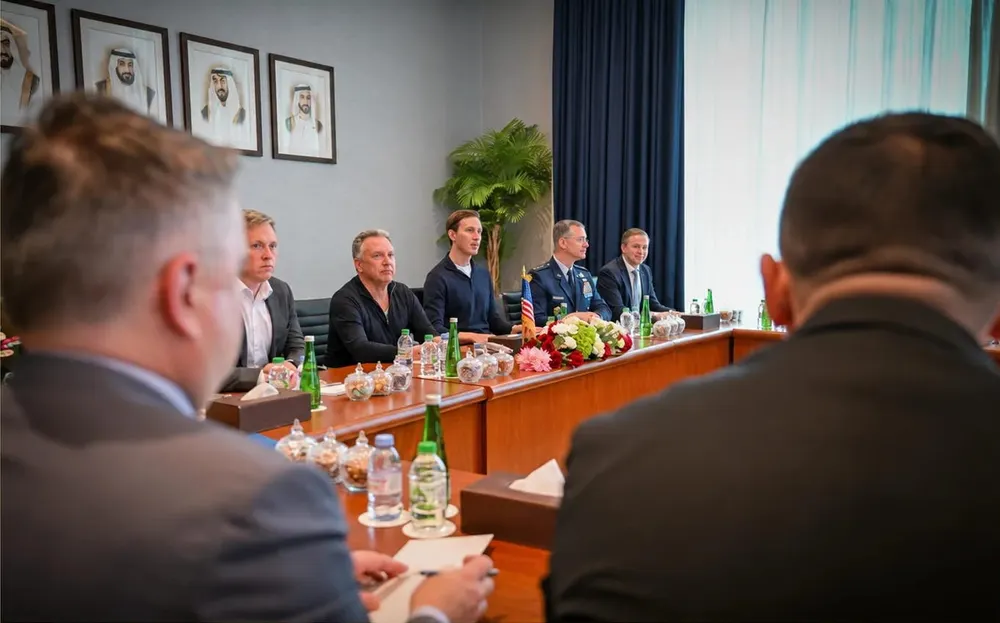
The talks among Russia, Ukraine and the U.S. in Abu Dhabi this week left no doubt about what Russia considers the central question on the table. It is not an end to a conflict or even “security guarantees,” but rather a new security architecture for Europe and Eurasia as a whole which must be established. “Essentially, the whole body is sick, and Ukraine is simply where the abscess burst,” the lead of Russia’s delegation, Vladimir Medinsky, said following the talks on Nov. 11. “A simple band-aid won’t do.”
The two days of talks ended with all sides expressing the sentiment that a certain amount of progress was made. U.S. envoys Jared Kushner and Steve Witkoff will now travel to Moscow to meet with Russian President Vladimir Putin, and then on to Dublin where they will meet with Ukrainian leader Volodymyr Zelensky. Whether or not any real outcome will result from this process, and whether the impressionable American side has the ability to deliver a real agreement, remains to be seen; and the Russians certainly know that they can’t control what other parties will do. However, they have clearly doubled down on the deeper principles far more bluntly than at any time previously, likely well aware of the pitfalls that occurred since the hopeful process initiated in Anchorage, Alaska last year.
Medinsky told reporters that European security had been the “central theme” of the talks, and that Europe needs a new, comprehensive and fair security system that does not come at the expense of individual countries. Russia proposed such changes in 2008 and again in 2021, he noted, and the Ukraine conflict exposed the failure of the entire system. A source in the negotiating team told TASS that the Ukrainian settlement is just one element of a larger discussion, that of “creating a comprehensive and indivisible security architecture for the entire continent.”
The message couldn’t be clearer, and it forces a higher question: What does lasting peace actually look like?
China is taking a similar approach, in particular to the crisis in Southwest Asia. In Tehran on Nov. 8, Chinese special envoy Zhai Jun met with Iranian officials and warned that force cannot solve problems and pledged that China was committed to help “build a new regional security architecture”—a concept China has repeatedly referred to which pairs diplomacy with long-term economic development as a stabilizing force. Zhai continued his diplomatic tour through the Persian Gulf region and met with Oman’s Ambassador-at-Large for Foreign Affairs Sheikh Abdulaziz bin Abdullah Al Hinai on Nov. 10.
Iran is leaning in: Iranian Parliament Speaker Mohammad Bagher Qalibaf wrote on Nov. 10 that China’s role “in ending the war and the situation of ‘neither war nor peace’ is significant.”
Whether Washington will be receptive remains to be seen, but it is beyond obvious that its current policy is at a dead end. On the sidelines of the G7 Foreign Ministers meeting in Paris on Nov. 10, Secretary of State Marco Rubio told reporters that there is “really no need for major combat operations any longer” against Iran, “because the blockade and the economic sanctions are doing devastation to their economy.” Rubio tried to inflate the new policy as a sort of carefully crafted decision rather than the complete and abject failure that the world knows it is. The sanctions will “get more painful as time goes on,” adding that: “eventually you have to eat.”
Not only is this a barbaric policy, but it is incredibly dangerous as well. The U.S.’ new Iron Gate task force aims to block what it considers to be “illegal revenue streams” from flowing across Iran’s land borders and even the Caspian Sea. On Nov. 11, Russian Foreign Ministry spokeswoman Maria Zakharova warned that the area of responsibility of this new policy includes Caspian transport routes, the security of which “is an internal matter for the Caspian Five”—of which Russia is included. “This poses an open threat to the rights and interests of sovereign Caspian states,” she said, adding that the policy is “essentially equivalent to direct military action.”
The world is in upheaval; old assumptions about geopolitical spheres of influence, blocs, and the power of sanctions are failing in plain view—the question is what will replace them. The Russian and Chinese proposals point in the direction of the kind of new architecture that is so clearly needed to get out of this crisis. However, Helga Zepp-LaRouche has put the most far-reaching proposal on the table in her call for a new international security and development architecture for the whole planet. Now is the moment to use it and organize up a storm for a real breakthrough.