As the currently reigning world system—that of geopolitics, war, and Wall Street—disintegrates, and as insanity and injustice seem to tighten their grip over world affairs, the central question is this: Is the concept of the common good, of a community of shared principle for all of mankind, a universal principle? Or just a nice idea? Does humanity’s survival depend on it?
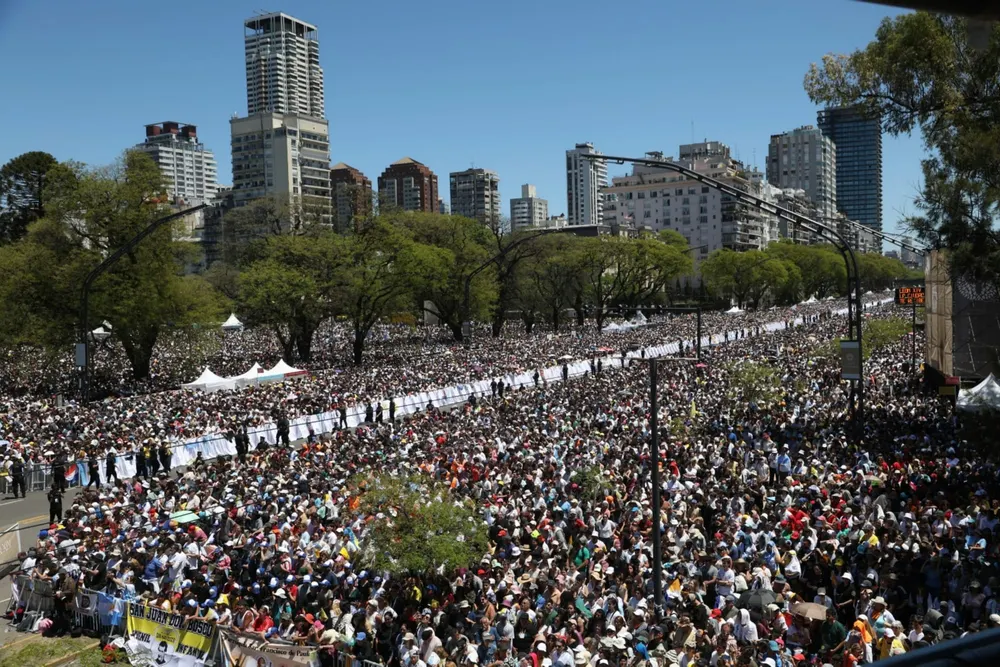
On Tuesday, as meetings were taking place in Abu Dhabi, Paris, and beyond on questions of war or peace, Pope Leo XIV addressed exactly this question to an audience in Buenos Aires and identified the promotion of the universal principles of the common good and the dignity of humanity as the task to be undertaken in a world undergoing profound change.
“The human person is the author, the center and the goal of all economic and social life,” Leo said. “The economy, therefore, must be at the service of the person, and not the person at the service of the economy…. The common good requires us to overcome sterile individualism and corporatist utilitarianism, and to promote a culture of encounter in which economic growth is translated into genuine integral human development.”
The same day, Russian Foreign Minister Sergei Lavrov published an article centered on the same idea and calling out those troglodytes in the West who resist that principle, to the detriment of their own countries: “The objective process of the emergence of a multipolar world order is being met with outright hostility in the West…,” Lavrov wrote.
“In an ideal world,” he said, “the global economy and international security should complement each other and jointly provide a foundation for peaceful coexistence and shared prosperity. Instead, the economy is increasingly becoming an arena of confrontation, with trade wars being unleashed to suppress geopolitical competitors in the wake of hot wars.”
The issue of comprehensive security for all involved was on the table in Abu Dhabi on Nov. 10, as delegations from Russia, Ukraine, and the U.S. met for the first of two days of negotiations. The day before, Lavrov had commented, “I hope that this experience [of the past years and decades] will serve us well in the current negotiations, which are beginning literally this very minute in Abu Dhabi, where, at the proposal of the US side and as agreed with us, issues of ensuring collective security in this region will be discussed under guarantees that will enter into force after a comprehensive settlement is achieved.”
Whether substantial progress along the lines of what Lavrov described will be made at the meeting—into which a self-deployed EU delegation tried to elbow its way —or whether this will go the way of the 2025 Anchorage summit, with agreements not kept, remains to be seen. Not at all inconsequential to that is the possible upcoming trilateral meeting between Presidents Putin, Trump, and Xi at the Nov. 18–19 APEC meeting, at which Trump would be put into direct dialogue with a dynamic of a different kind of world order.
Do not wait for Nov. 18; keep up the pressure in the meantime. A vote in the U.S. Congress on articles of impeachment against Defense Secretary Pete Hegseth failed to move forward, but that’s not the end. A recent statement by independent presidential candidate Diane Sare reads, “‘It’s the war, stupid!’ So said former FBI special agent and 9/11 whistleblower Coleen Rowley at my Sunday night meeting. The American people dealt a powerful rebuke to the Malthusian Epstein-elite in the midterm election, and here’s the part they don’t get: We’re not going back to sleep.”
What is needed is leadership, like Sare’s in the United States, to take the ferment breaking out among the populations of nations all over the West and uplift it to the level of the highest principle. As Friedrich Schiller, the Poet of Freedom whose 267th birthday is today, insisted, mankind is greater than its destiny.
Let us choose to place our hopes on the higher one of humankind, and bend the will of our governments to meet it.