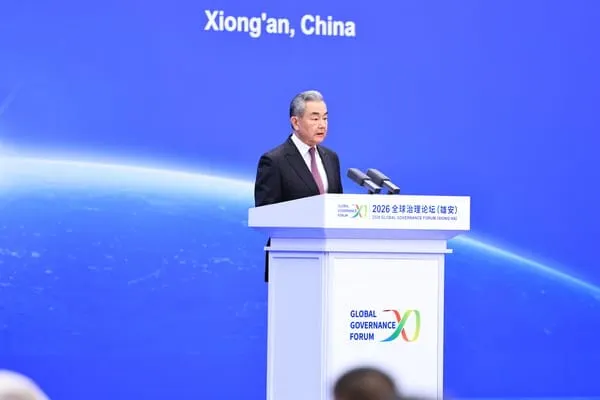
If we are to avoid war and provide hope to all humanity in these critical times, the world must now “put development firmly at the center of the international agenda,” China’s Foreign Minister Wang Yi stated in his keynote address to the Oct. 23-25 first Global Governance Forum, which opened today in Xiong’an, China. The gathering of some 400 international representatives are meeting to discuss “Rebuilding Confidence and Cooperation: A Century of Change and Reforming and Improving Global Governance.”
China will campaign for “the right to development” to be recognized as a basic human right, Wang announced. He expressed optimism, because “The rise of the Global South is the most momentous shift the world has seen since WWII… [because] it reinforces and expands the force for good on the international stage.”
Ensuring the Global South has a greater say in international affairs will not only correct a historical injustice, Wang argued, “but provide a wealth of ideas for improving global governance.”
On Oct. 28, Russian President Vladimir Putin will keynote the two-day Third Russia-Africa summit in Moscow. That same issue, to “put development firmly at the center of the international agenda,” will be the focus there as well.
And it now appears probable that three weeks later, in the course of the Nov. 18-19 APEC summit in China, presidents Xi, Putin and Trump will hold a unique tripartite summit discussion, where the issues of global peace, security and development will be on the table. An enormous breakthrough should not be expected out of that meeting; but it could be the beginning of a new, global dynamic that can start to pull humanity back from the brink.
In his opening remarks to the 177th consecutive weekly meeting of the International Peace Coalition, EIR’s Dennis Small summarized the moment we are facing:
“You know, there are times in human history and developments when the future seems far more certain and foreseeable than the present. And I think we are in that kind of moment today. We seem to be poised between heaven and hell—some would say equidistant, but I don’t think we need to talk about purgatory or limbo or anything like that. But the point is that humanity is facing an option where it is possible to generate a new alternative, a new security and development architecture, with respect for, and to the benefit of, all nations, all peoples; just as we are at razor’s edge of a potential thermonuclear holocaust. And it is this undefined situation which actually characterizes the current very tense, difficult international situation, which calls out for action to determine which path we will be taking.”
Small later referred to the ongoing Chinese Global Governance conference: “The Chinese have made it pretty clear that they’re willing to host such a meeting [of Xi, Putin and Trump]; China itself is now having a series of meetings, including on their Global Governance Initiative. international meetings to strengthen and present their view of what a new global architecture needs to look like.
“And as Helga Zepp-LaRouche has emphasized on repeated occasions, that is the elaborated expression on security and development issues that comes closest to what we in the Schiller Institute and Helga Zepp-LaRouche, in particular, have been actively promoting—Zepp-LaRouche’s Ten Principles specifically—regarding the shape of what a new win-win global security and development architecture must look like.”
Small concluded: “Why do I say that the future is more certain than the present? Well, there are a couple of things we know for sure about the future. Number one: this system is dead. The system is collapsing—has collapsed. They have $2.4 quadrillion in financial assets and it is not going to survive. It is already a dead letter and the majority of the world’s population is moving in another direction. That’s a fact.
“Number two: What is also a fact of the physical universe is that, when a dialogue occurs among parties with different points of view, if that dialogue occurs on the basis of principle, as opposed to pragmatism and momentary changes, if it’s on the basis of principle, one can always find a higher-level solution in the benefit of both sides. This is the Nicholas of Cusa principle, which Helga Zepp-LaRouche has been talking about repeatedly. This has been the basis on which we have appealed to the Pope to call for a meeting of Xi Jinping, Trump, and Putin. And it’s the surety that lies behind the possibility of a Vatican-Russian dialogue leading to something positive, despite their very different points of view, but both based on principle. That’s how the physical universe works: it works the way Nicholas of Cusa said, based on the Coincidence of Opposites…
“Therefore, our role in the IPC is the injection of principles into the discussion around the mass ferment to find the solutions which in fact are in the common interest of all of mankind. The fundamental principle is that the One Humanity comes first. If we start that way, there’s a way out. If we don’t, the answer is indeed going to be hell and not heaven.”