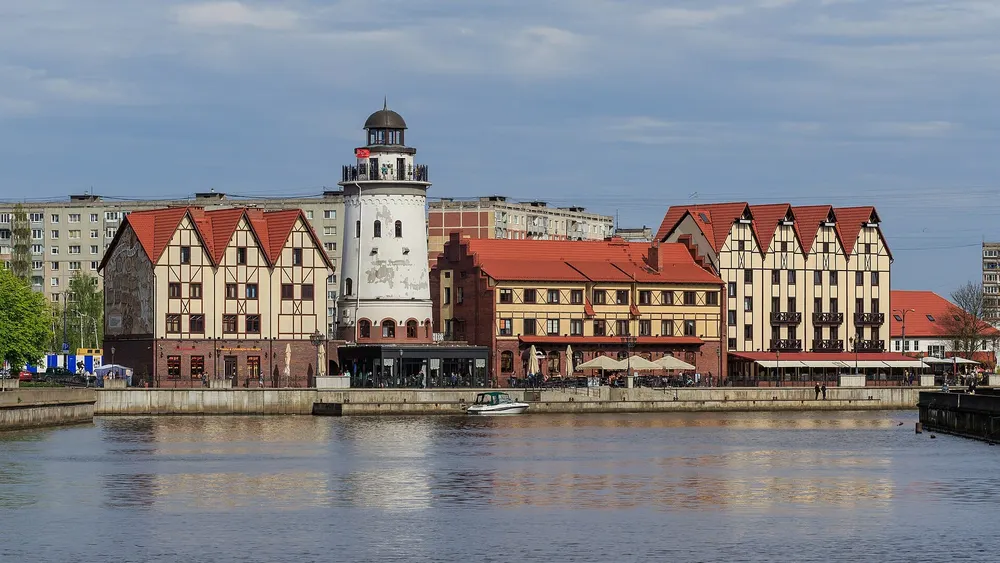
Over the course of the last four days, various representatives of the Russian government issued a series of well-coordinated warnings to those forces in Europe who have been threatening—both in words and in actions—to tighten the noose around the Russian exclave of Kaliningrad, or even to seize it directly. This culminated with President Vladimir Putin’s Oct. 1 comments during his Valdai Club exchange, that, “If it comes to a direct attack on the Russian Federation—in this case, Kaliningrad, although it could potentially involve other territories as well—the question of Russia using all the weapons at its disposal would inevitably and immediately arise. That is inevitable.”
Putin added that none of the official Foreign Ministry comments on the matter “mention the use of nuclear weapons.” However, earlier statements issued by the Russian embassies in the United Kingdom and Ireland were explicit on that point. A chronology with the key quotes follows:
Sept. 29: A statement by the Embassy of Russia in Ireland, dated Sept. 29, 2026, which took note of “the level of real threat to its national security from the West with the marked and substantial increase of NATO and EU military activity along the entire Western border of Russia…. The joint Lithuanian, Polish, French military exercise ‘Gallant Boar 2026’ stands out as specifically aimed at the Russian enclave of Kaliningrad at the coast of the Baltic Sea. There has been information that NATO is preparing [an] air and naval blockade of Kaliningrad and Kaliningrad region….
“As Russia’s Foreign Minister Sergey Lavrov said recently, if the West attacks us, we will respond and it would be a completely different war and a very brief one. There should be no mistake—Russia would be ready to use all its arsenal, including nuclear weapons, to defend its territory if NATO countries try to isolate Kaliningrad region from the rest of the country. Under such a scenario the risk of armed confrontation is high with the likelihood of Russia using preemptive strikes against centers of decision-making in the Alliance countries already at the early stage of the conflict. It is a matter of utmost seriousness and should be treated by Europe as such.”
Sept. 29: In a statement on Telegram posted the same day, the Russian Embassy in London said: “We have noted an article in The i Paper on Kaliningrad, which suggests, among other things, that NATO could blockade the region or ‘de-recognize Russian sovereignty.’ The prospect of a hypothetical strike is also explored in Sky News’ recent mini-series The Wargame…. Those advocating plans to blockade or strike Kaliningrad should have no illusions about the consequences. Any British or NATO military action against Russian territory would be met with a response using all means at Russia’s disposal, including nuclear weapons.”
Sept. 30: Foreign Ministry Spokeswoman Maria Zakharova provided a lengthy answer to a media question regarding the possibility of a nuclear strike on NATO countries in case of an attempt to blockade Kaliningrad: “The Russophobic hysteria of Western revenge-seeking quarters has come to a head…. They have embarked on a path of total militarization…. Alliance members hold aggressive military exercises in direct proximity of our borders, training to implement offensive scenarios against our country, including the potential blockade of the Kaliningrad Region and Russian ports on the Baltic Sea, as well as the dispatch of allied troops via the Suwalki corridor…. Several European leaders have taken the liberty of speaking publicly about their capabilities ‘to raze Russian air defenses and missile bases [in the Kaliningrad Region] to the ground.’ Some EU countries that border on Russia are flaunting their readiness to allow the deployment of nuclear weapons in their territory, and are making appropriate changes to national legislations….
“These functionaries should be brought back to reality. We hope that our warnings will be heard by those they are meant for. As President Vladimir Putin has said, our country does not threaten and doesn’t intend to threaten European countries. However, there should be no doubt whatsoever that Russia has the necessary capabilities for preventing any aggression and inflicting defeat on any aggressor. If Europe attacks Russia, it will be a completely different sort of war—a very short war.”
Oct. 1: In the course of his dialogue with the media at the Valdai Discussion Club, Putin was asked about the matter: “The Foreign Ministry’s statement and the letters that were sent out were entirely justified. If it comes to a direct attack on the Russian Federation—in this case, Kaliningrad, although it could potentially involve other territories as well—the question of Russia using all the weapons at its disposal would inevitably and immediately arise. That is inevitable…. We are not threatening anyone. We are simply stating that we do not have all that many means of defending ourselves. And, incidentally, neither that letter nor the Foreign Ministry’s statement mentions the use of nuclear weapons. They speak, as I have just put it, of employing all the forces and means available to our country. As for how that would actually happen, we will decide that ourselves.”