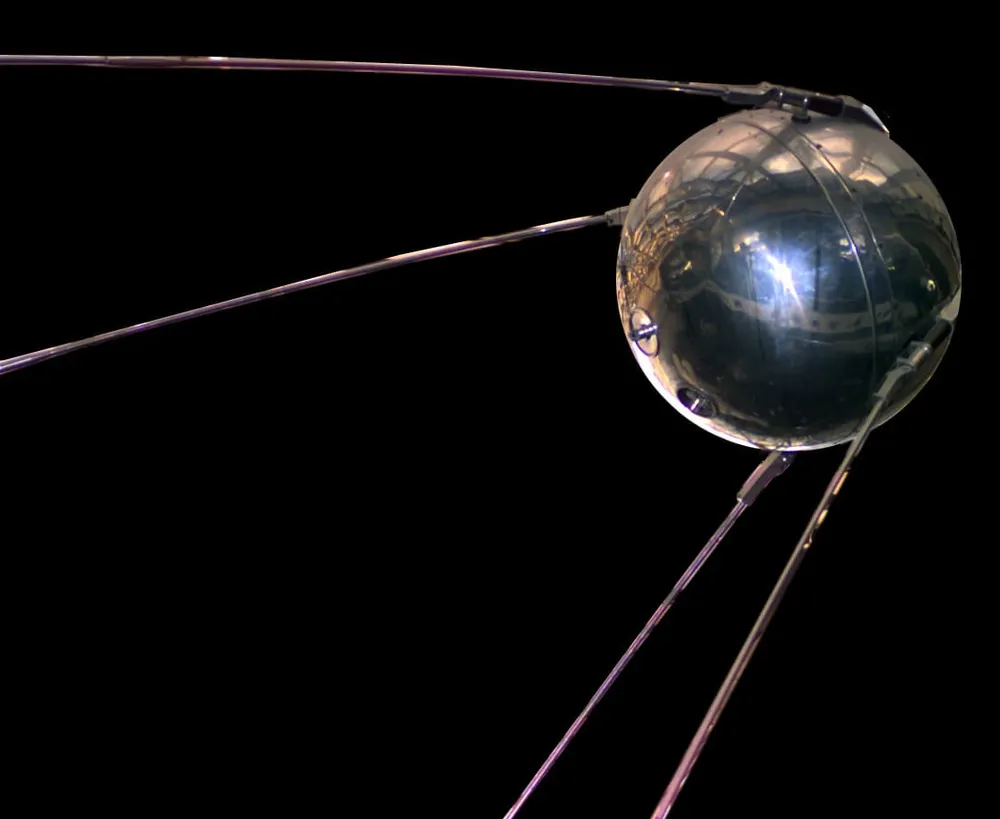
On October 4, 1957, the Soviet Union successfully launched the first artificial satellite, Sputnik 1 (‘traveling companion’ or ‘fellow traveler’, and otherwise the word used for any moon or other natural satellite). This event changed the course of history, and marked the dawn of the current space age.
The polished metal spherical satellite was about 23 inches (58 cm) in diameter, weighing 184 lb (83.6 kg); it sported four long radio antennas to broadcast its signal, which could be picked up by even ham radio operators. In a prominent biography of Dr. James Van Allen, James van Allen: The First Eight Billion Miles by Abigail M. Foerstner, he was quoted as remarking at the time that American scientists understood that the signal was [[designed]] by the then-Soviet scientists to be easily detected—they wanted us to know that it was in orbit. You can listen to the telemetry of Sputnik as it passed overhead here.
It was launched into low Earth orbit, and due to its 65 degree orbital inclination, its flight path eventually covered the entire planet.
On November 7, 1957, President Dwight D. Eisenhower gave a televised and radio address to the American people on the status of America’s national security, and although noting America’s vibrant military capabilities, he also admitted that the US could fall behind. His discussions with leading scientists convinced him that both science education and basic research remained high priorities for a secure future.
He concluded his remarks by emphasizing, “What the world needs today, even more than a giant leap into outer space, is a giant step toward peace. Time and again we have demonstrated our eagerness to take such a step. As a start in this direction, I urge the Soviets now to align themselves with the practical and workable disarmament proposals, approved yesterday by a large majority in the United Nations.
“Never shall we cease to hope and work for the coming of the day when enduring peace will take these military burdens from the back of mankind, and when the scientist can give his full attention, not to human destruction, but to human happiness and fulfillment.”
The U.S. quickly scrambled to build its own first artificial satellite, and on January 31, 1958, the Explorer 1 was successfully launched. The scientists who led the project—Jet Propulsion Laboratory Director William H. Pickering, University of Iowa physicist James Van Allen, and Wernher von Braun of the Army Ballistic Missile Agency—held an unprecedented press conference at 1:00 am at the National Academy of Sciences building on Feb. 1, 1958 announcing the exciting news.
On July 29, 1958, President Eisenhower signed H.R. 12575, the National Aeronautics and Space Act of 1958, creating the framework for the nation’s civilian space program, and NASA was born.

