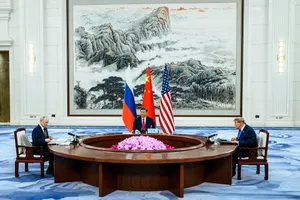
The Nov. 19 summit between the Presidents of China, Russia, and the United States in Shenzhen proposed to “jointly explore constructing a new type of major-country relations in an era of multipolarity,” China’s Global Times argued in its Friday editorial. Concretely, “Can major countries move beyond the narrative of competition and achieve constructive interactions? This is a question that China, Russia and the US must answer.”
Confrontation is not inevitable, despite the different national conditions of each of the three countries, the editorial asserts. “By communicating in advance, considering issues from one another’s perspectives and acting with caution on major sensitive matters involving each other’s interests, particularly by refraining from crossing each other’s red lines, major powers can indeed avoid the `Thucydides Trap.’”
The “Thucydides Trap is the metaphor used today for the geopolitical ideology that the rise of one country inevitably leads to conflict with the prevailing power.
“Looking back at the evolution of the international order, humanity has taken many wrong turns in the management of major-country relations,” as seen, for example, the last century’s two world wars, the editorial reminds. The agenda of the meeting ("a landmark event in major-country diplomacy with Chinese characteristics") was how to safeguard world peace, which requires stability between major countries, since “peace among major countries brings stability to the world, while their contention would only lead to chaos.”