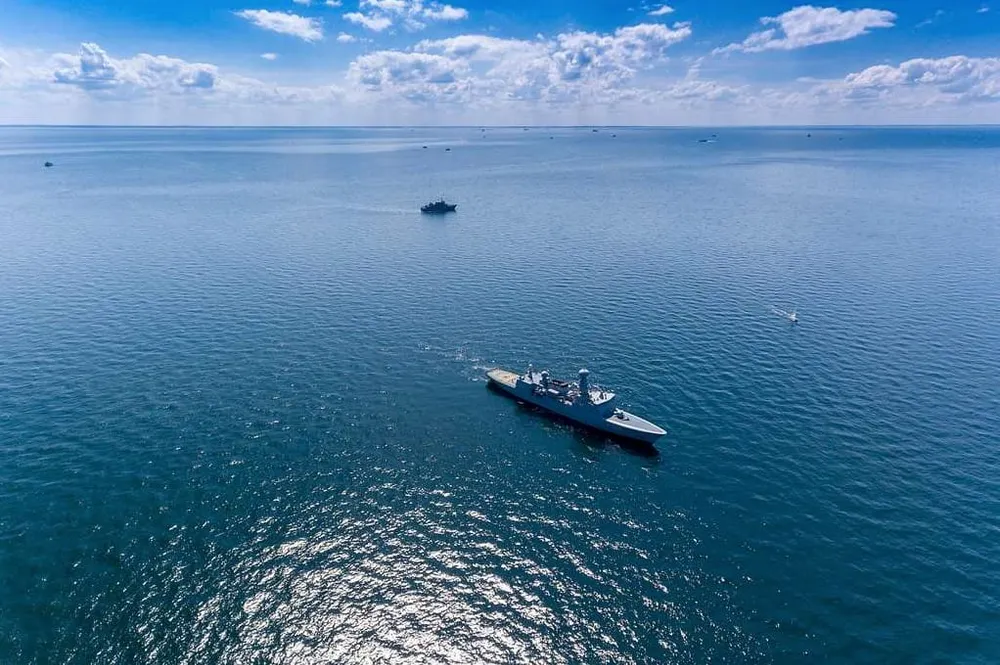
When Finnish President Alexander Stubb and Norwegian Prime Minister Jonas Gahr Støre called Russian President Vladimir Putin last month, their ostensible mission was to talk about ending the war in Ukraine. According to an account in The Wall Street Journal on Nov. 25, they also had the additional task of preventing a NATO-Russia clash in the Baltic Sea.
“The Baltic Sea had become one of the world’s most dangerous potential flashpoints between Moscow and the West, and the two leaders wanted to ease tensions by reassuring Putin they had no intention of cutting off a vital shipping route for Moscow,” the Journal reported, citing unnamed sources. “Russia ships more than 60% of its seaborne oil through the Baltic Sea, providing a lifeline for its wartime economy. But the sea is surrounded by North Atlantic Treaty Organization members. The potential for conflict was highlighted in recent days by a Ukrainian drone attack on a Russian cargo ship near Finland. Coordination between Finnish and Russian authorities to rescue and recover the ship helped prevent the situation from escalating.”
The Journal goes on to report that Moscow took a number of “alarming” steps in recent months which signaled its fears about a potential blockade, including escorting Russian commercial ships–which are repeatedly referred to as “shadow fleet vessels”–with nuclear-capable warships through the Baltic and North Seas, and authorizing them to use force if necessary to prevent them from being boarded.
“We have no intention of blockading the Baltic in peacetime, you can rely on that, we will act in accordance with the law,” Stubb reportedly told Putin in the Oct. 27 phone call.
The phone call came after provocative comments by Polish Foreign Minister Radosław Sikorski and Estonian Foreign Minister Margus Tsahkna fed Russian fears of a blockade. “Any blockade of the Baltic or Kaliningrad could not be prevented by conventional means,” said Alexander Voloshin, Putin’s onetime chief of staff who now works in the private sector and occasionally assists the Kremlin’s diplomacy with the West. Since Russia’s forces are tied up in Ukraine, the Kremlin would have no choice but to respond with “immediate, pre-emptive nuclear strikes,” he said.
After the phone call, Putin publicly praised the two leaders, but suggested that “someone” wanted to turn the Baltic into another Strait of Hormuz, where the U.S.-Iran war had temporarily disrupted oil shipments and sent energy prices soaring. “We don’t want that, but we will respond to any challenge,” Putin said. If a confrontation went too far, he warned, “there will be no winners.”