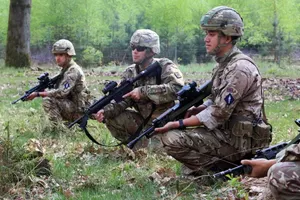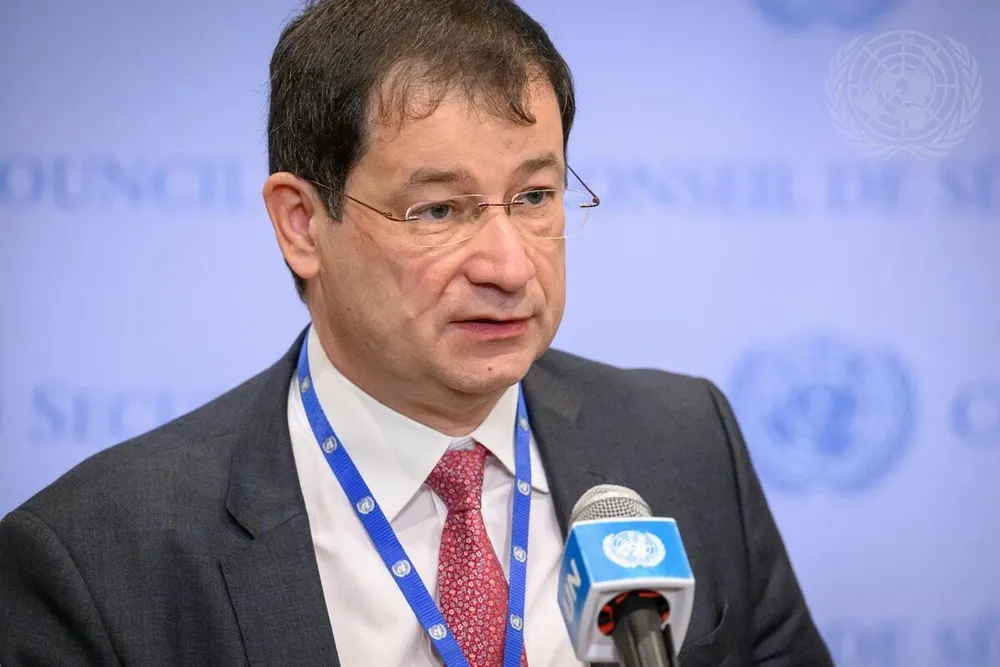
Russian Permanent Representative to the Organization for Security and Cooperation in Europe (OSCE) Dmitry Polyansky warned in Vienna yesterday that NATO’s military activities near Russia’s borders, and the involvement of individual alliance countries in attacks on Russian civilian vessels in the Baltic Sea, bring the world closer to nuclear war. He pointed to NATO’s military activities near Russian borders taking place in parallel with the Freedom Shield 2026 exercises, during which the unblocking of the Suwalki Corridor is being practiced, reported TASS. Freedom Shield 2026 is a Lithuania-hosted, German-led exercise, which is taking place in two iterations, the first was in June of 2026, the second currently ongoing.
According to Polyansky, all of this is happening as part of a single operational plan that envisages, on the one hand, the deployment of troops to Ukraine, and, on the other hand, the blockade of the Kaliningrad Region and the creation of an immediate threat to Belarus. Polyansky stated that he had no doubt whatsoever that “the purpose of the exercises near the borders of the Kaliningrad Region is to seize it by means of land, air and sea capabilities. In other words, a direct path to nuclear war with Russia is being rehearsed,” Polyansky continued. “We’re also inching closer to that by way of the direct involvement of certain NATO countries in terrorist attacks on Russian civilian vessels in the Baltic Sea,” he added.
At the same time, Russian President Vladimir Putin has approved a new Arctic Development strategy which asserts that NATO views the Arctic zone as a potential theater of military operations and is practicing the use of weapons, including nuclear weapons, in northern conditions, reported TASS.
“NATO regards the Arctic as one of the potential theaters of military operations and is practicing the use of armed forces in Arctic conditions, including the possibility of using nuclear weapons,” the document says. “To enhance NATO’s ability to demonstrate its strength in the Arctic region, the bloc’s command and control system is being improved, infrastructure projects are being implemented, measures are being taken to introduce unmanned systems, new space, cyber, and reconnaissance tools, and NATO forces are being deployed in greater numbers in the north near the state border of the Russian Federation.”