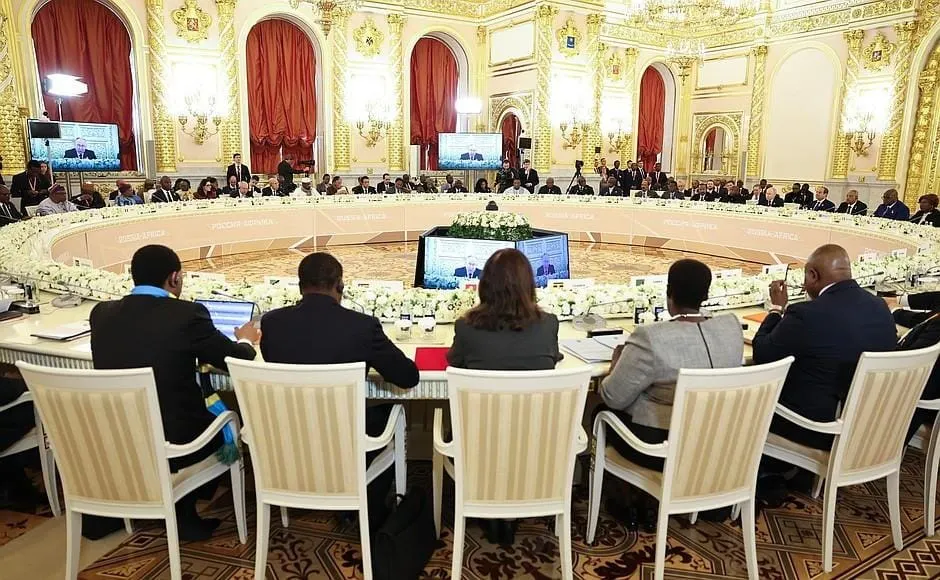
Nov. 6—The Third Russia-Africa Summit opened in Moscow Oct. 28 with delegations from 48 of Africa’s 54 states, 22 of them led by a head of state or government, an increase from the 17 at St. Petersburg in 2023. The two-day event, with a packed agenda of plenaries, working sessions, exhibits, and sidebar meetings, concluded with the posting of its “Russia-Africa Partnership Forum Action Plan for 2027-2029” statement, presenting 236 individual points of commitment for actions, ranging from education, to culture and history, to combating infectious diseases, to planning new transportation infrastructure. Nuclear power development figured prominently. The summit also issued a “Declaration on Artificial Intelligence.”
The first evening, the heads of ten African regional organizations, joined for the first time by the Eurasian Economic Union and the Commonwealth of Independent States, met to discuss what was described as “aligning the integration processes underway on both the African and the Eurasian continents.” Summit co-hosts Russian President Vladimir Putin and President of the Republic of Burundi Évariste Ndayishimiye, chairperson of the African Union (AU), also attended the meeting. Speaking for the AU, Ndayishimiye said, “Our compass is Agenda 2063…. We would like to achieve a level of cooperation that goes beyond commodity exports.” Africa’s most important capital, he said, is its youth, who “need engineering education, cooperation in science and education.” He added, “We adhere to the principle of African solutions to African problems…. Thank you for respecting our priorities.”