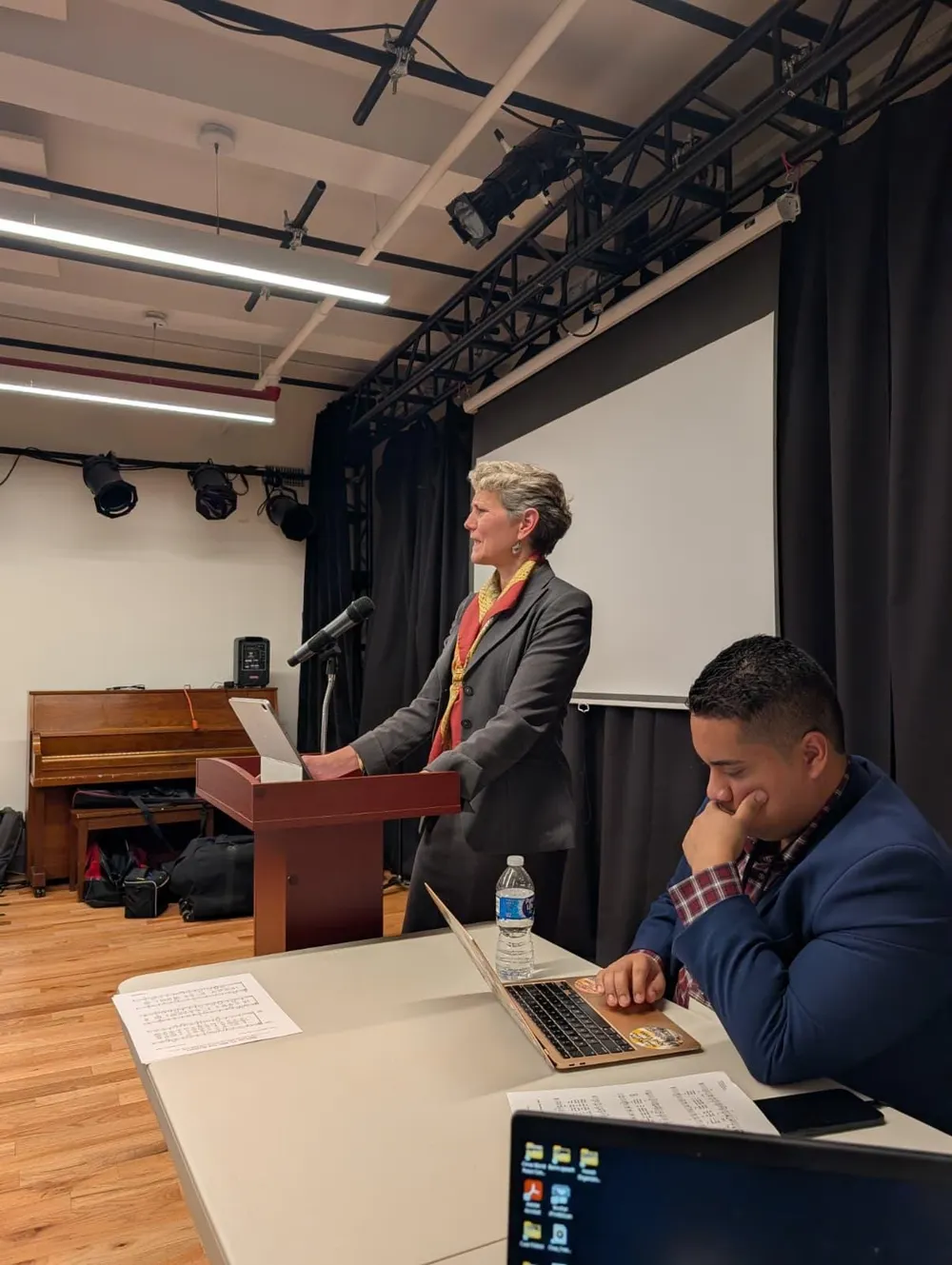
The following is an edited transcript of a speech made by Diane Sare on Nov. 8, 2026 in Manhattan. Subheads have been added.
I don’t have to start by telling you how bad the Iran war is, how high the cost of living is, or that ICE [U.S. Immigration and Custom Enforcement] agents wearing masks shooting people through their car windows is bad. I think you know that. I think most Americans still are afraid that we are on a trajectory toward nuclear war, which is also correct.
The one area that I think many Americans may not have considered in its full implications is the impending doom of the trans-Atlantic financial system, but I’m not going to start with that. I want to start with what hit me yesterday when we were organizing on the corner of 6th Avenue and 4th Street, in Greenwich Village. And that was trauma. The American people are traumatized, and it appears worse in the Village, because traumatized people come to the Village from all over the country, because they are actors, they are musicians, they are writers, they are sensitive people, and they are intelligent people; and they come to the Village, and they suffer from the harm of our culture and self-inflicted wounds, mutilations of their own bodies, drug abuse, peculiar attire or lack of attire, that you know is not comfortable.
And I was thinking, if you are under 25 years of age, the world as you’ve known it has been post-9/11[2001]. And in the middle of that, we had a pandemic for almost two years; your school was shut down, and you were forced onto Zoom for online learning. So, the already low literacy rates plummeted, screen addiction became rampant, and OnlyFans membership soared.
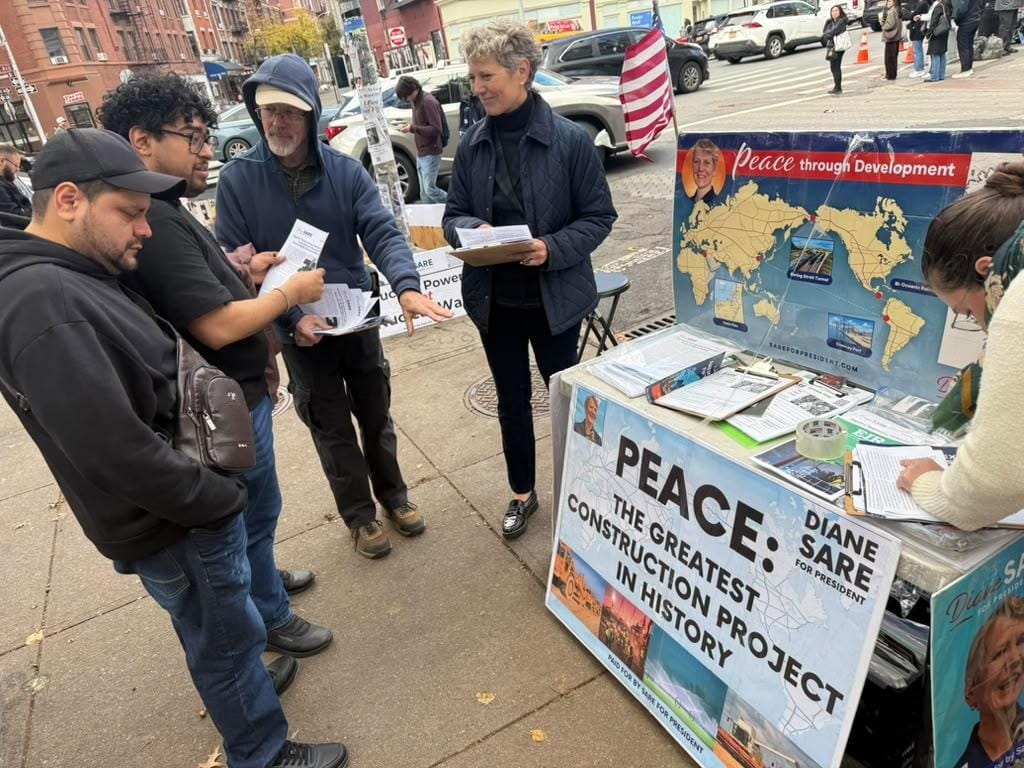
That’s trauma. I met a couple of teachers yesterday who told me that they have a friend who is a speech pathologist who said, as we were talking about literacy, that children also don’t know how to speak; the reason they don’t know how to speak is that children learn how to speak by looking at their parents, but they are not looking at anyone, because they are looking at a screen.
So therefore, even language has been taken from them. And this problem is not just in the Village, although perhaps it’s more colorful there. When I was in Iowa recently, I met middle-aged women who seemed to be normal, but they said, “We don’t know what is true anymore. There are so many conflicting narratives, there is so much conflicting information that we can’t figure out what is true and what is not true.” And the lack of certainty paralyzes people. Happily, it didn’t stop them from voting.
Without Peace, There Will Be No Recovery
So, my Presidency and the movement that we—those of you in the room, those of you who are listening from around the nation—are going to build before November 2028, has a very big task. We are going to organize the biggest peacetime economic recovery in the history of the United States. And I emphasize “peacetime,” because without peace, there will be no recovery.
We have an economy that prioritizes money. And some people really like that. They figured out all kinds of schemes to generate lots of money. We probably have more millionaires and billionaires than we’ve ever had in history. I just found out— Anyone know how many data centers we’re about to have, supposedly, if they all get built? Is it, I heard 3,000?
Now, with all this money, there is a problem, which is not only that the rest of us who have more important things in our lives than money are becoming very poor. But, as economist and former presidential candidate Lyndon LaRouche used to say, “Money is an idiot.” Money doesn’t even have as much sense as a ray of light, which always chooses a least-time pathway to arrive at its destination.
And I’m not just talking about cash. I mean everything—Bitcoin, crypto. Can you eat Bitcoin? Will it fill a pothole? At least with paper currency, you can burn it. So we have to cleanse our entire government of this takeover by money-worshipping billionaire elites. We have to do an orderly bankruptcy reorganization. We have to bust up monopolies, most of which seem to be run by someone who was on Jeffrey Epstein’s client list.
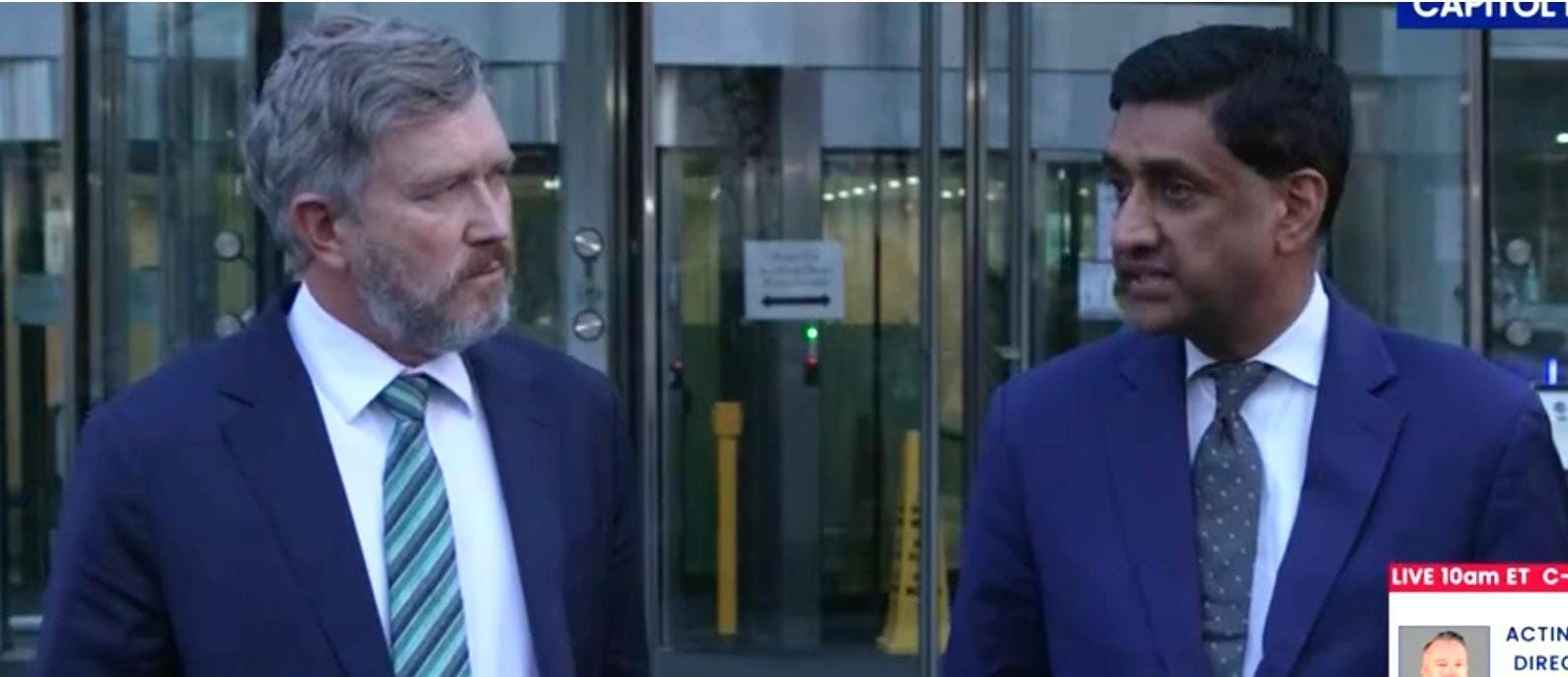
We need to launch criminal investigations of every single person named in the Jeffrey Epstein files. And one of the things we can work on during this so-called lame duck session is what Congressmen Thomas Massie and Ro Khanna are introducing—legislation on top of the Epstein Files Transparency Act, to make it possible for state attorneys general to prosecute the Epstein associates, so we don’t have to wait for the federal Epstein associates who are sitting all over our Congress and in all of our agencies to pretend to investigate themselves. Sounds a little bit like masturbation, and maybe incest.
I’ve said before that it occurred to me at the beginning of the recent Israeli genocide against Palestine, that the inability of our Congress to respond to the cold-blooded torture and murder of children was an indication that we have a serious problem of pedophilia in our nation, in the corridors of power. That is going to stop. The way we are going to stop it is not with rules. We already have the rules. No one cares to enforce them.
Human Beings Are Not Animals
This comes back to the problem with money and our AI [artificial intelligence] vulnerability. The problem we have is that we now live in a society that doesn’t know the difference between a human being and an animal, and believes that a robot can replace a human being. And on this, I am going to have to invoke the name Lyndon LaRouche, because he was on to this from the very beginning.
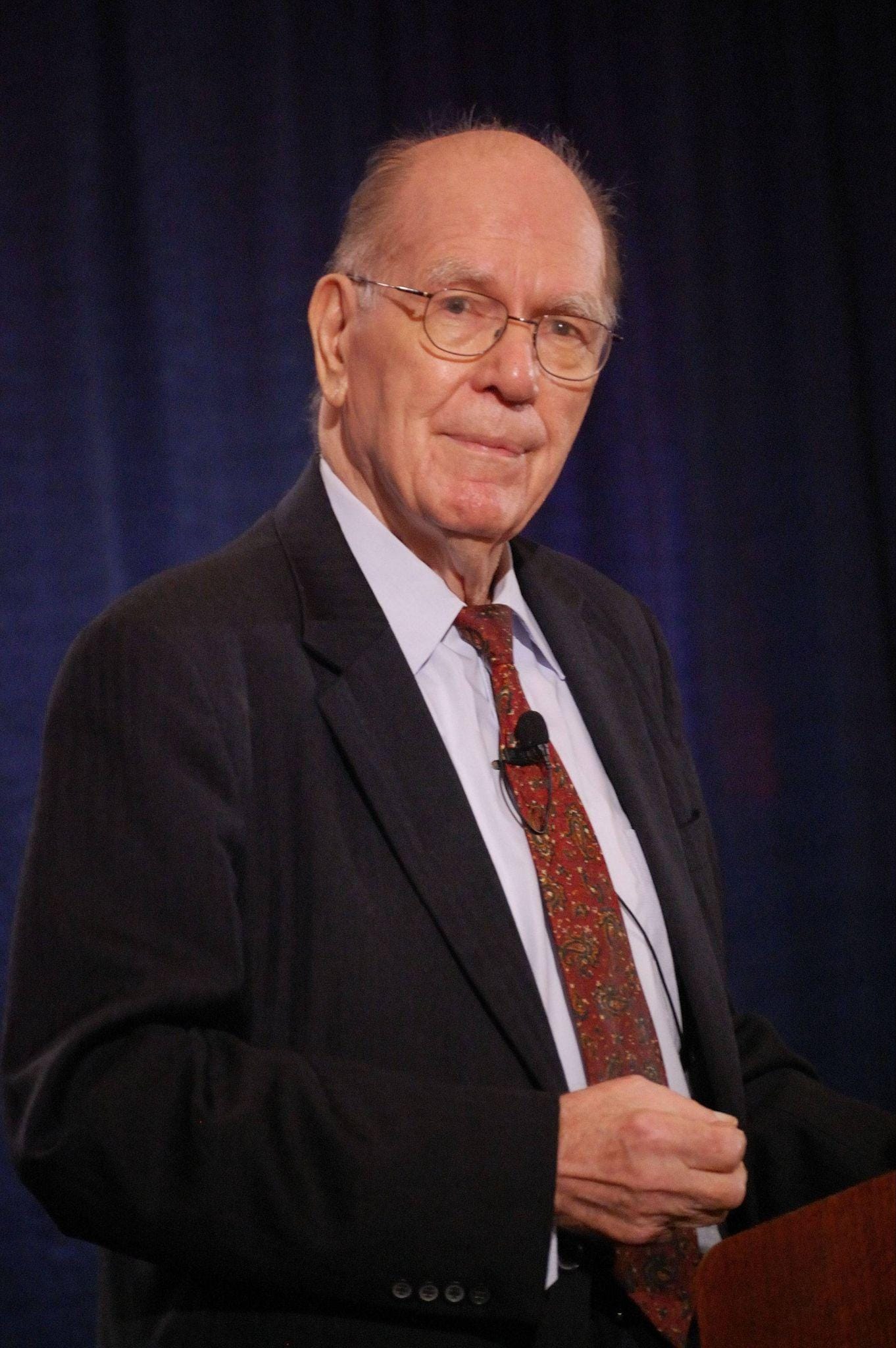
And I would like to say something to all of you right now, and all of you on Zoom. Some of you have admonished me and Jose Vega not to say “LaRouche,” to disavow our association with LaRouche. They say, “Isn’t it cultish to keep bringing up that name?” No; actually, if you believe that, you are in a cult. Discoveries throughout history are associated with the names. Whether or not you entirely agree with Einstein’s theory of relativity or special relativity, it is called “Einstein’s theory of relativity.” We talk about the Suzuki Method of learning the violin.
In fact, in every great discovery, great work of art, great musical composition, there is a person associated with it. They did not just appear out of the ether. And when you name the discoverer, the scientist, the composer, the artist, everyone knows what you mean. So, I shall name Lyndon LaRouche despite the fact that millions of dollars were spent by some very evil people to make you feel uncomfortable when that name comes up. And maybe you should try using his name as well. It keeps vampires away.
Now, LaRouche was on to this perversity from the beginning, and I’m going to quote from a speech that he gave in 1984 where he spoke about his own mental development. He said, “One day in 1947, I acquired an advance copy of one of the first Paris paperback-print publications of Norbert Wiener’s Cybernetics. The thing was very seductive, at least to people like me.”
He goes on:
There was another feature of the book which was not quite so innocently foolish, what was called the Wiener-Shannon doctrine of information theory. With that, I became angrier and angrier and angrier, and I threw that thing against the wall. I didn’t know that people like [David] Hilbert had thrown Norbert Wiener out of classes at Göttingen, but I would have sympathized strongly with that if I had known that.
At Göttingen, they said they wouldn’t tolerate that garbage-method Wiener was bringing into the seminars. Of course, this is also the doctrine of John von Neumann, who is a sort of calculating machine with a heart, and not a very good scientist, although he is a brilliant mathematician if you like that sort of thing. I hated it. I recognized in Norbert Wiener’s information theory the enemy which I had been seeking all my life: that misconception of man, which leads a biologist with an exposure to physical mechanics to get up and announce that it might be possible to prove that life exists in the universe. That filled me with a conviction to destroy this conception of “negentropy” as defined by Wiener and his accomplices, as the main enemy, philosophically, of the human race and as the enemy lurking within science.[[1]]
LaRouche’s Discoveries
LaRouche, with this dedication, went on to make his own discoveries in the science of physical economy. There were two principles clearly defined that came out of this. One, the question of “potential relative population-density” and the supporting conception of “energy flux-density.”
So, potential relative population-density—it is what it sounds like: the idea that at a given level of technology, say, burning wood, how many people can be sustained in a given square kilometer of land? How much land do you need to sustain a certain number of people with that level of technology?
And you can imagine yourself, if burning wood is your only source of fuel, and you’re running around trying to hunt deer and rabbits and eat grass, it might take a very, very large amount of land to sustain a very tiny handful of people. But if you develop dense forms of energy, energy flux-density, density per capita, per area of land, what you discover is that, for example, high temperatures can allow you to extract extraordinary resources from the same amount of land. Suddenly you can purify water, you can irrigate farmland, and what you discover is that as your energy density throughput increases, the potential population that can be sustained also increases.
Just to do an exercise—I don’t know if New Jersey still has the same population; it was around eight million the last time I looked at this. If you just extrapolate— And you have to remember New Jersey isn’t like Bergen County everywhere; it has farms. Twenty percent of New Jersey is the Pine Barrens, where we’re not allowed to develop anything. But if you took the population density of New Jersey and mapped it on to the entirety of the United States, the United States could have 4.6 billion people. And I made the point about the farms, because land is also different; that’s why it’s relative. There are all kinds of factors, but just to give you a sense of the potential and why human economics has to deal with this.
If you look at the development of the biosphere, you will discover that our universe is moving from less order and less energy to more order and more energy. For example, what’s the difference between a jellyfish and a mammal? Do you think you could tell a polar bear to stop eating meat and go back to being a jellyfish? I don’t think it ever was a jellyfish, but that’s sort of like the so-called environmentalist movement today: “Don’t consume energy, consume less, stop eating, go back to being an amphibian or something.” It doesn’t work.
What is unique about human beings, beyond the mammals, is that we change our relationship to nature, because we make a scientific discovery. We don’t sprout wings, we don’t develop spots, our ears don’t grow; it’s not physical in that domain, it’s an entirely different domain. But a scientific discovery made by an individual within a society that can absorb that discovery changes our species’ relationship to the universe.
If you think about the opposite approach, of Thomas Malthus with the British East India Company, he said that population grows geometrically but resources only grow arithmetically. Actually, the truth of the matter is that resources, as long as you allow the freedom of the human mind to develop its creative talents, will grow faster than your population growth. And that is the point of the breakthrough of the United States of America and our Declaration of Independence.
What Is the Meaning of Your Life?
What are our inalienable rights as the framers of that document said? “Life, liberty, and the pursuit of happiness”—not property, happiness. The knowledge that you are making a discovery that you are contributing to future generations; that you are not mortal, that the meaning of your life doesn’t end when your physical body ceases to be here.
So, there is a lot more that I could say, but I’m going to give you just a few things that I think we need to get done. Some right now, one of which I mentioned, which is the Thomas Massie-Ro Khanna bill in the lame duck session. Another thing we have to do during this lame duck session, is stop the U.S.-Israel merger in the NDAA [2027 Fiscal Year National Defense Authorization Act]. The House version [of the NDAA establishing, in Section 219, the United States-Israel Defense Technology Cooperation Initiative] already passed. The Senate version is Section 1217.
We should do a full mobilization. A million people have signed a petition that they don’t want [the Democratic Partyʼs New York Senator Chuck] Schumer and [Rep. Hakeem] Jeffries [representing New Yorkʼs 8th C.D., Brooklyn, for Senate Majority Leader and Speaker of the House of Representatives, respectively]. People are not asleep. I think it’s possible to stop this, but we have to mobilize. We also have to, as I said, put these Epstein people in prison. That is why the Ro Khanna-Massie bill has to pass. And as a fringe benefit, let’s get [“U.S. Secretary of War”] Pete Hegseth impeached also.
Now, otherwise, the big things going forward: We have to reinstate the old Franklin Roosevelt era Glass-Steagall Act. We have to separate the banks according to function. We have to protect people’s savings and deposits and your small business loans and your mortgages, and you should not be on the hook to bail out somebody with a bad gambling habit and too much money. We have to nationalize the Federal Reserve, and we will use our Third National Bank and Treasury to direct credit into those activities which will do what LaRouche said, increase the potential relative population-density.
That means all kinds of things: 42,000 miles of high-speed rail, nuclear power—fission now and a crash program to develop fusion. We have to build the North American Water and Power Alliance.
Farmers depend on water management. If you’re going to have droughts and floods, it is very hard to be a farmer. And speaking of the farmers and many other businesses, we have to bust up the monopolies.
We need to go back to the Moon. We need to get to Mars. We have to take what I observed in the Village and what we know, which is a traumatized and deprived population, a population which lacks skill, which lacks motivation, where only 37 percent of high school seniors can read on a high school level.
We have to take this population and create a skilled workforce that can do everything that I said. I’ll let Anastasia say what my friend Delbert Spurlock’s background is and why he is qualified to discuss this, but he and I have been discussing a plan to pair military people, not only the Army Corps of Engineers, but planners in the military, with the building trade unions and apprenticeship programs to actually figure out how we are going to solve this problem.
How To Create a Skilled Workforce
One idea that’s sort of obvious is, we do not need 850, or however many it is now, military bases all over the planet. We don’t need to be supporting and supplying undeclared wars of aggression all over the planet. We do need the skilled workforce, and we can retool all of these companies—Raytheon, Northrop Grumman, Lockheed Martin, Boeing—to actually produce the things that we desperately need in this nation.
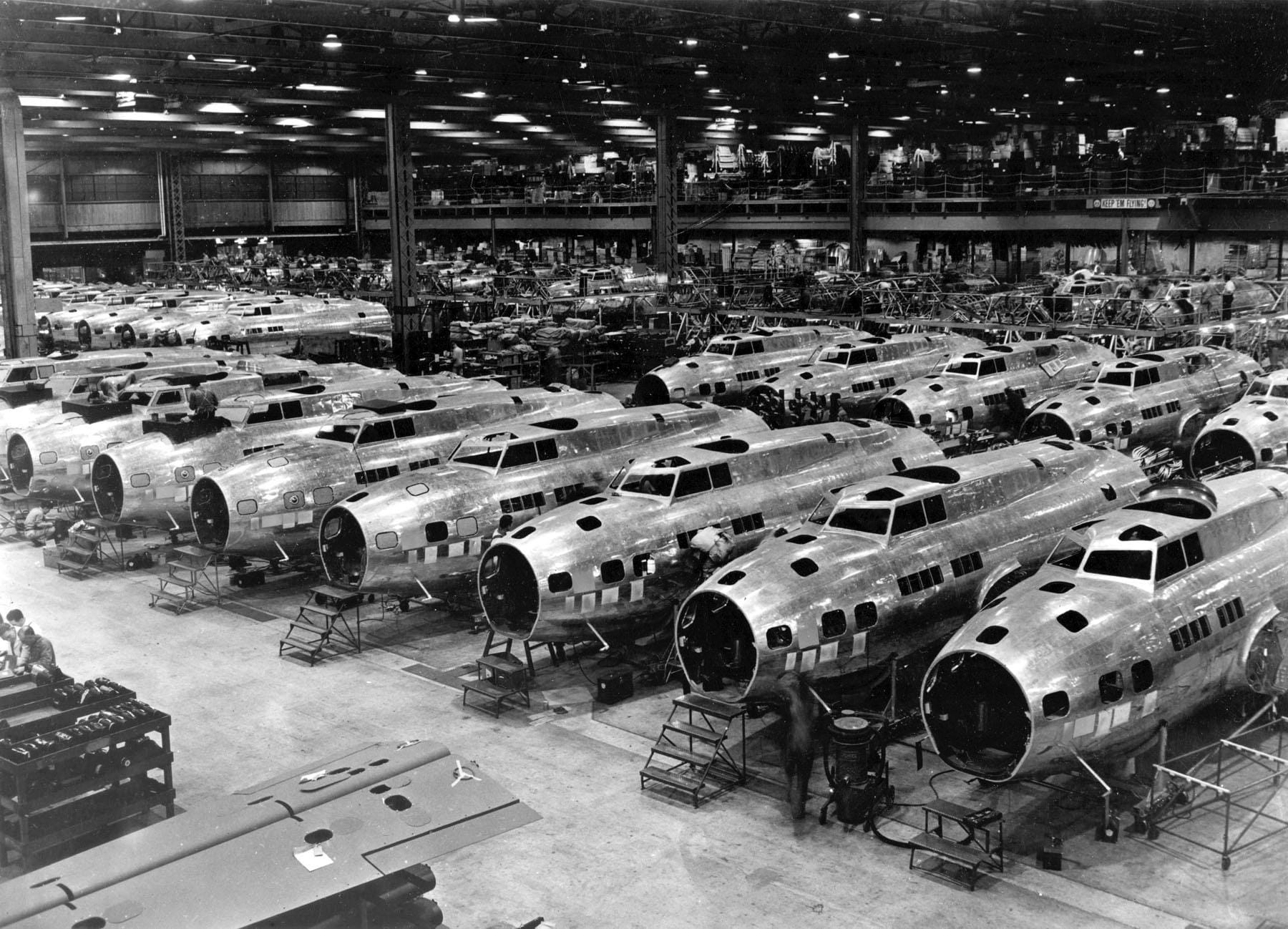
It’s a reverse FDR Arsenal of Democracy. He took our auto plants and helicopter factories and retooled them to churn out, more than what he wanted, 50,000 planes—it was an absolutely astronomical figure that no one thought we could do, and we did it. [300,000 planes over the years 1940-1945—ed.] Well, we can reverse that. We can take all these things that make all these weapons and make things that we actually need.
This will not work if the United States is in isolation. The United States has to give up the idiotic idea of being the global hegemon. Besides, only a few people in the [President Donald] Trump administration and the CIA believe in that anyway. We have thoroughly squandered whatever moral authority we may have had, and truly great American presidents were wise enough never to want to be a global hegemon.
The President of the United States will have to meet with the leaders of Russia, China, India, Brazil, leaders from the African Union, in order to establish a new economic and security order for the planet as a whole. This order must respect the sovereignty of every nation and respect the right of every nation to economic development and economic self-sufficiency. As you know, there are many programs from the Schiller Institute, from LaRouche’s work on development; projects the world over.
There are postcards in the back of the room on the Oasis Plan for Southwest Asia, which is very, very urgent at this moment, especially if [Israeli Prime Minister] Bibi Netanyahu is actually out. We will see about that.
And finally, there was an election in the United States in 1928, exactly one century before the upcoming election in which I am running. In 1928, a very wise man who understood economics from the standpoint of Alexander Hamilton was elected governor of the state of New York, and he went on to become a great American President. That was Franklin Delano Roosevelt. He was not perfect, but he was pretty damn good, and he worked hard for the American people, and he earned their trust. My Presidency will be informed by the actions that he took, to rescue our nation from the depths of the Great Depression and convert it into being the industrial powerhouse that collaborated with Russia and China to defeat fascism in Europe and Asia. To quote Rosie the Riveter, “We can do this.”
Notes
[[1]]: LaRouche later went on to develop his own concept of negentropy, which was very different from Wiener’s. LaRouche insisted that, while inanimate processes like heat-powered machines experience the loss of heat-energy, thus going from more organized to less organized states over time, this situation is not seen in living processes nor in human economics. Instead, living processes and human society exhibit the opposite effect, and go from less organized to more organized states. LaRouche insisted that this type of “negative entropy” is the actual nature of living and human creative existence.