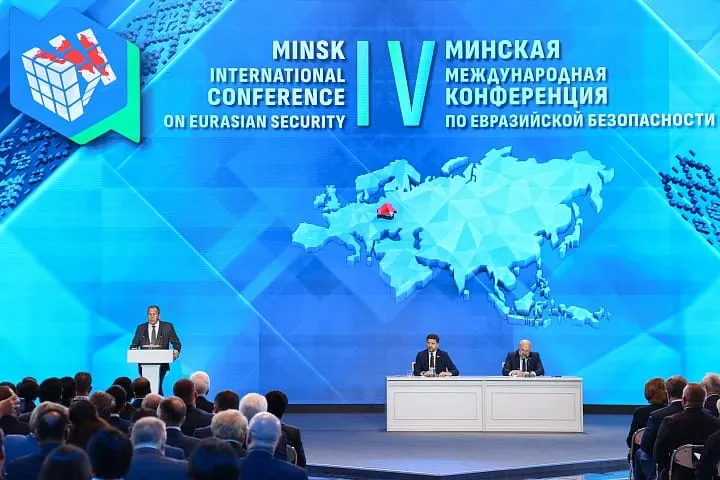
“Candid and open discussions are important today as never before,” Russian Foreign Minister Sergey Lavrov argued in his speech to the opening Plenary of the Nov. 3-4 Fourth Minsk International Conference on Eurasian Security. “Especially so, as the Global Majority has an objective demand for a different world order model.
“Under this model, genuine equality of sovereign states must be ensured as a sine qua non prerequisite for the safe and progressive development of all nations. Not everyone likes that. There is a fierce struggle for the right to determine the principles on which the new world order will be based,” but Eurasia has a great deal to offer this struggle as “the world’s largest continent, boasting unique history… home to several millennia-old civilizations which enriched each other over the years. True, they fought against each other, but enriched each other in the process as well.”
Putin first proposed in 2015 that a Greater Eurasian Partnership be formed, with the idea that, by coordinating the work of the various Eurasian integration associations (Lavrov named the EAEU, the SCO, and ASEAN), the nations of the region could ensure “a more rational use of the wealth of our common continent.” Russia envisions this Greater Eurasian Partnership as “a material basis and a foundation of the Eurasian security architecture that we discuss at the Minsk conferences,” he reported.
“Practical implementation of the principle of equal and indivisible security lies at the core of it all,” Lavrov stressed. “A system of mutual and cross-cutting security guarantees in both bilateral and multilateral frameworks” could be built, through which the “root causes” of the different regional conflicts can be resolved “without the destructive external interference by extra-regional countries.”