
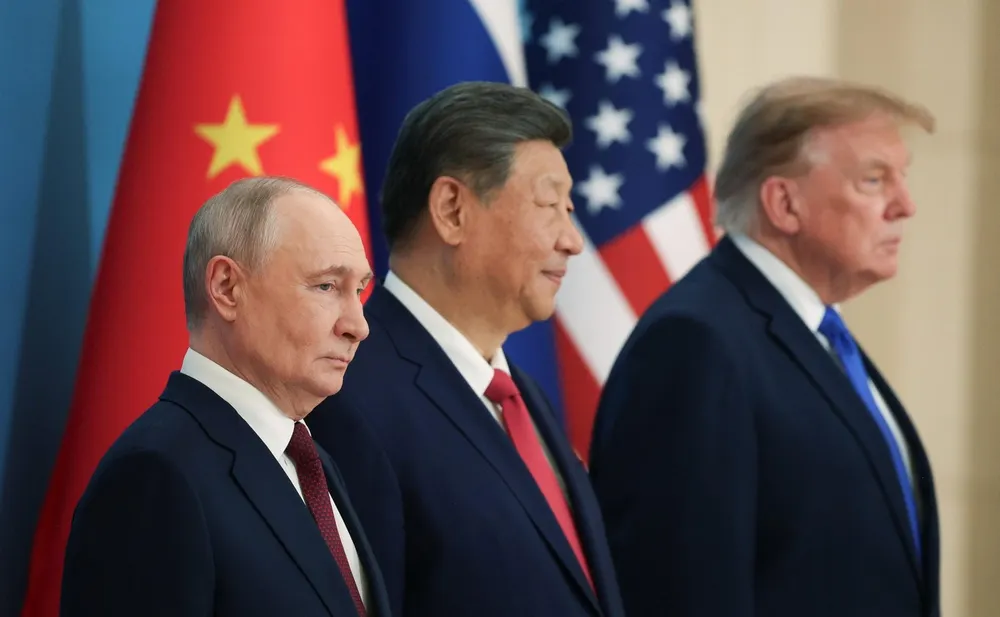
Despite media efforts to either black out or mischaracterize the tripartite meeting of presidents Xi, Trump, and Putin in Shenzhen on Nov. 20, as little more than publicity optics, there are also thoughtful evaluations being issued.
For example, Wang Wen, dean of the Chongyang Institute for Financial Studies at Renmin University of China, told TASS that he thought that President Xi had presented four principles for ongoing great power relations (mutual respect, peaceful coexistence, mutually beneficial development and dialogue) that provide a new perspective “that departs from both the Yalta-style division of spheres of influence and the model of unipolar hegemony… It does not seek to form alliances among major powers; instead, it explores a path for major powers to exercise self-restraint and collectively stabilize the global order within a multipolar world,” he said. “There is no need to carve the world into isolated, disconnected blocs; ‘decoupling’ or severing supply chains serves the long-term interests of no one,” he added.
Jeffrey Sachs, the director of the Center for Sustainable Development at Columbia University, told TASS: “Yes, I believe we are closer than we were a few months ago, although the decisive step has not yet been taken by the United States… The central obstacle remains NATO enlargement… [A] clear public statement by President Trump is needed, declaring that the United States rejects NATO enlargement because it violates the principle of indivisible security,” he concluded.
Former U.N. weapons inspector Scott Ritter wrote that “Shenzhen was the first step away from World War III… The decision by the new ‘Big Three’ to recommit to the nuclear nonproliferation treaty is simply a restatement of the existing official policy line of all three countries… The Shenzhen meeting has created a framework where three-way negotiations on nuclear disarmament are now possible. This is a big deal.”
