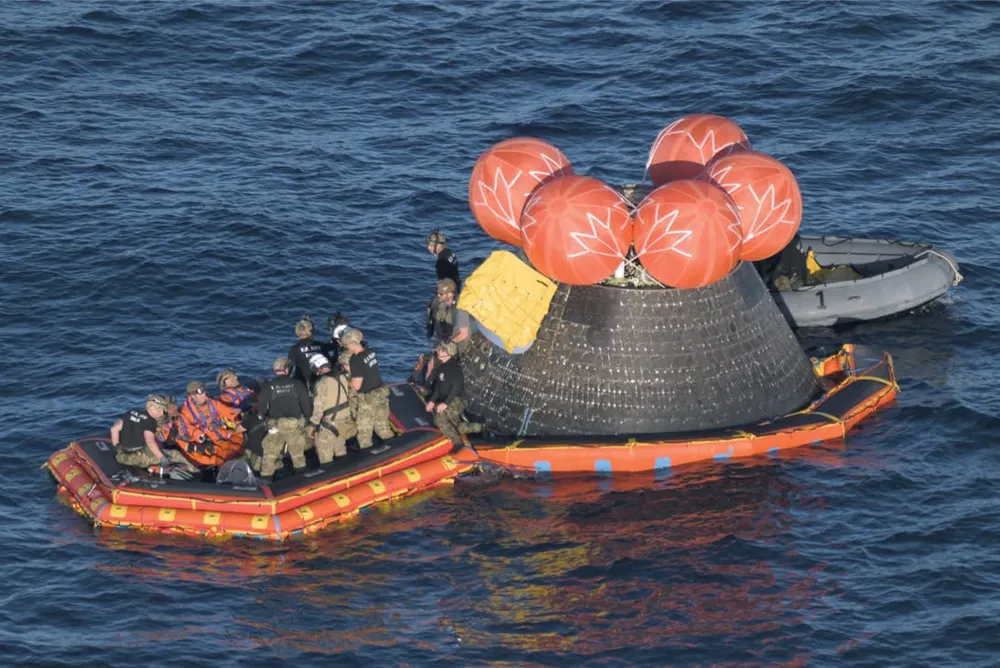
April 14—While over the last few months and years the American population has been inundated with reports of new wars and conflicts, from genocide in Gaza to the threat to civilization in Iran, the successful splashdown of the four Artemis II astronauts, who had, for the first time since 1972, come face-to-face with the lunar surface, has given the people a spark of optimism about the future of their country.
Although the Artemis mission had its origins in “geopolitics,” namely as an attempt to send Americans back to the Moon before China sends its own astronauts there, the nature of space exploration—and space explorers—transcends the limited and selfish mind-set of geopolitics.
As the United States has not accomplished such a feat in over 50 years, the cis-lunar mission was a new and exciting experience for the great majority of the population. Millions of people watched the return splashdown of the astronauts’ capsule in the Pacific Ocean, after ten days in space and traveling 250,000 miles from the Earth, the farthest man has ever flown. Many gathered all over the country in collective “watches” in order to see the return on the big screen. The entire mission was also online on the NASA channel, including the continual reports back from the astronauts, except when the capsule was on the far side of the Moon and for some 40 minutes out of communication with Earth. The astronauts reported on what they were seeing and doing in attempting to name the sites that they were passing, sometimes with the help of an entire science team back at Mission Control, which would double-check their observations against their own data.
There were also a few minutes of tension as the astronauts traveled through the atmosphere, at one point reaching 25,000 miles per hour, in their return to Earth. The Orion space vehicle, newly designed by NASA and Lockheed Martin for deep space missions, has a unique heat shield capable of withstanding enormous temperatures, which at one point reached 2,700 degrees Celsius on its return trip through the atmosphere. With very minor “glitches,” the mission was a resounding success. Just a couple of days after their return, all four astronauts were able to address employees at the Johnson Space Center. And the spirit they exuded was clearly transmitted to the audience there and to hundreds of millions who have heard them throughout the world.
They were, of course, very much moved emotionally, as exemplified by pilot Victor Glover thanking God for the opportunity to fly this mission. The closeness of the crew in sharing this unique experience had, as they indicated, created a bond among them that would “last forever.” They were also keenly aware of how this mission, and their enthusiasm for the mission and its success, was reflected in the people in the audience and those who had watched the mission.
Astronaut Christina Koch, in reflecting on her feelings in viewing the Earth from lunar orbit, said that the Earth appeared as “this lifeboat hanging undisturbedly in the universe” amidst an immense darkness of space. She discussed her idea of their Artemis “crew,” as a team working for a common cause which is “inescapably, beautifully, linked.” Koch continued, adding, “I may not have learned, I know I have not learned, everything that this journey has yet to teach me. But there’s one new thing I know, and that is, Planet Earth, you are a crew!”
Canadian Jeremy Hansen concluded his short remarks by asking the other three fellow travelers to come up beside him for his concluding comments. After a group hug, Hansen said, “What you saw, was a group of people who loved contributing, having meaningful contributions, and extracting joy out of that. And what we’ve been hearing is that that was something special for you to witness. And the reason I had them come up here with me is because I would suggest to you that when you look up here, you’re not looking at us. We are a mirror reflecting you. And if you like what you see, just look a little deeper, this is you.” At this, the entire audience of NASA employees rose to their feet in a resounding burst of applause.
While there will no doubt be a great deal of “blustering” by President Trump and others about how this mission is a “victory” for his embattled Administration, the real nature of this success once again places NASA at the center what America should contribute to the world, in terms of shared scientific and technological breakthroughs to advance the cause of humanity.