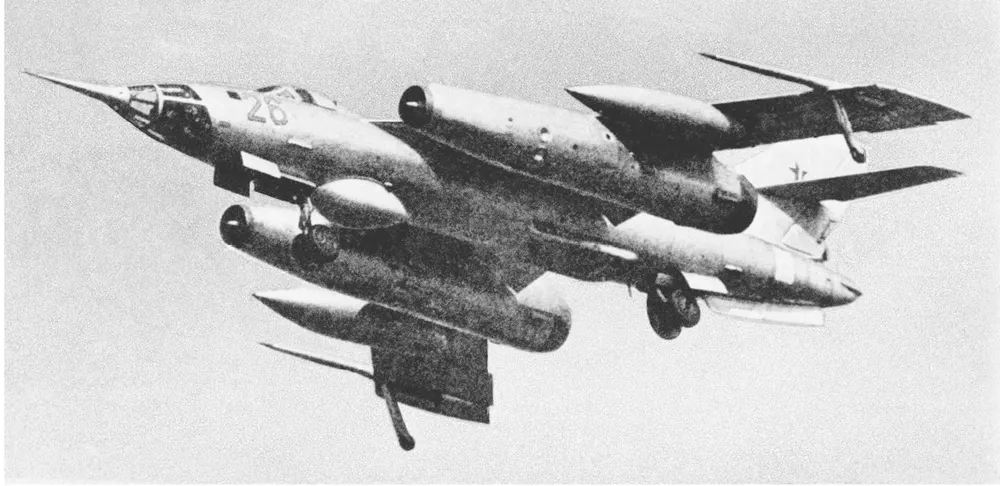
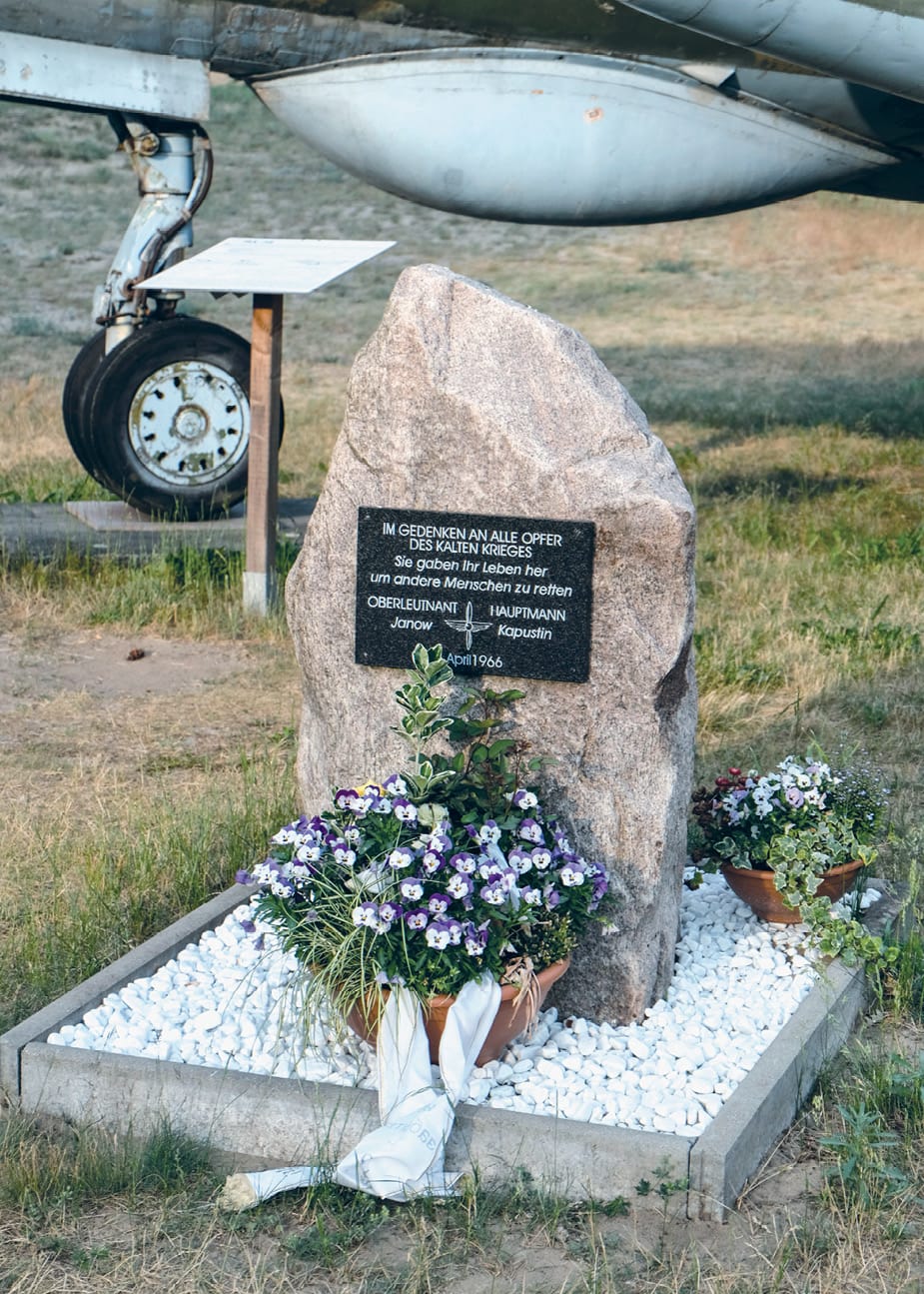
April 8—Monday, April 6 is an important day of reflection for Berlin, though less prominent today, due to the present poisonous geopolitical climate. Sixty years ago, a new and very modern Soviet Yak-28P fighter jet crashed just outside of Spandau, a densely populated area of West Berlin, due to sudden engine failure. The two pilots from the 132nd Bomber Aviation Division of the 24th Air Army, Boris Kapustin and Yuri Yanov, who were flying over West Berlin to transfer the plane from Finow (North of Berlin) to a military unit in Köthen (Southwest of the city of Dessau), died in the effort to steer the plane outside of the city area, in order to save human lives.
An exhibition, prepared by scientific curator Dr. Christian Hufen, was opened this week at the Russian House of Science and Culture in Berlin under the poetic title The Vast Sky. It documents the memory of the pilots in Germany and Russia, as “not only a story of tragedy, but also of honor, dignity, and rare human courage.”
In remarks, Russian Ambassador to Germany Sergei J. Nechayev pointed out that the two pilots expressed the good tradition of Soviet soldiers in World War II, or as Russians call it, the Great Patriotic War, of protecting the civilian population, the “normal people” from the effects of war. He expressed his appreciation for the then governing mayor of Berlin, Willy Brandt, for acknowledging, at the time, the selfless action of the pilots, despite the prevailing anti-Soviet climate, and for his later Ostpolitik, or openness to diplomatic relations with the Soviet Bloc. Nechayev announced the upcoming May 9 celebrations, which commemorate the Allied victory over the Nazi regime in World War II, a conflict in which the Soviet Union lost 27 million citizens. He pointed out that Russia does not have any problems with the German people, even if there are sometimes “thunderstorms” outside. Cooperation between the two nations has always been to the benefit of both sides—a “win-win” for all of Europe, he said.
The tragic event in April 1966 which the exhibition highlights, occurred in the midst of the Cold War, when Berlin was divided into the four occupation sectors (British, American, French, and Russian). The plane crashed in the British sector, where it led to a frantic examination of this modern Soviet plane, with new, complex electronics, and parts of the wreck were secretly transferred to Britain for investigation. On April 8, the corpses of the two pilots (both of whom were 34 years old) were handed over to Soviet representatives, who took them home.
Willy Brandt Recognizes the Humanity of the Sacrifice
For weeks following, the West Berlin and other international papers were full of articles about how the Soviets were endangering the lives of Berlin citizens by conducting risky “test flights and maneuvers” over the city territory. There was no public empathy with the two pilots, until Willy Brandt, then governing mayor of British-occupied Berlin, acted as a statesman. The Berlin city archives still preserve the letter of a West Berlin citizen, who insisted that public tribute had to be paid to the pilots, which he said, corresponded to the feeling among many other citizens in West Berlin. This letter has the notes of an assistant to the governing mayor at the time, recommending that it be discussed on a TV program in regard to the concerns of Berliners.
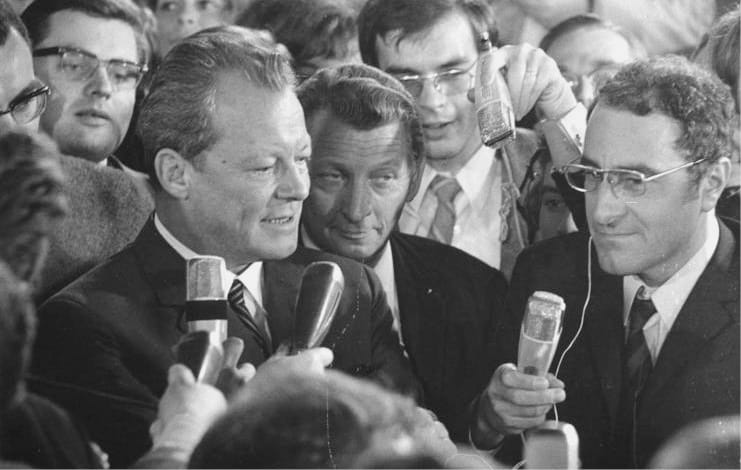
On April 23, 1966, Brandt, who was also national chairman of the Social Democratic Party (SPD), before becoming German foreign minister later that year, said on Berlin TV,
Three weeks ago, a Soviet military twin-engine jet crashed into the Stößensee. The two pilots, Kapustin and Yanov, lost their lives. We can assume that they recognized during the decisive minutes the danger of crashing into densely populated living areas and therefore steered their plane, in coordination with their ground station, into the Stößensee. That meant giving up the possibility of their own rescue. I am saying that in thankful acknowledgement of their sacrifice, by which a catastrophe was avoided. Regardless of what we think about aerial exercises over our city, I wish that the families of the two officers who crashed would know about our sympathy.
So, after two decades of anti-Soviet propaganda in Berlin, Brandt took the important step of paying tribute to the sacrifice of the two pilots, while also accepting the interpretation of the tragic event, provided by the Soviet authorities. TASS reported his acknowledgement. In Moscow, the 23rd Congress of the Communist Party of the Soviet Union had just ended, at which Leonid Brezhnev consolidated power with the new title of General Secretary. Brandt became German Chancellor in 1969, a position he held until 1974, and initiated the Ostpolitik, opening up an era of detente with the Soviet Union under the leadership of Brezhnev, which opened the long pathway to German reunification.
On May 10, 1966, the two pilots were buried as heroes of the Soviet Union in their home towns, and awarded posthumously the Order of the Red Banner for their courage. They became very popular in the Soviet Union and the GDR through the song “Ogromnoye nebo,” “The Vast Sky” (Oscar Feltsman, composer; Robert Rozhdestvensky, lyricist), performed by Edita Piekha. At the Berlin event, a young Russian actress, Daria Delman, gave a very beautiful and moving rendition of the iconic song. It conveys a devotion to friendship, honor, and dignity reminiscent of German poet Friedrich Schiller’s ballad “Die Bürgschaft,” “The Pledge.”
A historic recording of Ms. Piekeha performing “The Vast Sky” is available here. Below is a translation of the lyrics to the song.
Ogromnoye Nebo
This, my comrade,
We have to remember:
Two friends served together
In one squadron,
And both in their service
And in their hearts
There was a vast sky,
A vast sky,
A vast sky—
One for them both.
They flew and were friends
In the heavenly distance,
With one outstretched hand
They could reach to the stars.
And then came disaster,
Like tears to the eyes:
One day in flight,
One day in flight,
One day in flight,
Their engine gave out...
They ought to have jumped—
The flight was doomed!
But onto the city
The plane would have crashed!
It would have passed through,
Leaving no living trace,
And thousands of lives,
And thousands of lives,
And thousands of lives,
Would then be cut short!
City blocks flashed below,
It was too late to jump...
“We’ll fly to the forest!”—
Decided the friends.
“Away from the city
We’ll carry this death…
And though we may perish,
And though we may perish,
And though we may perish,
The city, we’ll save!”
The plane like an arrow
Tore down from the skies;
The forest of birch trees
Shook from the blast!
Not soon would the glades
Be grown over with grass…
They thought in the city,
They thought in the city,
They thought in the city,
It must be a training!
Academy grads,
Once in combat formation,
They never forgot
The bond of their friendship.
For that is the purpose
Of steadfast men’s friendship:
That the sky,
The vast sky,
The vast sky,
Is one for them both!
This, my comrade,
We have to remember:
In one squadron
Two friends served together…