The following is an edited transcript of the speech by Professor Zhang Weiwei to Panel One of the April 6, 2026 EIR Emergency Roundtable event, “A Dialogue of Civilizations: Is There Still Time To Prevent the War Against Iran from Escalating into a Global Nuclear Conflict?” Dr. Zhang is a professor of international relations at Fudan University in Shanghai and director of its China Institute. The video is available here.
Thank you, and hello, Madame Helga LaRouche; hello, everyone. Today we are here to voice our strongest condemnation against the military attacks launched by the United States and Israel against Iran; a war of aggression that violated international law, trampled upon human rights, and brought unprecedented disaster to the Iranian people and beyond. I would like to make a few points here.
First and foremost, we are deeply grieved and outraged by the heavy civilian casualties caused by this aggression, and by its reckless attacks on schools, bridges, sports facilities, universities, and other civilian targets, which constitute war crimes. This is not only a blatant violation of international humanitarian law, but also a betrayal of the most basic human conscience.
Second, equally appalling are the U.S.-Israeli attacks on Iran’s nuclear power station facilities, which undermine the international nuclear nonproliferation system and risk triggering nuclear contamination for the whole region, putting the lives of tens of millions at ever higher risk. We must stop this immediately.
Third, the war has also spilled over to the whole Persian Gulf region, plunging the region into greater chaos and instability. What began as an attack on Iran has quickly spread, with military conflicts and tensions escalating in neighboring countries, creating a vicious cycle of violence that shows no sign of abating.
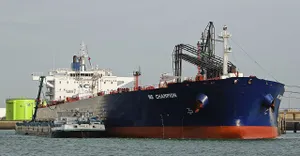
Furthermore, this war has also posed a serious threat to the global economy, sending shockwaves through the world energy market, trading relations, and supply chains. The Hormuz Strait, a key global energy and material transportation channel, has been disrupted by the conflict. While bringing disaster to the world, the U.S. reckless attack has also exposed its own deep-seated problems and its own weaknesses, revealing the fragility and the coming possible collapse of the U.S.-led unipolar world order. The blitz-attack launched by the United States and Israel has failed, and they may well sink into a quagmire of a war of attrition, which they have no chance to win.
With Iran’s firm and swift resistance, the myth of the U.S. military might has been shattered. President Donald Trump clearly wants to end the war as soon as possible, but to save face, he may still launch reckless attacks, causing more damage and bloodshed. Yet, the basic fact today is that the United States cannot defeat a determined and proud nation like Iran, which has been under U.S. sanctions for close to five decades.
Furthermore, the U.S. economic hegemony is shaking. Without doubt, the de facto blockade of the Strait of Hormuz has affected all countries. The surge in global oil and gas prices has directly impacted the U.S. economy, driving up inflation, turning supply chains into crisis, while U.S. federal debt has exceeded $39 trillion. And global de-dollarization is accelerating, and the war could trigger the collapse of the petrodollar system, or end in an unprecedented financial crisis for the United States and beyond. Moreover, the U.S. moral hegemony has gone bankrupt. The U.S. disregards international law and blatantly practices the law of the jungle, and is now facing a swift backlash.
China’s ‘Great Solar Wall’ Controls the Desert
by Marcia Merry Baker
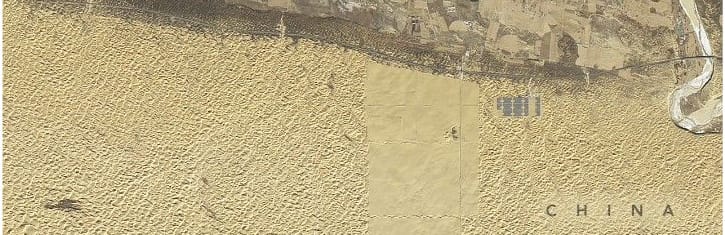
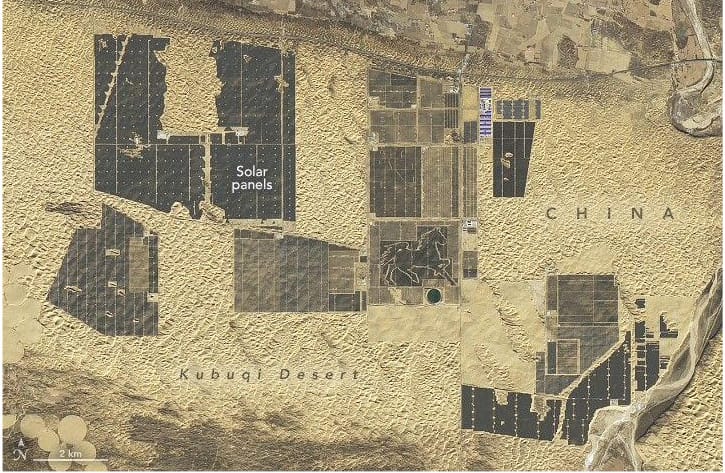
April 17—These before-and-after satellite images show the “Great Solar Wall” under construction in the Inner Mongolia Autonomous Region of north China, with extensive solar panels and desert-control plantlife in a band of dunes in the Kubuqi Desert, just south of the Yellow River. In this region, and parts of the Ulan Buh Desert (Inner Mongolia) and Taklamakan Desert (Xinjiang Province), China in recent years has implemented “solar plus greening” programs with solid results of photovoltaic power, sand control, and ecological upgrade. The technologies involved are directly relevant for Oasis Plan projects in parts of the Sinai, Negev, and Arabian Deserts, and the extended Southwest Asia and North Africa regions, along with nuclear power and desalination. China, approximately one-quarter desert land, has since 1978 also conducted an anti-desertification program of afforestation—the Three-North Shelterbelt Program (“Great Green Wall”)—active in 13 provinces, focused on the Gobi Desert.
The United States has rapidly transformed and transitioned from the host of the World Cup into an isolated loner.
Let me add this. Many people complain that the UN is useless, but we see today that numerous countries have publicly stated that the war has not been authorized by the UN, and they therefore refuse to support it. In other words, the moral authority enshrined in the UN Charter cannot be challenged. The challenges will face more and more backlashes.
Finally, the U.S. alliance system is collapsing. Not a single U.S. ally is willing to participate in the Hormuz Strait escort operation proposed by Donald Trump. Gulf states that have paid high premiums to the United States have not received protection. Instead, they’ve become the main victims of the war.
Now let me turn briefly to the Oasis Plan put forward by Madame Helga LaRouche. I’d like to inform the audience here that, thanks to China’s long-term commitment to green energy and sustainable development, China’s energy dependency on foreign oil and gas has dropped to as low as 15% by the end of last year. And China’s energy self-sufficiency rate is 85% now. As a result, China is far less affected by the worldwide energy shortage caused by this reckless war.
What’s more important is that China’s efforts to turn deserts into green powerhouses have achieved stunning successes. Across China’s vast northern area, a remarkable transformation is taking place. Once-barren deserts are being reborn as massive green energy hubs. China’s four major deserts in the north now host vast solar panel arrays and wind turbines, turning unproductive sand into a source of limitless clean energy. Solar panels not only generate electricity, but also shield the sand from wind erosion, creating shaded areas under the solar panels where drought-resistant vegetation can grow and animals can live. This mode of power on panel, grass under the panel, and breathing between panels has turned a sea of sand into a thriving ecological and energy oasis. China’s renewable power generation last year, reached about 3,500 terawatt-hours, half of which comes from solar and wind power; exceeding the total power generation of the European Union, which is around 2,700 terawatt-hours for a given year.
In other words, if peace and development can be restored in the Middle East, we can really put this Oasis Plan into operation with the help of China and all others, all those in favor of peace and sustainable development. So, I try to finish my speech with this slightly optimistic note. And thank you. Thank you, everyone. Thank you.