Skip to content

Schiller Institute and Chinese Think-Tank Organized an Event in Berlin

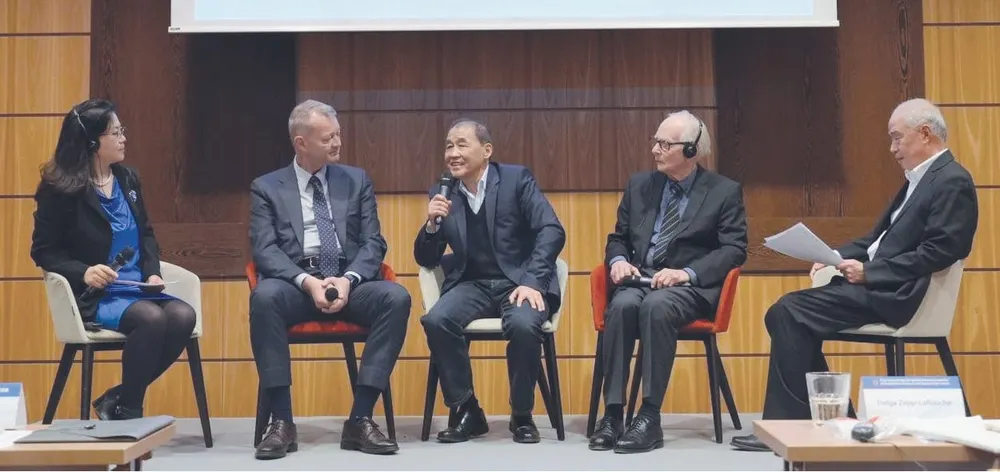
A highly successful seminar on “China-Europe Dialogue on Global Governance as Well as Civilizational Exchange and Mutual Learning,” organized by the Schiller Institute and the Beijing-based Academy of Contemporary China and World Studies (ACCWS) took place in Berlin on April 15. Prominent speakers from Germany and China took the podium and engaged in a dialogue, articulated in two panels, moderated by Stephan Ossenkopp from the Schiller Institute and by Hu Yajuan from the ACCWS.

The event was opened by Gao Anming, editor of the China International Communications Group (CICG), Schiller Institute founder and chairwoman Helga Zepp-LaRouche, and Ms. Yang Chengcheng, Minister-Counselor at the Chinese Embassy in Berlin.

Gao started his speech by referring to Friedrich Schiller’s Ode to Joy poem. He described the current world situation as characterized by “changes and tensions.” “Power politics poses the biggest challenge since World War II, and a China-Europe dialogue can be a factor of stability.” The construction of a true multilateralism to shape the future of humanity and reform the financial architecture are the tasks ahead of us. Gao emphasized the importance of the decision, incorporated in China’s 15th Five-Year Plan, to increase the “step-by-step opening” of the Chinese economy, and concluded his speech by calling for deepening reciprocal knowledge, as Leibniz had done 300 years earlier.

Helga Zepp-LaRouche started with the positive note, that the world has the chance to overcome 500 years of colonialism and should not take the ongoing epochal change as a threat. She chastised the Western attitude of looking at China with “augmented-reality spectacles,” not seeing the tremendous achievement China has made since 1971, when she first visited the country. She then went into the immediate task ahead, of solving conflicts, starting with Southwest Asia, where, if a nuclear war does not break out, there must be an “enlarged Oasis Plan” that includes Africa. The Schiller Institute has produced a report on the perspectives of a tripartite Europe-China-Africa development strategy that is consistent with Africa’s own 2063 Agenda. The second edition of the report is available in a few advanced copies. Xi Jinping’s Global Governance Initiative also reflects principles laid out by the Schiller Institute’s own proposals. Not accidentally, the Schiller Institute’s complete name is “Association for Statecraft.”

Ms. Yang welcomed participants and outlined the promising perspectives of China-German cooperation. China’s economy grew 5% in the first quarter of 2026 and will further open itself to foreign investments, as it was stressed during Friedrich Merz’s Feb. 25-26 visit. She mentioned that BASF had opened the world’s most modern chemical plant in China, as an example of the broad potential for cooperation between the world’s second and third largest economies.

The first panel, “Quality Opening as Engine of Global Governance,” was opened by ACCWS deputy director Fan Daqi, who briefly presented the result of a research paper by his institute. The paper shows the complementarity of the two economies and the perspective of cooperation in third state markets. He called for strengthening institutional guarantees. He was followed by Michael Bose, chairman of Automotive BerlinBrandenburg (ABB), who addressed the “complex interrelations” of the automobile industry. Comparing the German auto industry with the Chinese one today, you must admit that the “teachers have become students.”

Shi Shiwei, director of the Research Center for German-Chinese Trade at the University of International Business and Economics, went into detail on all innovative sectors in which investments should be directed as priorities according to the new five-year plan, which are significant for Germany.

Bernd Einmeier, chairman of the German-Chinese Society for Economy, Education and Culture, stated bluntly that “Germany has no idea of what China is.” He highlighted the high symbolism of the treatment given to Chancellor Friedrich Merz’s visit to China, as Chinese leaders agreed to receive him on the day of their New Year celebrations, their most important traditional holiday.

Oliver Lubich, sales manager at Hainan Airlines in Berlin, said that the potential for air traffic between the German capital of Berlin and Hainan is much greater than the 55 flights currently established by treaty.

This post is for paying subscribers only

Subscribe

Already have an account? Sign In