Raphael: Sublime Poetry
Exhibition at the Metropolitan Museum of Art,
New York City
March 29 to June 28, 2026
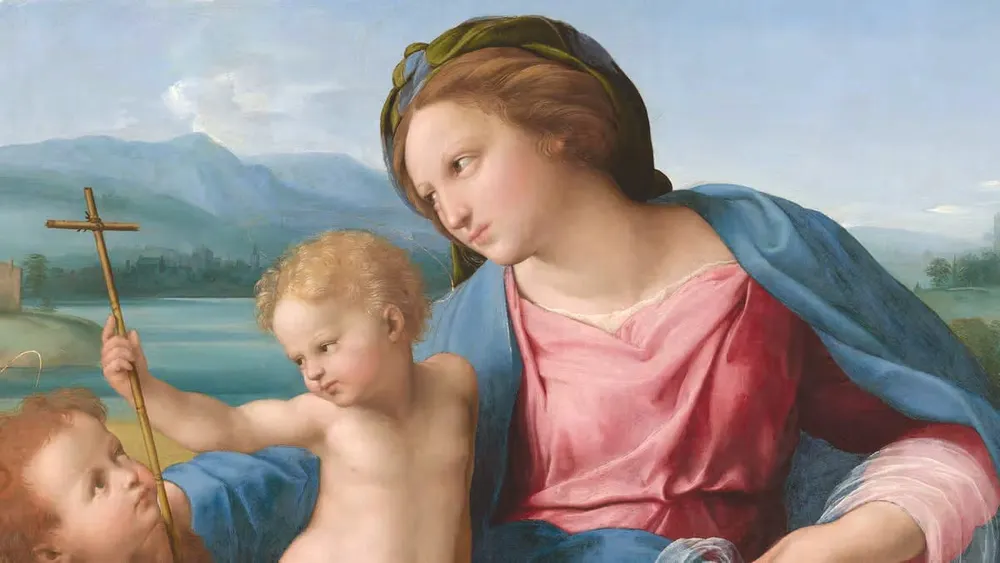
April 6—April 6 marks the birthday of the great painter Raphael (Raffaello di Giovanni Santi, 1483-1520). The Metropolitan Museum of Art in New York City has just opened the first-ever major exposition of the poet-painter’s oeuvre in America. As the Met’s website states, Raphael: Sublime Poetry is the first comprehensive exhibition on Raphael in the United States, bringing together more than 170 of the artist’s greatest masterpieces and [some] rarely seen treasures to illuminate the explosion of creativity in art, science, and economy that was the 15th Century Italian Renaissance. That seismic upshift in world culture was largely (though not solely) centered in the Florence of Brunelleschi and Leonardo da Vinci, as well as the great thinkers Toscanelli, Nicholas of Cusa, and the controversial Niccolo Machiavelli. Not only Raphael’s work, but that of other artists such as Perugino, Luca della Robbia, Piero della Francesca, and even Raphael’s father, Giovanni Santi, is most usefully presented.
One of the works on display is the first known to be entirely done by Raphael himself: a two-sided processional banner, prepared by Raphael for the Confraternity of the Most Holy Trinity in 1497-99. Significantly damaged by time, it nonetheless shows, particularly in its treatment of the creation of Adam on the one side, and the crucifixion of “the Second Adam,” Jesus, on the other, the astounding maturity of conception of which Rafael was capable at the age of 14-15, as well as concentration span. The banner was completed over a two-year period. By 1500, at the age of 17, Raphael was declared by his contemporaries to be a master craftsman and artist.
The exhibit, importantly, places Raphael within the city-builder context of 15th-Century Renaissance Italy. Raphael’s father, Giovanni Santi, was also a renowned painter, as well as a poet. One of the few extant original copies of his epic poem regarding Federico de Montefeltro, a warrior prince, who was also a great patron of the arts for the city of Urbino, is also on display in the exhibit, as are Giovanni Santi’s paintings.
Giovanni died when Raphael was 11 years old, but prior to that, he had begun to work with his son directly. He introduced his son to his workshop, and arranged, prior to his death, to have his son study with the great painter Pietro Vannucci, also known as “Perugino” because of his association with the city of Perugia.
The extraordinary education in matters of geometry, architecture, painting, sculpture, drawing, engraving, and machine construction available in the workshops of these Renaissance masters—and the many students who assisted them—was embraced by Raphael, who, in dialogue, not only surpassed, but advanced the work of many of his contemporaries.
One feature, noted in the exhibition’s opening hall, is that, while other painters would render certain figures in their paintings—such as sponsors—disproportionately smaller than the ostensible religious subject portrayed (as in a portrait of, for example, Saint Augustine, commissioned by members of an Augustinian lay order for devotional purposes), Raphael, even as a teenager, rejected such traditional practices. He instead painted all the figures as proportional. This created a visual alteration of the living donors’ relationship to the compositional subject as a whole. This also made a subtle, but unmistakable statement regarding an implied accessible “temporal eternity” for human beings, redolent with theological, political, and social implications.
An extensive treatment on Raphael, the Renaissance, and specifically Raphael’s work, The School of Athens, has been authored by Paris-based artist Karel Vereycken in an article published on his website, titled, “Raphael 1520-2020: What Humanity Can Learn from the School of Athens.”