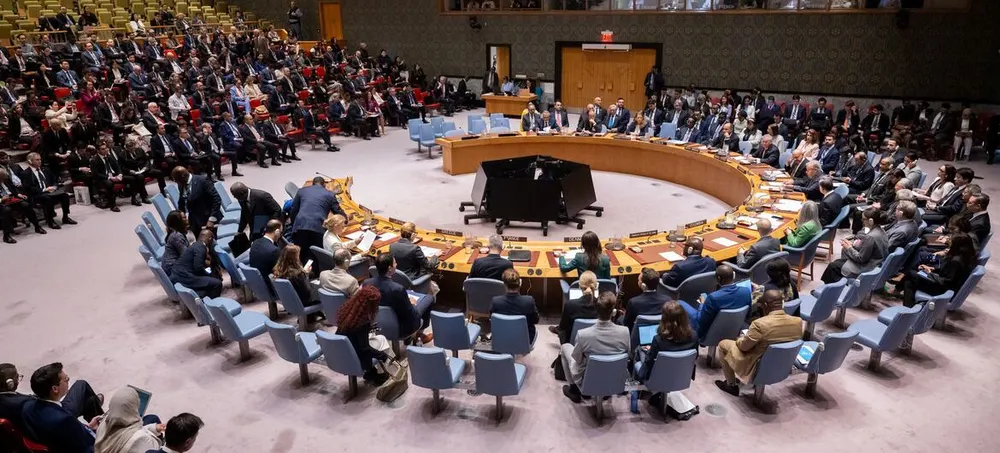
The United Nations Security Council hosted a special hearing on May 26, continued on May 28, on the subject: “Upholding the Purposes and Principles of the UN Charter and Strengthening the UN-Centered International System.” It was chaired by Chinese Foreign Minister Wang Yi as part of China’s rotating presidency of the Security Council for the month of May, and was attended by representatives from more than 100 countries, including more than 20 foreign ministers and other high-level representatives. In the context of the ongoing breakdown of the post–World War II order, as seen in numerous instances across the world today, China decided to focus the meeting on the UN’s central role in uniting the world community of nations to find a framework with which to avoid descending into global confrontation and the law of the jungle.
UN Secretary-General António Guterres opened the hearing by noting that the UN Charter “is a survival guide for humanity—a promise born from the devastation of two world wars, a commitment that the force of law must prevail over the law of force.” He then warned that these are now “under profound strain,” referencing dangers such as the “erosion of respect for international law,” “geopolitical divisions are deepening,” “conflicts are proliferating and intensifying,” and “global military spending is at record levels…. Together, we must summon the political will to uphold” the principles of the UN, he insisted.
Guterres also noted the importance that the UN’s role in defending peace has for enabling the economic development of nations, saying that “there can be no peace without development, and no development without peace.”
While the UN should be reformed to “reflect today’s realities,” he noted, “no reform, institutional or structural, can substitute for political will. The Charter is clear.” The UN Charter “remains humanity’s best hope for peace,” he concluded.
China Sets the Stage
Wang Yi then spoke, beginning by recognizing that “the international situation is undergoing the most complex and profound changes since the end of World War II.” “The giant ship of human civilization is sailing into dangerous waters,” he went on, “and world peace and development is at a crossroads.” Reminding the Council that the UN had itself been born “from the ashes of World War II,” Wang declared: “The challenges before us are testing the international community’s commitment to safeguarding peace, its resolve to stand up for justice, and its courage to make bold reforms.”
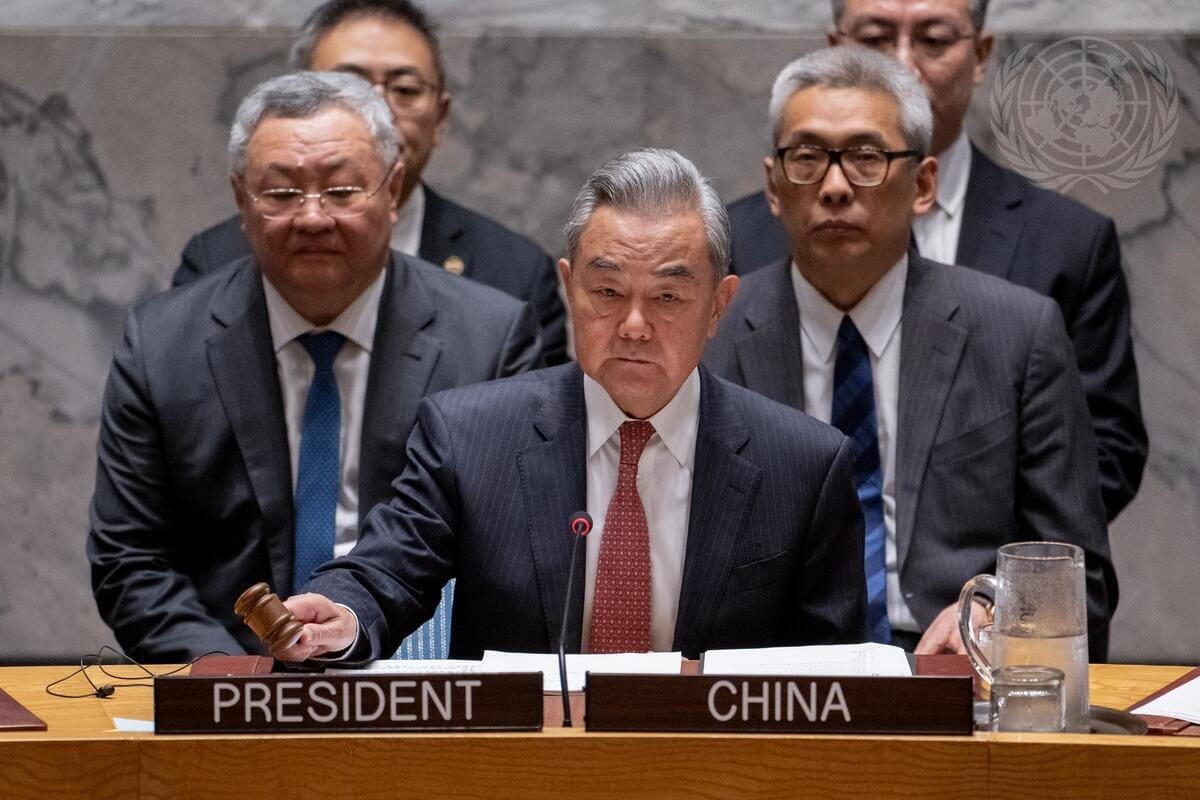
Wang then laid out five points of focus for restoring the UN’s mission and principles:
1. Reinvigorate the UN Charter for stronger leadership. The UN “is the biggest common denominator of the post-war international community. The root cause of the chaos in today’s world is not that the Charter’s spirit is outdated, but that the international order … [is] not being effectively upheld and observed.”
2. Strengthen the authority of the Security Council. “The more volatile the world, the greater the leadership required of the Council,” he said, and warned against any unilateral or aggressive actions.
3. Reinvigorate global development cooperation. “Development, as the key to all problems, must remain at the center of the international agenda.”
4. Reinvigorate the global governance platform. “We should strengthen the sense of community with a shared future for humanity.”
5. Reinvigorate the effectiveness of the UN system. “The UN is at the center of the post-war international system. Its role should only be enhanced, not weakened, and its standing upheld, not replaced.”
Wang closed by referencing Chinese President Xi Jinping’s four initiatives—the Global Security Initiative, Global Development Initiative, Global Civilization Initiative, and Global Governance Initiative—and said China is committed to “uphold principles and follow the path of justice.”
Russia: UN Charter Sets the Standard for Justice
Russia’s Permanent Representative to the UN, Vassily Nebenzya, was somewhat more blunt in his critique of the current rules-based order. Nebenzya said that Cold War tensions have passed, “but a global catastrophe is now much closer than ever before, as it is not only ubiquitous violations of the UN Charter that we are witnessing today, but also the questioning of the value of the Charter and the obligation to comply therewith.” He blamed double standards and Western elites’ “desire to preserve their dominance in the world” for the continued collapse in credibility of the Charter.
Nebenzya particularly highlighted the drive for rearmament underway in Europe, exemplified by Germany’s stated goal of becoming the largest conventional military in Europe. Similarly, France’s efforts at creating a “nuclear steering group” for Europe are alarming, and are reversing the previous trends toward nuclear non-proliferation and dialogue.
Yet, Nebenzya defended the Charter as a foundational document for global stability—a theme touched on by many throughout the two days of hearings. “What makes the UN Charter so unique,” Nebenzya said, “is the fact that this is a document that vested all states with equal rights. It laid the groundwork for the United Nations to help peoples oppressed by colonialism to gain their independence and become the global majority. The UN Charter also proclaimed such goals as facilitating social and economic progress of all peoples without exception, as well as promoting respect for the dignity of all individuals.” Despite the complications facing the world, “the UN Charter has become a benchmark for justice.”
Notably, Russia had intended to send Deputy Minister of Foreign Affairs Alexander Alimov to represent it at the meeting, but the United States refused to give him a visa. China’s Wang Yi had tried to intervene to secure a visa, but still the U.S. refused. Iranian Foreign Minister Abbas Araghchi was also denied a visa to attend.
The Global South and the Importance of the UN
Of the over 100 representatives who spoke over the two days of hearings, there was overwhelming agreement on the importance of the UN for defending the voices of all. The Pakistani representative made the point that the entire world agreed to the founding principles of the UN Charter, and said that, despite all of our differences, “the UN Charter remains our common language for peace.” The representative from Panama said that to seek peace is not a sign of weakness, but rather a turn to the rule of reason.
Several countries stated that the only difference between a world ruled by law and a world ruled by brute force is the UN Charter. Czechia’s representative said that without the United Nations, smaller countries would not have a place at the table, but would instead find themselves on the menu. This representative warned that if any country believes that they have a right to act unilaterally, history shows us that this thinking always ends in catastrophe. Thailand’s representative said that World War II showed us that unlimited competition between great powers leads to insecurity for all.
With a few exceptions, all countries called for multilateralism and cooperation as the only hope for world peace. The representative from Sierra Leone said that multilateralism has been the “cornerstone of stability,” but it is under attack, and unilateralism has become a threat to all. Ethiopia’s representative said that some have complained about the United Nations, but nobody has presented a better alternative to peacefully resolve disputes. Belarus’s representative said that he supports the UN Charter, but not the “rules-based order,” which he said is used to promote “narrow special interests.”
The representative from the Maldives said that the UN Charter is their “first line of defense,” and that the use of force cannot become normalized. The speaker from the Fiji Islands said that the UN Charter gives his country an equal voice, not because of its economic might or military reach, but because of this sense of equality. Ireland’s speaker addressed the need to defend the dignity of each individual and each nation.
Countries from the Sahel area of Africa, such as the young representative from Burkina Faso, called for a reform of the financial system. This system has hindered economic development “for far too long,” he noted, yet it’s extremely efficient at financing terrorist movements. This speaker said that the old colonial powers are trying to weaken the region by using terrorism. He praised people in the region for standing up against this colonial manipulation and called for an investigation into the financing of terror groups. Mozambique called for an economic system that works for all humanity, not just a privileged few, and also called to investigate the money laundering behind terror. Namibia called for an end to the embargo on Cuba, and for giving justice to Palestine, and said that decolonization remains unfinished.
In line with the emphasis on constructive reform, several representatives from Africa spoke of the need for Africa to have more representation on the Security Council. The representative from Nigeria said that when the United Nations was created, there were only 54 member nations, but now there are 198. This means that some voices are not heard and that Africa should have two permanent seats on the Security Council and five non-permanent seats. This speaker also called for greater cooperation between the UN and the African Union.
In contrast, the U.S. representative criticized UN waste and ineffectiveness, and proceeded to list the U.S.’s “decisive actions” that he alleged had created “success” in the cases of Gaza, the Strait of Hormuz, Haiti, Sudan, and the Democratic Republic of the Congo. The U.S. representative praised the “clarity and effectiveness” of these actions. Meanwhile, many of the Europeans were obsessed with Russia, arguing for greater force postures and military might, and the UK’s representative called for sanctions and some technocratic adjustments. Argentina’s representative praised austerity, and called on the UN to defend life, freedom, and property.
Despite these, the meetings made clear that the majority of the world sees the principles of the UN Charter as a cornerstone for moving forward into the 21st Century. Reform is necessary, as is transparency and accountability, but only through dialogue and a commitment to upholding common principles can those improvements be achieved.