The following is an edited transcript of the remarks by Dennis Small, EIR Ibero-America director, to the July 31, 2026 EIR Emergency Roundtable, titled “Solve the Immigration Crisis with Development—What You Need To Know About the Strategic Significance of Pope Leo’s Encyclical.” Subheads have been added. The video is available here.

The issue of how we deal with the migrant crisis will determine if mankind has or has not the necessary moral fitness to survive. And by “deal with the migrant crisis,” I mean resolve it in the only way it can be resolved: by increasing mankind’s power to provide an adequate living and growing longevity, a rising standard of living and Classical cultural capabilities, to the entire human species. This is what Lyndon LaRouche referred to as “potential relative population-density.” It is the collapse of that potential relative population-density, which is the proximate cause of what we call the migrant crisis, among many other things. And that is the only area in which there is a solution.
Back in the mid-1970s, an agronomist linked to the Rockefeller Foundation by the name of William Paddock, made some statements which later became U.S. State Department policy. He said, and I quote: “The Mexican population must be reduced by half. Seal the border and watch them scream.” And when he was asked by an interviewer how this could be done so drastically, he said: “By the usual means—famine, war, and pestilence.” Now, Paddock later founded a group called FAIR, F-A-I-R, which was anything but, which proposed in 1979 the building of a wall along the U.S.-Mexican border which would be made of concrete sunk deep into the ground so it could not be dug under, and rising up with metal; and it would then be curved so that nobody could possibly get out. This was a proposal which, I suppose, goes along with “seal the border and watch them scream” to reduce the population of Mexico and other countries.
Here we are, a half-century later, more or less, and President Donald Trump has a policy which he has announced against what he calls “illegal aliens.” (We should probably refer to them as “undocumented workers.”) “Illegal aliens” is only when he’s in polite company. Other than that, he will usually employ extensive expletives that do need to be deleted. But he’s talking about removing 15 million people in the United States! Trump is providing people a choice: people can either be ICE’d—be arrested by [U.S. Immigration and Customs Enforcement] ICE, to be harassed, to be detained, to be tortured, and perhaps to be killed as well—or, if they agree to go quietly, they can self-deport and take an “exit bonus” of $2,600 each. This is like a personally applied bounty on each of their heads.
Under these conditions of the Trump plan, they can return to their countries of origin, supposedly voluntarily; countries of origin from which they fled because they have been decimated by the policies of the IMF, decimated by wars, destroyed by disease, driven into poverty by the same Wall Street and City of London banks which are today controlling the Trump administration and provoking the wars and the poverty causing these crises in the first place.
Development, Not Destruction
That’s one approach, but at EIR and the Schiller Institute we have a better idea. Why don’t we do something a little bit different? Why don’t we, for example, take a survey of what the continent looks like; why don’t we, instead of this policy of destruction, build major projects such as the one I’m showing on the screen here [Figure 1]?

You heard earlier today about the Extended Oasis Plan. You’ll hear a little later about similar great projects for Africa. This one refers to the situation in Ibero-America.
Why not build a Bioceanic Rail Corridor, a high-speed rail line and associated development corridor from the Port of Chancay in Peru—which is already a superport, the biggest megaport on the west coast of the hemisphere, built jointly by China and Peru—and then connect it to the Atlantic coast of South America in Brazil, whether that be at Ilhéus, which is one of the proposals, or a little further south at Santos, which is the port of the city of São Paulo. Both are good proposals; it would probably be a good idea to build both projects. And this would create the circumstances for bringing development to the entire region and addressing the problem of forced migration, of economically imposed and militarily imposed migration, with a different kind of approach.
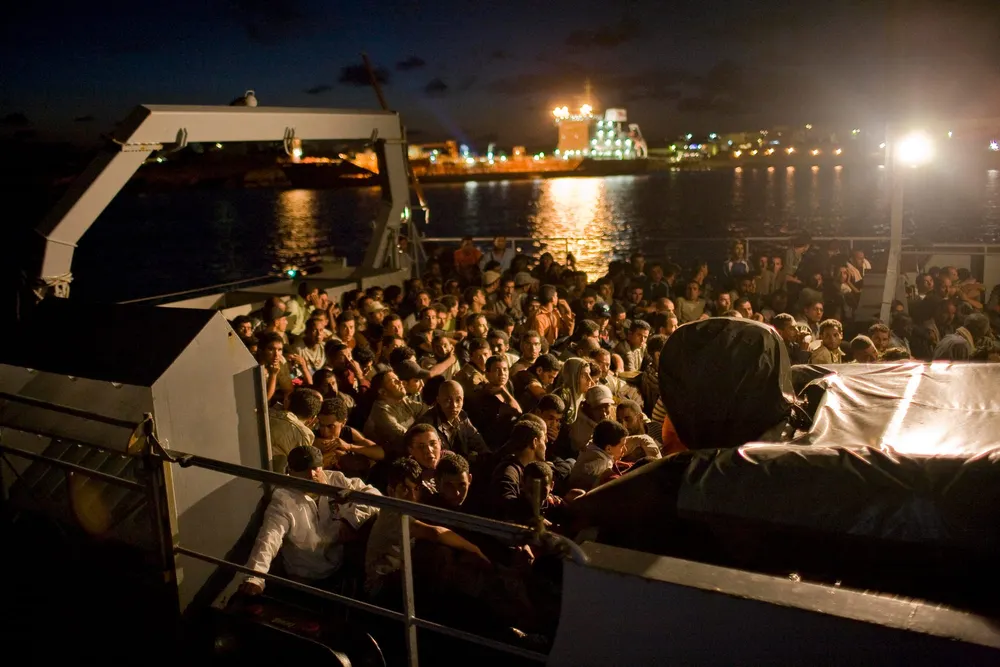
But before we get into that, let’s first get a better idea of what the nature of the problem is that we’re dealing with here. If we look globally at the question of migration and the related issue of displacement of people, which can be internal displacement or foreign displacement from their respective countries, we’re talking about a situation where hundreds of millions of human beings have been driven into migration or have been displaced [Figure 2].

Over the last 45 years, you can see that the total number of combined migrants and displaced persons rose from about 232 million in 1980 to approximately 422 million today. That is an 84% increase over this 20-year period. Even if you look at this in terms of the percentage of the total world population, the increase is still stunning. Back in 1980, migrants and displaced persons were 3.5% of the world population. Today, they are 5.1% of the world’s population—that’s about a 46% increase in the percentage of this devastated category of our human species.
We’re talking about 5% of the human beings living on this planet having been driven into conditions which are not worthy of the dignity of man! That is the simple fact of the matter. And to the degree to which we tolerate this, and most especially the wars and economic devastation which are producing this, we will not have the requirements, the moral fitness to survive.
Where are these flows coming from? You can pretty much guess. The major countries are Afghanistan, destroyed by war; Syria, destroyed by war; Venezuela, destroyed first by economic sanctions, now by a military invasion and takeover by the United States; Ukraine, destroyed by war; Sudan and South Sudan, destroyed by economic conditions imposed by the City of London and Wall Street, and war. Then, of course, we have Mexico and Central America, the nearest sources of immigration for the United States, whose economic conditions have been devastated, as we have proven previously, by the policies of Wall Street and the City of London, by the IMF.
If this trend continues, we are soon going to reach about a half-billion people trying to survive under these conditions.
LaRouche’s Science of Physical Economy
The reason that this is occurring, again, is that the potential relative population-density of the planet has been greatly diminished across the board. As I mentioned, potential relative population-density is the central concept which Lyndon LaRouche elaborated to measure the impact on the physical economy of the world and the ability to maintain a growing, prosperous population based on advances and breakthroughs in science and technology, and similar breakthroughs in Classical culture. Potential relative population-density is not a monetary measure. It is a physical-economic measure which indicates the power or the ability of a society to prosper and maintain a growing population. That potential relative population-density is being devastated by a world financial system, a trans-Atlantic system which is in a systemic breakdown collapse. The migrant problem is a reflection of that breakdown of the potential relative population-density as a result of a bankrupt speculative financial system totalling about $2.4 quadrillion.
We see this in the devastation of production. We see it in terms of people’s consumption. There’s no infrastructure; there’s no education, worthy of the name. The culture is so devastating that Satan is rubbing his hands in glee at what he sees. I’m speaking largely of the United States, but not only so. We have been sunk into a level of moral depravity both by what we do and, even more emphatically, by what we tolerate being done to others, that if it is not reversed, we are not going to have the moral fitness to survive as a species.
China’s Approach to Development
One has to ask the question: Is this necessary? Is this the human condition? Is this what happens as economies grow?
Absolutely not. Look back at Figure 2, and look at the second curve, what China has achieved in the same time period we are discussing. China has eliminated poverty. It has reduced the number of poor people by about 850 million people in a period of 40-45 years. It was done by developing the productive powers of labor, by developing the infrastructure, by creating jobs, by focusing on productivity and not on speculation.
Yes, we are measuring different categories on this graph, and with different scales. One is the number of world migrants and displaced, and the other is the number of poor in China. But my purpose in putting these on the same graph is that they are both reflections of whether or not mankind is managing to increase its potential relative population-density. In China, they are doing that. In the trans-Atlantic sector, we are not.
It’s not surprising, therefore, that in recent polls a majority of Mexicans and Canadians now prefer China to the United States. I’m sure that this is not a preference over language, food, or soccer teams. It’s over whether or not there is a future possible under these conditions.
Now, let me show you two maps that I’ve shown before, which I think are worth showing again.


The first [Figure 3] gives you a quick idea of a number of the major projects that China has prepared for South America, some of which are already in existence. One is the Chancay Port. They have also helped Bolivia develop the Mutún iron ore deposits, to actually produce steel for the first time in Bolivia’s history. There is this crucial question of the Bioceanic Rail Corridor, which would open up the entire interior of the continent to development. There is discussion of a new sea-level Nicaraguan canal, which is very necessary for world trade and development. China agreed with Panama to build a high-speed rail line through Panama, with the idea of then connecting it up through the rest of Central America. There were discussions as well with Mexico on high-speed rail, but they have been stalled.
So, if you’re an Ibero-American living in one of these countries, and you are adequately informed and you look at the world and you think of what’s available to your country, this is what you see.
Now turn your attention northward and ask: What has the United States offered by way of development to Ibero-America over the last couple of decades? Figure 4 shows what you see: nothing. The United States has offered no infrastructure projects of any significance whatsoever, let alone built them. On the contrary, the policy from the United States, as stated in the 2026 U.S. National Security Strategy document of the Trump administration, is that China must be excluded from Ibero-America at all costs. If this means overthrowing the government of Venezuela and making a coup d’état and kidnapping its President, so be it. If it means blowing up the Chancay Port—I would not exclude that; not after Nord Stream—if it means stopping the Bioceanic Corridor, if it means actively attempting to prevent the reelection of the Lula government in Brazil, so be it. Lula is committed to these kinds of development projects, and Brazil is a member of the BRICS and a leading force internationally for infrastructure and development to put an end to poverty.
The South American Bioceanic Rail Corridor
Let me conclude by turning back to the question of the Bioceanic Corridor. Railroads are crucial to development, not simply to get from point A to point B. That’s good too; sometimes you have to go from A to B. But rail corridors are crucial for opening up a new technology platform over an entire area of development. This is what the United States did with the Transcontinental Railroad under Abraham Lincoln, completed in the mid-19th Century. The total length of that railroad was 1,900 miles, give or take. It was absolutely critical to the growth, industrialization, and technological advance of the United States of America.
A little later, the Trans-Siberian Railroad was built across Russia, largely inspired by the economic policies of Lincoln and of the American System. That was a railroad of 5,700 miles, which came from the American System policies of Count Sergey Witte and others, which opened up the entire area to broader development.
It is now time to do the same thing, a century or two later, in South America. The Bioceanic Rail Corridor [Figure 1] would be about 2,800 miles long. It is estimated that it would take about one decade to build—faster if it’s done, not just with Chinese technology, but with “Chinese time.” The Chinese do things fast, and this shows that it is absolutely possible. The estimated cost would be in the range of $80 billion, less than a tenth of the United States military budget every year.
The project is estimated to create approximately one million direct jobs inside Brazil alone to build this railroad. It’s a real challenge. You’ve got to go through the Amazon region. Then you’ve got to cross the Andes—they are a very high mountain range—to get over into Peru. But the multiplier effects that this will have, not only on employment, but on productivity overall, are almost inestimable. One could readily calculate that another 2-3 million indirect jobs would be created as part of this great project.
But again, the crucial question is the kind of optimism in the population that this project will unleash, as it already has done in Peru with the Chancay Port. This creates in the population a sense that it is possible; that there is a reason to educate their children, to educate themselves, to develop their skills, to contribute to the advancement and well-being of their nations as part of a broadly developing humanity as a whole.
That is the true objective; that is the way to address the migrant problem. It is, of course, necessary to treat migrants and displaced persons with humanity and dignity, as Pope Leo XIV has emphasized, and stop this insanity of the Paddock Plan, which the Trump administration is implementing, and similar policies underway in Europe. There is no question about that. But the root problem will not be solved unless and until we drastically increase the potential relative population-density of our species. And that will require putting the financial bubble of Wall Street and the City of London—all $2.4 quadrillion of it—where it belongs: frozen, on trial, with those responsible for it paying the price. As under the Franklin Delano Roosevelt period, this means putting guilty bankers in jail.