
While Western media has fixated on the hysteria of U.S. President Donald Trump’s team, from the President and his Vice President on down, against Pope Leo XIV’s mobilization of the Catholic Church worldwide to voice an emphatic “no” to their threat of war to “obliterate” an entire civilization, little attention has been paid to the substance of Pope Leo’s April 13-23 missionary visit to today’s continent of hope, Africa.
Throughout the trip, the Pope continued to denounce war and “despots and tyrants” who seek to dominate the world. He exemplified moral authority, as recognized around the world, with his firm statement that he “did not fear” President Trump and his administration, with whom he had no interest in debating, since his role is to uphold the Gospel. On the last leg of his trip, in Equatorial Guinea, he repeated the formulations which had originally drawn Trump’s rage, condemning those who wage war in the name of God. “His holy Name must not be profaned by the will to dominate, by arrogance or by discrimination; above all, it must never be invoked to justify choices and actions of death,” Pope Leo stated.
Less noticed by most of the arrogant Western establishment and its media outlets, was the manner in which the Pope made an enormous contribution to the great task before humanity: replacing the monstrous oligarchic system of the rentier-financier imperialists with a society fit for human beings in the eyes of the Creator.
The Pope traveled to four nations of Africa—Algeria, Cameroon, Angola, and Equatorial Guinea—as “a pilgrim of peace and unity,” “a shepherd,” “a servant of dialogue, fraternity and peace.” On every occasion, whether meeting with government officials and members of the diplomatic corps, giving homilies at multiple large masses, addressing university professors and students, meeting with youth, addressing religious leaders, or visiting the Great Mosque of Algiers, nursing homes for the elderly, an orphanage, a psychiatric hospital, or a prison, he sought to inspire everyone, and most especially the youth, to take up the responsibility of becoming “active agents of change” to bring about “a future of peace and reconciliation, in which the dignity of every human person is respected and their fundamental rights guaranteed.”
With the same urgency as his calls for wars to be stopped, Pope Leo insisted throughout his trip that “the time has come, today, not tomorrow, now and not in the future,” for societies and economies of nations to be governed by morality, and dedicated to securing the common good of their people. He spoke out repeatedly against the robbery of the continents’ resources by rich, speculative interests, foreign or domestic, and pointed to the “joy and hope” of Africa’s young people as “a profound and empowering force” through which Africa can contribute to the transformations which are possible in this “extraordinary time of great renewal” worldwide.
“Despots and tyrants of both body and spirit seek to render souls passive and passions gloomy; they prefer a populace prone to inertia, docile and subservient to power…. True joy frees us from such alienation,” he counselled.
In each country, Pope Leo encouraged its people to take confidence that Africa has a great role to play in the world, precisely because of its youth and their desire for change.
“Africa can make a fundamental contribution to broadening the overly narrow horizons of a humanity that struggles to hope,” he told students and professors at the Catholic University of Central Africa in Cameroon’s capital, Yaoundé. The greatest hunger in the world today may well be the “hunger for a future imbued with hope that is capable of engendering a new sense of justice and producing fruits of peace and fraternity,” he suggested in his homily during a mass at the Cathedral Basilica of the Immaculate Conception in Mongomo, Equatorial Guinea. Here, too, he insisted “this is not an unknown future that we must passively await, but rather one that we ourselves are called to build with God’s grace.”
Addressing government officials, representatives of civil society, and the diplomatic corps in Angola, Pope Leo asserted most beautifully how Africa can lead in building that world:
For the entire world, Africa is a reservoir of joy and hope, which are virtues that I would not hesitate to call “political,” because her young people and her poor continue to dream and to hope. They are not content with what already exists; they strive to rise above, to prepare themselves for great responsibilities, and to take an active part in shaping their own future. Indeed, the wisdom of a people cannot be stifled by any ideology, and the longing for the infinite that dwells in the human heart is a principle of social transformation far deeper than any political or cultural program. I am here among you, at the service of the finest powers that animate the persons and communities, of which Angola is a rich and vibrant mosaic.
LaRouche: No Nation Is Condemned To Be a ‘Poor Nation’
The outlook expressed by Pope Leo XIV for the future of the African nations is one shared by American statesman Lyndon LaRouche, the founder of this news service and magazine. Addressing a packed auditorium of 450 people in Lima, Peru, on April 4, 1987, at a conference jointly sponsored by the Schiller Institute and the St. Augustine School in Lima to commemorate the 20th anniversary of Saint Paul VI’s encyclical, Populorum Progressio, LaRouche, too, had insisted that “the entire developing sector is threatened in a similar way [as Africa], unless necessary measures are taken soon,” declaring that “we must win the fight for such a just economic order, and we must win it now.”
“Never accept the idea that some countries are rich, and other countries are poor,” LaRouche urged his listeners, elaborating on the need for mankind to take on the challenges of space exploration. “Never think of yourself as a person from a poor country. I have asked you to turn your eyes up to the stars, to see, with pride and confidence, what your mind is capable of enabling you to accomplish. Your dreaming that dream of the stars, is your nation’s potential; your nation’s potential is its future reality.”
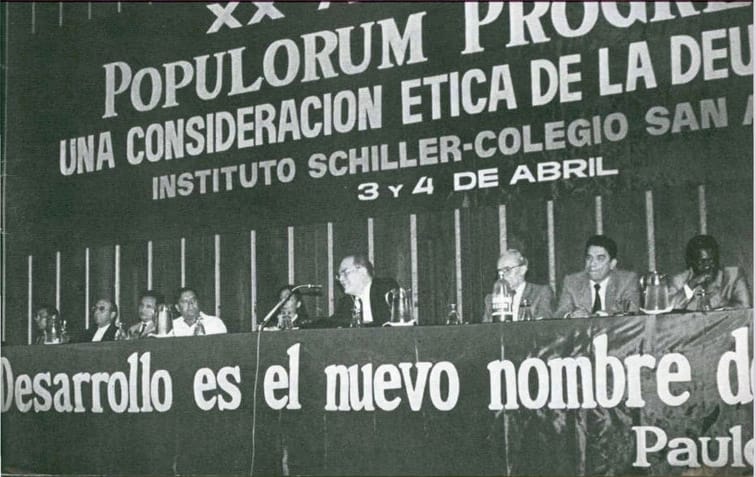
LaRouche had counseled Peru’s leaders, and its youth particularly: “Never accept the sight of human misery; human misery is unnecessary. Never accept the idea that the world is in danger of being overpopulated by anything except a surplus of diseases and Malthusians.”
Africa, the Continent of Hope
On his flight to Algeria, his first stop, Pope Leo told reporters that he had hoped to make Africa the first journey of his pontificate, a desire which, for logistical reasons, was not to be the case. That he chose to prioritize a visit to Africa is itself a statement against the racist Western view of Africa espoused by the Robert Kagans and Josep Borrells of this world, that Africa is the center of the poor “jungle” which threatens the imagined “garden of the West.”
Each of the four countries he visited has its own particular characteristics. His trip began in Algeria, a former French colony and now a nation of 48 million people, 98-99% of whom are Muslim; Arabic and Tamazight (Berber) are the official languages, while French is still spoken in some circles. Because of government support programs, Algeria notably has one of the lowest poverty rates in Africa. The Pope chose, by his own account, to visit Algeria for two reasons, even though there are, at most, perhaps 10,000 Catholics living in the country. Algeria holds a special place in his heart as the birthplace of St. Augustine. The Pope led the worldwide Augustinian order as Prior General from 2001-2013 and describes himself as “a spiritual son of Saint Augustine.” Equally important, however, is that he saw his visit as a “wonderful opportunity to continue to build bridges and promote dialogue” with the Muslim faith.
From there he flew to Cameroon, a nation of some 30 million people, 40% of whom are under 14 years old. Catholicism is its largest religion, with Protestants, Muslims, and other religions making up more than half the people. Here, French and English are the predominant languages, but the north and southwest regions of the country have been wracked by an Anglophone guerrilla separatist conflict; meanwhile, over 35% of all Cameroonians live below the official poverty line. The Pope, even as he acknowledged in his many encounters the pain and difficulties faced, came with a message of hope. “It is with deep joy that I find myself in Cameroon, often described as ‘Africa in miniature’ because of the richness of its lands, cultures, languages, and traditions,” he told government authorities, representatives of civil society, and the diplomatic corps. “This variety is not weakness but a treasure. It constitutes a promise of fraternity and a solid foundation for building lasting peace.”
In Angola, with its largely Portuguese-speaking 38 million people, more than 30% live in extreme poverty, despite its great oil and diamond wealth. Nearly 40% are Catholics, making it the most prominent religion in the country. Almost half (47%) of Angola’s people are under 15 years old, making it one of the youngest countries in the world. Here, the Pope visited three cities, as well as the Mama Muxima shrine outside Luanda, in his three days in the country.
His last stop was Equatorial Guinea, a nation of just under two million people and the only predominantly Spanish-speaking country on the continent, where more than 70% are counted as Catholics. Here, some 37% are under 14 years old, and over half of the nation lives below the poverty line, despite the country’s oil riches.
Justice and the Peace of the Faiths
Justice stems from recognizing “the image of God in others.” This assertion by the Pope in his address to government officials, representatives of civil society, and the diplomatic corps in Algeria was a theme sounded throughout his African visit. “We are brothers and sisters, for we have the same Father in heaven,” he told that meeting. “In a world full of conflicts and misunderstandings, let us meet and strive for mutual understanding, recognizing that we are all one family!” He stressed that today, “the simplicity of that awareness,” that we are all one family, with the same Father in heaven, “is the key to opening many doors that are closed.”
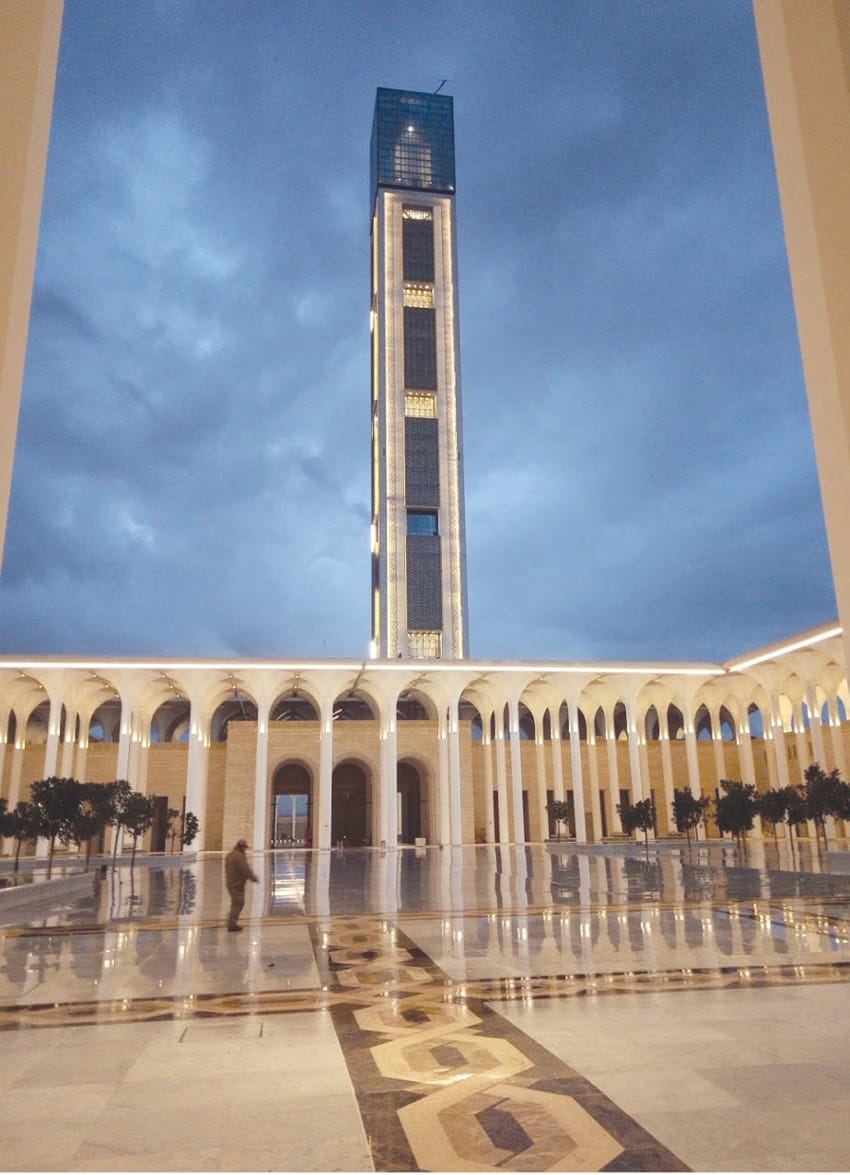
Pope Leo was given a personal tour of the Great Mosque of Algiers (Djamaâ El-Djazaïr) by the Rector of the mosque, Mohamed Mamoun Al Qasimi. He offered a few moments of silent prayer and signed a message of peace in both Arabic and French in the mosque’s Golden Book. In responding to his welcome from Al Qasimi, Pope Leo repeated that “to seek God is also to recognize the image of God in every creature, in the children of God, in every man and woman created in God’s image and likeness. For us, this means that it is very important to learn to live together with respect for the dignity of every human person.”
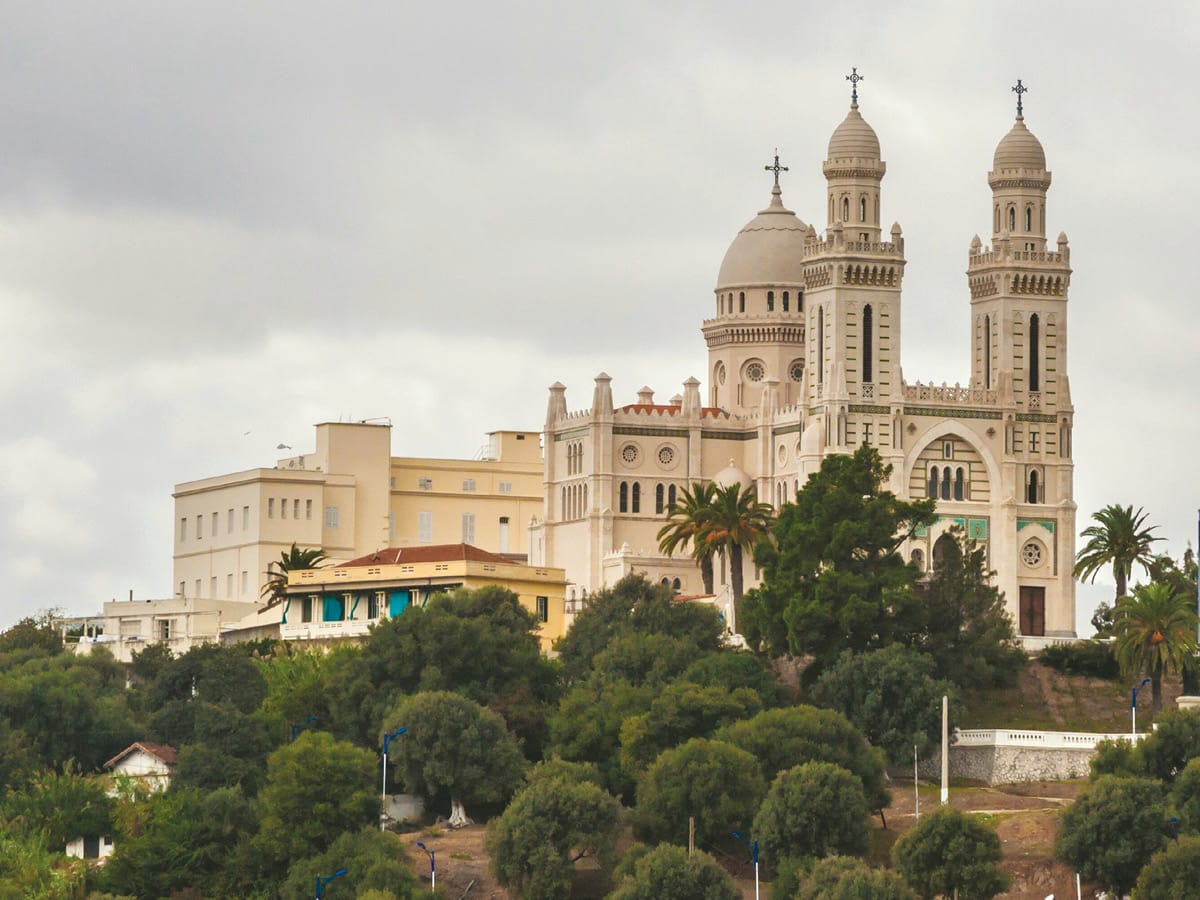
He also met with the Algerian Catholic community at the Basilica of Our Lady of Algiers, a beautiful church which houses a magnificent statue of a black Madonna, where both Christians and Muslims have come to pray for more than a century. Written in mosaic in the apse are the words: “Our Lady of Africa, pray for us and for the Muslims.” Pope Leo called the basilica “a sign of our desire for peace and unity. It symbolizes a Church of living stones, where communion between Christians and Muslims takes shape under the mantle of Our Lady of Africa.”
The Pope pointed to the significance of his visit to the Great Mosque when he spoke with reporters upon leaving Algeria. “We have different beliefs; we have different ways of worshiping; we have different ways of living. We can live together in peace.”
Nor did the Pope limit that message to Muslims. In Cameroon, after meeting with 12 representatives of several Muslim communities, he expressed his gratitude for the warm welcome he had received from everyone in Cameroon, “Christians, Catholics and non-Catholics, Muslims, and people of traditional religions,” Vatican News reported. He encouraged all Cameroonians to continue “to communicate everyone’s desire to find peace, not a peace of indifference, not a peace that takes away the richness of differences, but a peace that is born when we recognize that we are all brothers and sisters, all creatures of the One alone, all called to respect the dignity of all.”
Not surprisingly, the devotees of the British imperial “Clash of Civilizations” doctrine who hold up Muslims as “The Enemy,” are already spewing out their fury on social media against the Pope for daring to assert that all of humanity is one family under God. Their anger reflects just how afraid they are of the power of that message.
Nations vs. Neocolonialism
The first event of the Pope’s “bridge-building” trip was a visit to the Maqam Echahid Martyrs’ Monument in Algiers, which honors those who died in Algeria’s struggle for independence from France.
“Our presence here at this monument pays tribute to this history of Algeria and to the very spirit of a people who fought for the independence, dignity, and sovereignty of this nation,” he said there. “In this place, let us remember that God desires peace for every nation: a peace that is not merely an absence of conflict, but one that is an expression of justice and dignity.”
In his meeting with officials, civil society, and diplomats afterwards, the Pope suggested that Algeria, with its “distinctive identity as a bridge between North and South, and between East and West,” and its history of overcoming difficulties, has “a particularly important perspective on the global balance of power,” which may allow it “to contribute to both envisioning and bringing about greater justice among peoples. By respecting the dignity of everyone and allowing yourselves to be moved by the pain of others, instead of multiplying misunderstandings and conflicts, you can surely become protagonists of a new chapter in history.”
“Today, this is more urgent than ever in the face of continuous violations of international law and neocolonial tendencies,” he noted. “Many societies that consider themselves advanced are plunging ever deeper into inequality and exclusion. Africa knows all too well that people and organizations that dominate others destroy the world, which the Most High has created in order that we might all live together.”
Contrasting this, Pope Leo noted that the great expanses of the Mediterranean and the Sahara “represent geographical and spiritual crossroads of immense significance,” in whose history “we discover immense treasures of humanity. … For the sea and the desert have been places of mutual enrichment among peoples and cultures for millennia. Woe to us if we turn them into graveyards where hope also dies! … Let us multiply oases of peace,” he declared. “Let us, then, unite our strength, spiritual energy, intelligence resources, so that the land and the sea may become places of life, encounter and wonder.”
This was a theme in his meetings with the authorities, civil society, and diplomatic corps in each of the other countries as well. In Cameroon, he warned that in addition to its internal problems, Cameroon faces “the damage caused from outside, by those who, in the name of profit, continue to lay their hands on the African continent to exploit and plunder it.”
In Angola, he spoke at greater length of how foreign interests “look to your lands in order to give, or, more commonly, in order to take,” bringing untold suffering, deaths, and disasters. This “logic of extractivism … sustains a model of development that discriminates and excludes, while still presuming to impose itself as the only viable option,” he charged. He recalled that Saint Paul VI, a full 60 years ago, had denounced this “senile and definitely out-of-date aspect of a commercial, hedonistic and materialistic civilization which is still trying to present itself as the gateway to the future.” The Catholic Church in Angola “desires to be leaven in the dough and to foster the growth of a just model of coexistence, free from the various forms of slavery imposed by the elite who are laden with much wealth but false joys,” he offered.
Likewise, in Equatorial Guinea, where Pope Leo cited the Social Doctrine of the Catholic Church, specifically the 1891 encyclical Rerum Novarem of Pope Leo XIII, and reminded his audience that “the gap between a ‘small minority’—1% of the population—and the overwhelming majority has widened dramatically” and that “it is the imperative duty of civil authorities and of sound politics to dismantle the obstacles to integral human development.” He condemned speculation on raw materials, stating: “It is even more evident today than in years past that the proliferation of armed conflicts is often driven by the exploitation of oil and mineral deposits, occurring with no regard for international law or the self-determination of peoples.”
Justice and the Economics of the Common Good
“In a world wounded by arrogance, people hunger and thirst for justice,” Pope Leo declared in the same meeting. “It is necessary to encourage those who believe in peace and to dare to engage in ‘countercurrent’ politics—those which place the common good at their very center.”
Pope Leo did not offer specific economic or political solutions in his many encounters, but throughout, over and over, he insisted that the starting point, the intention, of economic policy or governing, or participating in a nation, must be to serve the common good.
“The true strength of a nation lies in the cooperation of everyone in pursuing the common good. Authorities are called not to dominate, but to serve the people and foster their development,” he argued in his meetings with authorities in Algeria. “Africa and the world stand in need of people who are committed to living according to the Gospel and to placing their talents at the service of the common good. Do not betray this noble ideal,” he urged professors and students at the Catholic University of Central Africa in Cameroon.
“My visit is an expression … as well as of the desire to encourage each of you to keep moving forward with enthusiasm and perseverance in building the common good,” he explained in a meeting with authorities in Cameroon. “Serving one’s country means dedicating oneself, with a clear mind and an upright conscience to the common good of all the people in the nation,” he said, adding, “to govern means to love one’s own country as well as neighboring countries; the commandment ‘love your neighbor as yourself’ is equally applicable to international relations!”
War, Injustice, Poverty Can Be Overcome!
In his meetings in Equatorial Guinea, the Pope welcomed the decision taken by the authorities to name the new capital city being built Ciudad de la Paz (City of Peace). He explained:
You know that Saint Augustine interpreted events and history according to the model of two cities: the ‘city of God,’ eternal and characterized by God’s unconditional love (amor Dei), as well as love for one’s neighbor, especially the poor; and the ‘earthly city,’ which is a temporary dwelling place, where men and women live until death. From this perspective, the two cities coexist until the end of time (cf. De civitate Dei, 19,14), and every human being, through the decisions he or she manifests day by day, belongs to one or the other of them.
May the name of the new city “prompt every person to ask themselves which city they wish to serve! As I had the opportunity to remind the diplomatic corps accredited to the Holy See, according to the great father Augustine, the earthly city is centered upon the proud love of self (amor sui), on the lust for power and worldly glory that leads to destruction.
“By contrast, Augustine holds that Christians are called by God to dwell in the earthly city while keeping their hearts and minds turned toward the heavenly city, their true homeland.”
One of Pope Leo’s most compelling messages throughout his trip was that these beautiful concepts of the human family must become the basis for human practice; the ills of this world can be overcome. Addressing those gathered with him at Angola’s shrine to Mama Muxima, the Virgin Mary, Pope Leo told especially the young people there:
The Mother of Heaven entrusts a great project to you as well: to build a better, welcoming world, where there is no more war, injustice, poverty or dishonesty, and where the principles of the Gospel increasingly inspire and shape hearts, structures and programs, for the good of all. It is love that must triumph, not war!