This article is an expanded version of one by the same author, previously published in April 2026 in China’s People’s Daily.
May 2—The growing role of the BRICS nations today, the reach of the Shanghai Cooperation Organization (SCO), and the leadership of BRICS nations China and Russia in large development projects throughout the Global South, all point towards the creation of a New Just World Economic Order. This is an epochal shift which includes the end of neocolonialism. Shepherding in this new paradigm, Russian President Vladimir Putin has referred to “new financial platforms” to be created, and Chinese President Xi Jinping has been quoted in Qiushi, discussing “establishing new systems before the breakdown of old ones.”
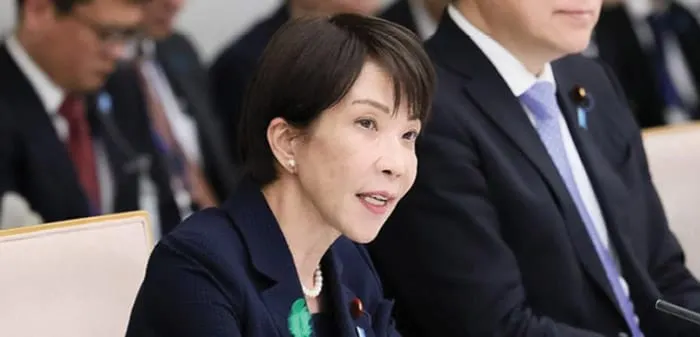
As part of a foolish and dangerous attempt by the current U.S. administration and by NATO to stop this emerging just order, the new Prime Minister of Japan, Sanae Takaichi, is playing her reckless part. Japan is now on a fast track of militarization, which would include the hosting of nuclear weapons. Although she may believe she is pursuing merely an anti-China policy, in fact Takaichi is playing the deadly role of a pawn of both Global NATO, and the current U.S. military drive defined by “might makes right.” In today’s nuclear-weapons-expansion environment, this will lead quickly to World War III, if it is not stopped.
On April 27, Takaichi convened a meeting at her residence of an “expert” panel intending to revise Japan’s recently adopted national security principles, known as the “Three Documents,” “to proactively advance the fundamental reinforcement of defense capabilities … a crucial measure bearing on the trajectory of national destiny.” Takaichi’s plan would enable Japan to quickly build up an advanced warfighting capability, including both nuclear weapons and the deployment of Japan’s military in distant theaters of war, such as Ukraine and Iran. President Donald Trump’s recent demand that Japan join the United States and Israel in its war against Iran underscores the immediate danger of Takaichi’s new war plan. Already in 2022, Japan had adopted the Three Documents—a then more aggressive offensive military plan than previously in use—which provided for the development of a counterstrike capability, a deepened Japan-U.S. military alliance, and for space, cyber, and electromagnetic warfare capabilities.
According to the Tokyo News report on the April 27 meeting at her residence, Takaichi said that Japan “must secure sustainable combat capabilities and prepare for protracted warfare.”
Japan’s Military Deployments Violate Its Constitution
Global Times reports that Japan is currently deploying three new types of offensive missiles: upgraded Type-12 long-range land-to-ship missiles in Kumamoto, Hyper-Velocity Gliding Projectile missiles in Shizuoka, and soon, U.S. Tomahawk cruise missiles to be carried on the Japanese Navy’s two planned Aegis destroyers. Simultaneously, Japan has sent legislative delegations to China’s Taiwan province to support the Taiwan “independence” movement in a provocative violation of China’s national sovereignty. On November 7, 2025, Takaichi announced Japan’s readiness to send its military into the Taiwan Strait under the pretext of a “Taiwan contingency.”
It is worth reviewing the sharpness of Article 9 of Japan’s Constitution, which was ratified in 1947, while the Tokyo war crimes trials were still underway:
Article 9. Aspiring sincerely to an international peace based on justice and order, the Japanese people forever renounce war as a sovereign right of the nation and the threat or use of force as means of settling international disputes.
In order to accomplish the aim of the preceding paragraph, land, sea, and air forces, as well as other war potential, will never be maintained. The right of belligerency of the state will not be recognized.
It is this Constitution which Takaichi and her war faction hope to rid of its pacifist character. As is well known, she also intends to alter the Three Non-Nuclear Principles—which specify that Japan will never possess, produce, or allow the introduction of nuclear weapons—to create a new National Intelligence Agency modeled on that of pre-war Imperial Japan, and to revise and relax prior restraints on domestic military production and its exports. On March 14, speaking at the graduation ceremony of the National Defense Academy of Japan, Takaichi said that the government will work to enhance defense capabilities “without excluding any option,” according to the Sankei Shimbun.
Military Build-Up Taken Abroad
Takaichi and Defense Minister Shinjiro Koizumi then took this aggressive outlook to talks and agreements with other nations in the region, including Vietnam, Australia, Indonesia, and the Philippines. They signed defense and economic agreements, in keeping with U.S. and Japanese efforts to encircle China and prepare for war.
In Vietnam on May 2, Takaichi signed six agreements on issues ranging from infrastructure to agriculture to space cooperation. “The two sides identified economic security as a new priority area for bilateral,” Takaichi told reporters after the meeting. Vietnamese Prime Minister Le Minh Hung said the two leaders also “reaffirmed the importance of resolving disputes in the South China Sea through peaceful means based on international law.” Reuters reported that “Japan and Vietnam share concerns about China’s territorial claims in the East and South China Seas, and both have sought to hedge against United States–driven trade disruptions by broadening economic and security ties.”
In fact, Vietnam has generally resolved issues over the South China Sea with China, while Japan is expanding its military capacities in the region, and issuing threats to China over Taiwan.
In Australia, Takaichi met on May 4 with Prime Minister Anthony Albanese, “concluding agreements on boosting economic and energy security ties, as well as defense, critical minerals and cyber partnerships. She said in a briefing alongside the Australian Prime Minister that China was among regional topics they discussed,” Bloomberg reported. This follows a defense agreement signed between the two nations last month, in which Australia and Japan’s Defense Minister Koizumi signed contracts for Mogami-class warships to be delivered to the Australian Navy under a landmark, $7 billion defense deal.
In Indonesia, Defense Minister Koizumi and Indonesian Defense Minister Sjafrie Sjamsoeddin signed an agreement in Jakarta on May 4. “We have both agreed to promote substantive cooperation in the defense industry, and development of our personnel, whilst taking into account our respective national interests,” Sjafrie said before the signing ceremony, in an audio recording shared by the Indonesian Defense Ministry.
Koizumi then visited the Philippines to observe the Balikatan military exercises, an annual U.S.-Philippines exercise which Japan joined this year. Ahead of Koizumi’s visit, Japanese media reported that Tokyo was weighing the transfer to Southeast Asian states of decommissioned naval vessels such as destroyers and submarines—repurposing defense hardware that would otherwise be mothballed or scrapped.
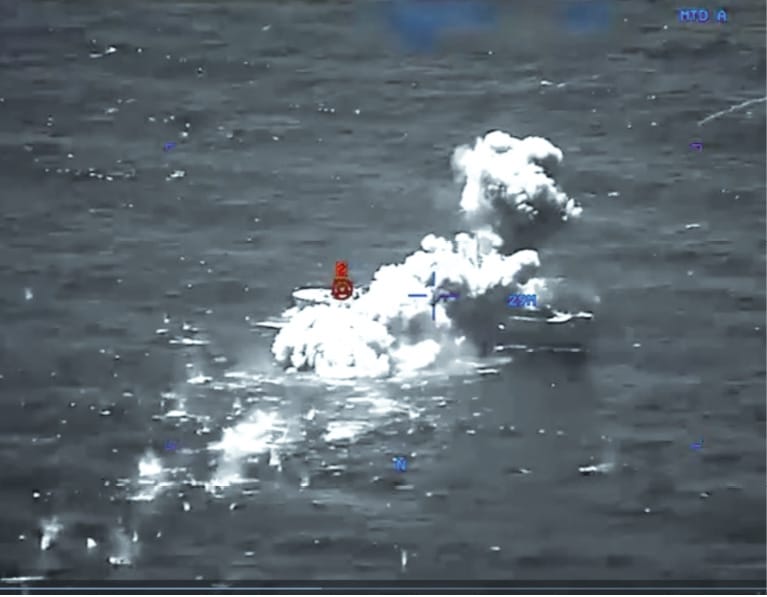
In a dramatic provocation, on May 6, Japan fired a surface-to-ship Type 88 missile as part of the exercises off the coast of the Philippines, hitting a decommissioned Philippine ship. This is the first firing of the missile by Japan outside of its own borders.
China’s Foreign Ministry spokesman Lin Jian, when asked about this, responded forcefully:
Japan once invaded and imposed colonial rule over the Philippines and other Southeast Asian countries, and thus shoulders grave historical responsibilities. As the world marks 80 years of the opening of the Tokyo Trials, not only has Japan, the aggressor, failed to deeply reflect on its historical crimes, it has even sent military forces overseas and fired offensive missiles under the pretext of security cooperation. This is yet another example of the Japanese right-wing forces’ push for accelerated remilitarization of Japan. They have repeatedly breached Japan’s exclusively defense-oriented policy and relevant rules in international and domestic laws…. The serious lack of education on true history, the fundamentally wrong historical views, compounded by strategies for military rearmament and preparation for war, have led to the malevolent emergence of neo-militarism in Japan and put regional peace and stability under threat.
Japan: 1895 to 1945
What is the history of Japan’s colonialism and its “might makes right” violence towards China and its East Asian neighbors? It is vital that the younger generation today know both the history of the last 100 years, including the causes of fascism, and the great potential today for the end of colonialism and the modern economic development of the Global Majority.
In 1895, Japanese forces exploited the weakness of China’s Qing Dynasty, seizing the provinces of Shandong and Liaoning and forcing the surrender of Taiwan to Imperial Japan. Taiwan was to remain a brutalized colony of Japan until 1945. In September 1931, Japan seized the city of Mukden in China’s Manchuria region, and shortly thereafter began bombing densely populated Shanghai. By July of 1937, Japan had invaded the Beijing area with 160,000 troops, marking a further escalation. That year, Japan also carried out the notorious Nanjing Massacre. Chinese victims—women, children, civilians as well as soldiers—numbered as many as 300,000. In the course of the entire “War of Resistance Against Japanese Aggression,” China suffered 35 million casualties.
A Spiritual Recrudescence and Improvement of Human Character
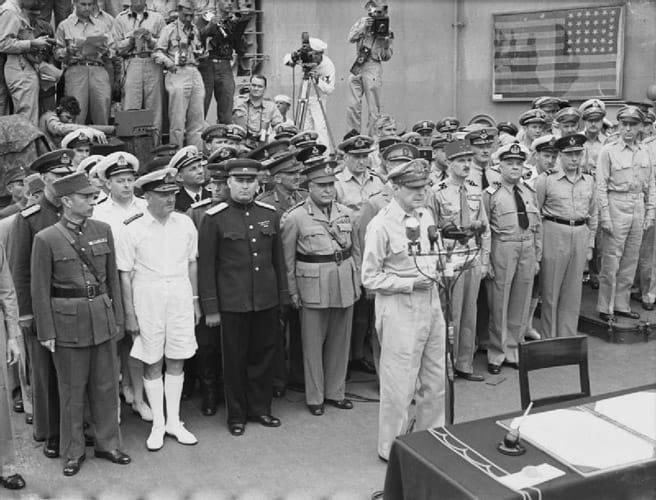
At 9:02 in the morning of September 2, 1945, on the deck of the battleship USS Missouri, U.S. General of the Army Douglas MacArthur convened the signing of the Instrument of Surrender of the Imperial Government of Japan. China, America’s fraternal ally, was represented by General Xu Yongchang. Eleven representatives of Japan’s Emperor, the Imperial Foreign Ministry, and the Imperial Army and Navy attended. Japan’s representatives were expecting orders of execution for their war crimes on the spot.
Instead, General MacArthur treated them as foreign diplomats and said, in part, the following, in light of the fact that mankind had just entered the age of nuclear weapons:
Men since the beginning of time have sought peace. Various methods through the ages have been attempted to devise an international process to prevent or settle disputes between nations. From the very start, workable methods were found, in so far as individual citizens were concerned, but the mechanics of an instrumentality of larger international scope have never been successful. Military alliances, balances of power, Leagues of Nations, all in turn failed, leaving the only path to be “by way of the crucible of war.” The utter destructiveness of war now blocks out this alternative. We have had our last chance. If we will not devise some greater and more equitable system, Armageddon will be at our door. The problem basically is theological and involves a spiritual recrudescence and improvement of human character that will synchronize with our almost matchless advances in science, art, literature, and all the material and cultural developments of the past 2,000 years. It must be of the spirit, if we are to save the flesh.
Schiller Institute historian Asuka Burke, writing in Executive Intelligence Review, February 9, 2018, emphasized:
In reporting back the surrender ceremony to the Emperor, a member of the Japanese delegation made the honest reflection that Japan, if it had been victorious, would not have treated the former enemy with such magnanimity. After all, we were not beaten on the battlefield by dint of superior arms. We were defeated in the spiritual contest by virtue of a nobler idea. The real issue was moral—beyond all the powers of algebra to compute.
Can Japan pull back from its current fast march towards ripping up its post-war Constitution, becoming a nuclear state with the most deadly offensive weapons, and once again provoking war with China? Perhaps, the looming defeat of the United States and Israel in their unprovoked war against BRICS nation Iran, and the potential of a prolonged constriction of oil and natural gas flows to Japan from Southwest Asia may help Japanese citizens and their political formations rein in Prime Minister Sanae Takaichi’s militarization drive.
For Japan to avoid its own complete destruction in a new Japanese-provoked war, its leadership must turn to “a spiritual recrudescence and improvement of human character”—as U.S. General of the Army Douglas MacArthur had demanded.
—Kevin Pearl contributed to this article.