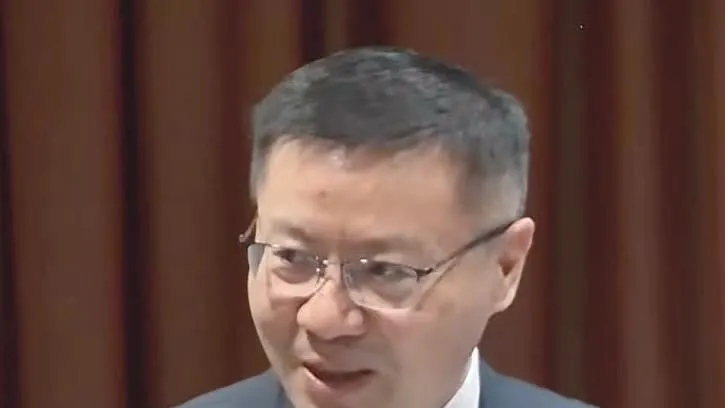
The following is an edited transcript of the address by Prof. Zhang Weiwei to Panel One of the May 30-31 Schiller Institute Berlin conference, “The End of 500 Years of Colonialism: For a Dialogue of Civilizations—The Urgency of a New Global Security and Development Architecture.” Prof. Zhang is director of the China Institute at Fudan University, Shanghai, China. Subheads have been added.
Thank you, Stephan. Thank you, Helga, for your enlightening speech. I will discuss the topic, “Building a Win-Win Multipolar World Order.” And as a scholar on the Chinese model of development, one feature of this Chinese model is experimental. We always try out pilot projects before we engage in bigger exercises. So, I would like to use the case of the partnership between China and the organization for Southeast Asia, ASEAN. Can the China-ASEAN partnership lead the way for a new multipolar world order to come? As you know, we live now in a world of disorder, in many ways, chaos. And I remember the theme for the 2024 Munich security conference was lose-lose, which reflects Europe’s current predicament.
The Ukraine conflict has unleashed a series of crises across the continent: rising inflation, refugee flows, energy insecurity, economic recession and stagnation, and most fundamentally, the loss of peace. Yet, in a striking contrast, the China-ASEAN region, home to over two billion people, roughly tripling Europe’s population, has sustained roughly five decades of unprecedented peace, development, and prosperity. So, I will try to explain to you, from my point of view, how to explain this Asia success—and from a Chinese point of view, where or why Europe has gone wrong. I will also discuss to what extent, perhaps, the China-ASEAN partnership can be a guide for a win-win multipolar world order in the years to come.
The Chinese like to discuss everything. We focus on the fundamentals; get the fundamentals right. And the fundamental of fundamentals is always development. But somehow in the West, this word is rarely used, especially for the West itself, where, in fact, I think it’s also necessary to stress development. And this is crucial, because people’s livelihood is extremely important in Chinese philosophy. Whatever you do, politically, economically, socially, it must wind up delivering something tangible for people’s livelihood, whether in material terms or non-material terms. So, fortunately, ASEAN and China put this first.
Three Pillars Plus One
So, I’ll describe the “three pillars plus one.” The three pillars are: one for development, another for political and security issues, and the third pillar for cultural and civilizational dialogue. [The plus] one is, the Chinese, or China factor, [which] has a great power in the region. And I’ll try to compare the EU vis-à-vis the United States as well.
Now, concerning this first pillar, the development pillar, the China-ASEAN region prioritizes development as the fundamental precondition for peace and prosperity.
This is important—the precondition for peace and development. This strategic divergence from the EU’s highly ideological approach to development and more, which, for the EU, is based on an absolute value, universal value, and they push it forward. To our mind, the China-Asian mind, this is ridiculous, because different civilizations have their own values. We should respect each other. We counsel for moderation. If the EU wants lectures, we’ll lecture back, assuming this EU lecture to be honest. You have made so many mistakes, blunders, which led to Europe’s predicament today. As a friend to Europe, we really feel sorry for Europe, and for Germany. How can you foster so much damage to your own country, to your own economies? It’s unbelievable! Yet that has happened.
But for Asia, for this region, we now represent the center of economic growth. Asia, China plus ASEAN, represents close to 40% of global growth. China itself represents more than 30%, and ASEAN represents 5-6% of the increased growth of the world economy, every year, for many years to come. So, this is extremely important.
For instance, at the particular moment when the Iran war occurred, it was a tragedy, and a global crisis, energy crisis. Yet China is successful in maintaining its energy stability under control. Thanks to twenty years, if not more, of this carefully planned development-based energy strategy for sustainable development, China’s dependency for external energy supply is only 15%, with 85% domestically under control. No problem. This, of course, has to do with renewable energy. China is now the largest producer/exporter of renewable energy and its equipment, etc. But also—I don’t know why—I feel sorry for Germany. Why did you implode, demolish coal-fired plants? We can do it in a cleaner way, you know. China is doing that; and, of course, renewable energy. As a result, the Europeans, who were among the earliest to talk about a green transition, are still talking about a green transition. But in China, it’s done. In four five-year plans, more or less, a green transition has been achieved in China.
Now, the second pillar is the political and security pillar. ASEAN has established a very unique approach. That is the principle of ASEAN neutrality and ASEAN centrality. If only the EU could have adopted this kind of policy— don’t pick sides between any big powers. China, as a regional power, strongly supports this principle. We respect ASEAN neutrality, ASEAN centrality. ASEAN is in the driver’s seat. ASEAN declared itself a nuclear-free zone. China is the first to recognize it. And also, ASEAN wisely adopted a number of interesting initiatives, like ASEAN-plus-one, ASEAN-plus-two, ASEAN-plus-three, ASEAN-plus-ten, with China, Russia, United States, with other countries; regular negotiations, a platform for regional powers and beyond to negotiate and talk with each other.
So, it’s very different from NATO’s philosophy or the EU’s philosophy today—[Which is] more or less like, keep America in, keep Germany down, keep Russians out. And from a Chinese point of view, in Asia, in China, ASEAN, it’s inconceivable. We include everyone, you know. It must be inclusive. Russia is Europe’s neighbor. It’s part of the European continent as well. It’s always there, the next 500 years, 1,000 years and more. So, you have to have a framework to ensure its overall security. So, we do that; inclusivity.
The third is a cultural and civilizational pillar, which is very important, which is a philosophical foundation for the China-ASEAN community with a shared future. We talked about this openly in legal documents; a shared future for China-ASEAN. And so, in this framework, we emphasize what’s called the Asian wisdom, ASEAN wisdom, Chinese wisdom. We look into our own traditions, such as strategic patience, negotiated solutions to disputes out of informal diplomacy.
China and ASEAN seldom, if ever, vote. If there’s a difficult point, we organize an eminent persons’ group, and then they have a discussion, and one round and two rounds in a separate room. In the end, a solution can always be found if all sides have the sense of willingness to do something. And also, very importantly, two steps forward, and one step back. It doesn’t matter, as long as we are making some progress.
Five Principles of Peaceful Coexistence
Also, of course, we advocate the Five Principles of Peaceful Coexistence, an extremely important heritage from the 1955 Bandung Conference. And on this, I remember back in 2011 when the Arab Spring occurred, I had a debate with Professor Fukuyama, the author of The End of History. He said the Arab Spring may also emerge in China. I said, “No chance. The Arab Spring will soon become the Arab Winter,” because I know the region here. And he did not believe me. In the end, it became the Arab Winter. And the whole year of 2011, I went to Brussels at least twice. We discussed it with the think tanks. I said this Arab Spring will become Winter; it will bring disaster to Europe. If you look at the origin of the crises in Europe today, many from this refugee crisis, which resulted from the failure of the Arab Spring: Arab Winter; a broken homeland from which people have to flee.
So, let’s do something together, China, Europe, with the Belt and Road Initiative. It’s very open. It’s open to every country, every nation in the world. We help Africa to develop, to create jobs there. China is doing that—helping Africa to build its own regional transportation network of roads, highways, railways, and airlines, etc.
So, as I said, this internal civilizational dialogue is very important. For with this, we can better understand and appreciate Xi Jinping’s four global initiatives: development, security, civilization, and global governance. And this is highly important. Thanks to these three pillars, I think the regional integration in this particular region has transformed this region. Southeast Asia used to be called the Asian Balkans. Now this phrase is no longer there for its fractious diversity of regions, ethnicities, political systems, ideologies, and more. Now this geographical curse has become a geographical blessing, on the whole. Of course, we all share problems and troubles, but on the whole, it’s a region of peace and development and prosperity. And even now, this geographical-curse to geographical-blessing is gradually moving into Central Asia, thanks to the Shanghai Cooperation Organization and other initiatives. With this kind of connectivity between China and Europe through Central Asia, Central Asia becomes a hub of transport and many other links.
We will also briefly discuss the role of China as the regional big power for this structure and for this relative success. I’ll compare China with the United States. The key difference between China and the United States in terms of state behavior and philosophical framework, is that China is a civilizational state. It’s an amalgam of the world’s oldest continuous civilization with a super-large modern state. So, China has its own long-held traditions. For instance, for the United States, it’s very simple: friend or foe, enemy or ally. For China, this philosophy is in terms of a much longer vision. It’s friend or potential friend—so that you could avoid a lot of conflicts and potential conflicts if you have this long-term vision. Even if there are some conflicts, you should hope in the end you’ll become friends again. This is what we call the civilizational wisdom, which we could share with others. This is my first point.
Secondly, Chinese culture is on the whole very inclusive and syncretic. In China, there is a long history of many problems, including wars, but we did not have, or very rarely have, religious wars. Buddhism, Taoism, Confucianism, and more, can live peacefully together and mingle with each other. That’s something very unique.
And thirdly, this tradition is also reflected in the behavior of, say, China and the United States. When China first tested its nuclear device in 1964, it immediately declared that it would never be the first to use nuclear weapons and never use nuclear weapons against non-nuclear weapon states. Of all the major powers, China has the highest threshold for the use of force, a tradition originating from Sun Tzu’s renowned caution on the prudence of military action two millennia ago, and also his philosophy to, if possible, subdue your enemy without really fighting a war. So, we are a tremendous asset, a tradition for peaceful solutions.
Yet, of course, China, as a modern state, has built up a powerful defense capability.
The U.S. Defense Secretary said about this time last year, “You must know China now has the most power. They can destroy all our aircraft carriers within 20 minutes.” In theory, if you put all the aircraft carriers in the South China Sea, they will go down within 20 minutes. But we hope this will never happen—military confrontation between the two superpowers.
So, we live in a transformative era that calls for transformative ideas and courage. In this regard, I think these lessons, through my quick analysis of the China-ASEAN partnership, especially the three-plus-one framework, could be inspiring, I hope, for our shared endeavor to build a win-win multipolar world order in the years to come.
Thank you very much.