
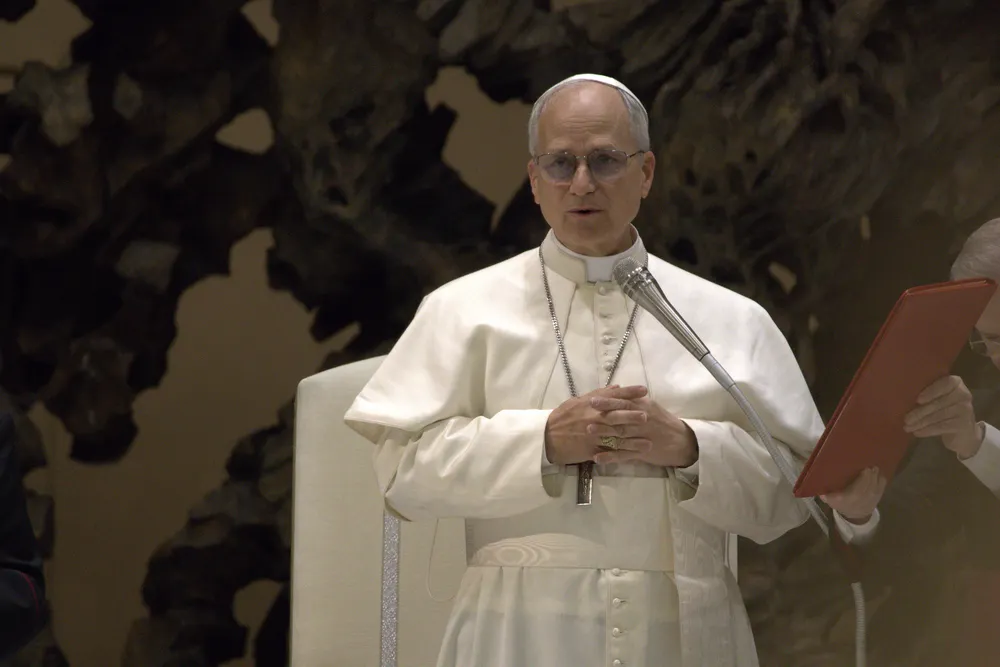
Speaking from the Canary Islands on June 12, Pope Leo XIV used the last speech of his one-week Apostolic Journey to Spain to address the highly divisive immigrant issue by reminding the world: “We are speaking, above all, of people created in the image and likeness of God, rather than of legal categories or problems to be managed.” He also chose to “address a message to those who take advantage of people’s desperation, to those who organize death routes, traffic in human beings… Stop. Repent…Free those you hold in bondage… You will have to appear before divine justice.”
Irony would have it that the same day, June 12, the European Union inaugurated a new migrant policy which fully qualifies Brussels to receive the wrath of God. The total opposite of the Pope’s approach, the EU policy is designed to expedite the expulsion of migrants from EU countries immediately upon arrival, and to create “return hubs” in third countries where they can be shipped—including nations such as Syria and Bangladesh. This is nothing different than what Leo’s predecessor, Pope Francis, described as the virtual “concentration camps” for desperate migrants which had been set up in Europe.
Historically, such an approach should come as a shock to Americans—although to many today it will not, to those who have made excuses for the inhuman way migrants are being treated by Trump’s ICE. Recently enough it was proudly stated that the United States of America is a “nation of immigrants,” a “melting pot.” After all, “E pluribus unum”—"Out of many, one”—was the de facto national motto for centuries.
Pope Leo XIV, the first American pope, clearly understands this legacy. On May 19, just before traveling to Spain, he sent a Commencement message to the graduating class at Villanova university, his own alma mater. He reminded them that this is the 250th anniversary of the U.S.A. and he invited them “to recall in a special way the guiding principles of the foundations of our nation: ‘We hold these truths to be self-evident, that all men are created equal, that they are endowed by their Creator with certain unalienable Rights, that among these are Life, Liberty and the pursuit of Happiness.’”
Leo did not say these things about the United States because he spent a lot of time in Chicago—so did Al Capone, and Barack Obama for that matter—but because the founding principles of the U.S. are identical to those motivating the Pope’s demand for justice for all immigrants today, and his emphatic affirmation in Spain that “The desire for goodness, beauty and truth is rooted in the very DNA of humanity. It is on the basis of this profoundly human aspiration and our centuries-old experience that the Church proposes paths toward a life of dignity and the common good.”
Although many of our jaded fellow citizens today would scoff at the idea, the United States was founded to do Good. Founding Father Benjamin Franklin, one of the Committee of Five that drafted the Declaration of Independence that Pope Leo quoted to the Villanova grads, was a protegé of Cotton Mather, who wrote in his 1710 Essays to Do Good:
“It is an invaluable honor, to do good; it is an incomparable pleasure. A man must look upon himself as dignified and gratified by God, when an opportunity to do good is put into his hands. He must embrace it with rapture, as enabling him to answer the great End of his being.”
The philosophical bedrock for our entrusted mission of “the pursuit of happiness” for all men, was provided by the German philosopher Gottfried Leibniz. In a 1694 essay On Wisdom, Leibniz wrote:
“Nothing serves happiness more than the illumination of the mind and the exercise of the Will to act at all times according to Reason… [This] can give new light to those who have the same common purpose of helping each other in the search for Truth, the Knowledge of Nature, the augmentation of human powers and the promotion of the common good.”
Leibniz elaborated on the meaning of the lives of those so dedicated:
“They can do as much for their happiness, as if they had a thousand hands and a thousand lives; yes, as if they lived a thousand times as long as they do. For so much is our life to be valued as a true life, as one does good in it. Who now does much good in a short time is equal to him who lives a thousand times longer; this occurs with those who can cause thousands and thousands of hands to work with them, through which in few years more Good can happen to their highest glory and enjoyment, than many hundreds of years could otherwise bring.”
So live a thousand lives in that fashion, and join the LaRouche movement—the Schiller Institute, the Sare for President campaign, the Vega for Congress campaign, The LaRouche Organization—in changing the world to make that possible for all. In particular we invite you to participate, in person or via Zoom, in Diane Sare’s July 5 meeting in Philadelphia, America 250: A Rededication.


