
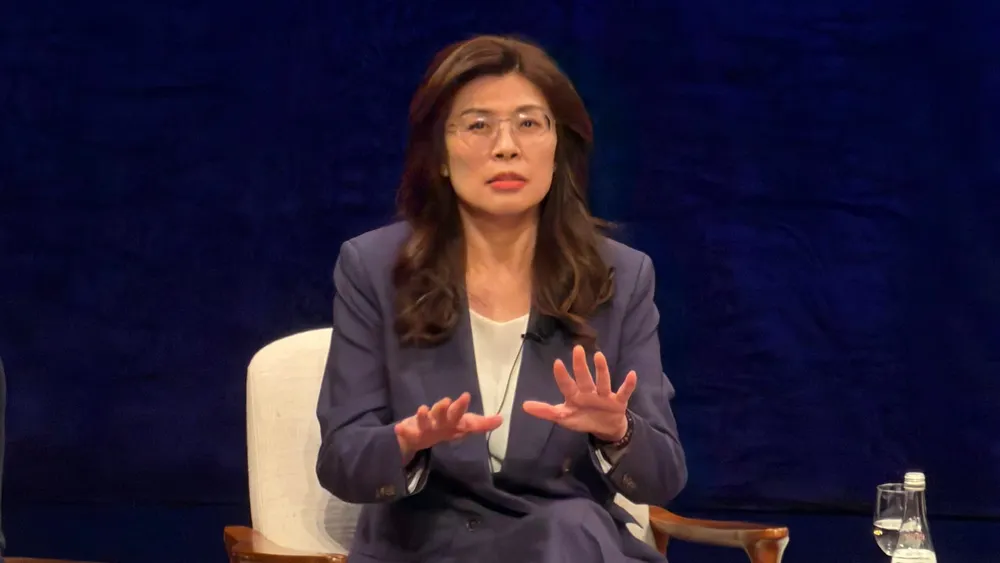
On Monday evening at the Asia Society in Manhattan, Kuomintang Chairwoman Cheng Li-wun took questions for ninety minutes from two veteran China skeptics: Asia Society leader Orville Schell, and former diplomat Daniel Russel.
Cheng—whose April 2026 trip to the mainland produced the first KMT-CPC top-level meeting in ten years, and whose six-day visit through Shanghai, Nanjing and Beijing was the highest-level cross-strait contact over that decade—answered with a clarity that, in the room, seemed to take some of the audience by surprise.
Cheng explicitly took “one country, two systems” off the table. “Taiwan is not Hong Kong,” she said. Hong Kong was a British colony to be handed back to China in 1997; Taiwan is already autonomously governed under the Republic of China constitution, with its own democracy and rule of law. There is no outside force that could hand Taiwan over. Any future structural change must be agreed to by the people on both sides.
What the future architecture will look like, she said, is a test of the wisdom and creativity of the Chinese people. “There was no EU-like structure before they started building the EU,” she observed. The European Coal and Steel Community took decades to evolve into the Common Market and then the Union. Could cross-strait peace follow a path that takes inspiration from Europe’s journey?
What is on the table, Cheng made clear, is no Taiwan independence. The current Lai government has attempted what she called “salami-slicing”—asserting that “Taiwan is already independent.” She rejects the framing. Per the ROC constitution, she said, there is only one China. That is not a declaration that reunification is the goal; it is a declaration that independence is not. The space between is where, she argued, years of patient development can unfold.
She was direct about timing. She acknowledged that a referendum for reunification would of course fail if held in Taiwan today—ten years of DPP rule has cultivated hostility toward the mainland. But polls show most Taiwanese do support cross-strait engagement, and most approve of her trip to meet Xi Jinping. The KMT’s task, she said, is to win four years of governance and demonstrate that cross-strait exchange produces peace dividends. If the KMT fails, the people will vote them out in 2032, with catastrophic results: “Taiwan will become a battlefield, and all its achievements will vanish. The younger generation of Taiwan will become ashes on the battlefields. I know that time is not in our favor.”
Cheng’s message to Washington was equally direct. “You can only Make America Great Again by figuring out a way to live with China, not by going to war,” she said. “Trump can be one of the most important politicians in this century by resolving tensions between China and the United States.” East Asia outside China is largely an alliance system the United States already leads. In her view, the United States can choose to be the leading force that converts those alliances into “an island chain of peace and prosperity,” or it can be the catalyst that converts them into a battlefield. The choice is genuinely on the table; it has not yet been made. (Washington was the next stop on Cheng’s U.S. tour.)
She ended the evening with reference to the KMT’s history of “miracles”: Sun Yat-sen established what is often described as Asia’s first democratic republic. The KMT defeated Japan. It turned Taiwan into one of the four Asian Tigers. It carried out a peaceful democratic transition. It built TSMC and Taiwan’s semiconductor lead. “When it comes to peace,” she said, “we are going to make the next miracle for Taiwan.”
Taiwanese commentator Angelica Oung characterized Cheng’s framework as “Status Quo+—where the + is engagement.” Cheng walked into what Oung called “the lion’s den” and “gave bold, impeccable answers, and lots of hearty laughs.” A small detail captured the evening. Cheng noted that Taipei and Beijing are geographically far apart, yet she had been able to meet Xi Jinping; in Taipei, she and President Lai Ching-te are minutes apart, yet Lai has refused to meet her.
While most of the questions were cynical, Cheng exuded confidence that there is a path forward for the entire Chinese nation—on both sides of the Taiwan Strait. The applause at the end indicated that much of the audience agreed.


