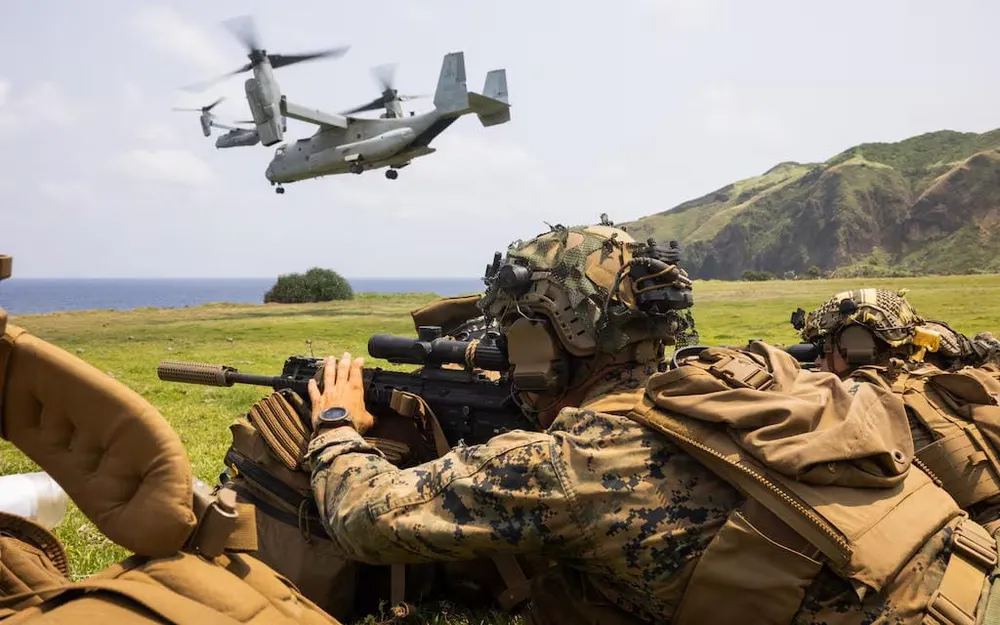
According to a report in the International Business Times, there were five military exercises going on simultaneously this past week involving the U.S. and/or countries of the First Island Chain with the aim of containing China. The exercises include Kamandag, a joint Philippine-U.S. Marines mission involving roughly 2,000 troops, which ran until Wednesday, June 24, and included Japanese parachute drills on Batan Island in the Philippines’ northernmost Batanes province, reported IBT. Taken alongside four concurrent drills across Japan, Guam and Hawaii, the combined deployment amounts to the largest simultaneous allied military activity along the chain in recent memory.
Alongside Kamandag, Tokyo and Washington are conducting Resolute Dragon 2026 in Kyushu and Okinawa until June 23, involving 9,000 troops focused on defending Japan’s southwestern islands.
About 10,000 personnel are taking part in Valiant Shield 2026 until June 24 across Guam, the Northern Mariana Islands and surrounding waters, marking the first exercise deployment of the Typhon mid-range missile system.
In Hawaii, more than 25,000 personnel from 31 nations are joining the biennial Rim of the Pacific (RIMPAC) exercise, running until July 31, aimed at strengthening maritime cooperation and preserving a free and open Indo-Pacific.
An estimated 100,000 Taiwanese troops are also participating in a concurrent Immediate Combat Readiness Exercise, adding a fifth simultaneous drill across the First and Second Island Chains.
Separately, the Chinese and Russian defense ministries announced that the Chinese and Russian air forces conducted their 11th joint strategic air patrol in the airspace over the Sea of Japan, the East China Sea, and the western Pacific Ocean, demonstrating shared determination and capability to safeguard regional peace and stability, reported the Chinese side. “The aviation group consisting of Russian Tu-95ms strategic long-range bombers and Chinese Xian H-6 strategic bombers Hung-6k (the nuclear capable version of the H-6 bomber -cjo) carried out a patrol over waters of the Sea of Japan, the East China Sea, and a western part of the Pacific Ocean,” reported the Russian side. “The event was held as part of the implementation of the 2026 military cooperation plan and is not directed against third countries.”