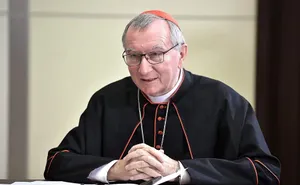

Pope Leo XIV began a seven-day Apostolic Journey to Spain on June 6, where he will encounter “a deeply polarized European society in the nation of Spain,” in the words of Vatican News Editorial Director Andrea Tornielli. “The Church in Spain, called to bear witness to a polyphonic unity in this age of polarization and confrontation, has endured, together with the entire Iberian people, the tragedy of civil war during the last century. Some of those wounds have not yet fully healed,” Tornielli wrote. In the current century, the issue of desperate migration from impoverished and war-torn nations in Africa and Southwest Asia has been additionally divisive in an already polarized society—and Catholic Church—including all-too-frequent expressions of Islamophobia.
The Pope is taking the issue head on.
His first remarks were delivered at the Royal Palace of Madrid to leading representatives of civil society and the diplomatic corps.
“I come among you to affirm… a deeper reconciliation and collaboration among the various elements of this nation,” he stated. “After all, your own history suggests that a culture of encounter, not confrontation, is what fosters stability and prosperity. In reality, the message of peace, which at present unfortunately strikes some as naïve and others as confrontational, is welcomed by those who do not shut themselves off in preconceived ideologies, but are rather open to the truth.”
He insisted on this issue: “Today, the temptation to gain popularity by fanning the flames of polarization seems to have grown rather than diminished, and human dignity continues to be violated… For the love of truth, I invite everyone to set aside the divisive and polarizing narratives of your societal reality and history, so as to overcome sterile simplifications through the fruitful appreciation of complexity. I see here a vocation particularly suited to Europe, in which Spain plays a unique and fundamental role.”
The Pope then elaborated on the theme of complexity in unity, a theme he had previously taken up in his discussion of Cardinal Nicholas of Cusa’s method of the Coincidence of Opposites.
“Appreciating and studying complexity, learning not to deny it but to embrace it as a blessing, and fleeing from identity-based approaches that seem to explain everything yet only fill the world with ‘ghosts’ and enemies, are the tasks of those who are heirs of a great history… Security, which we all too often expect to find in weapons and walls, is in fact best achieved by learning to move forward alongside one another, growing together, side by side.”
He turned his attention to one of the high points of Spanish humanist culture, the Era of King Alfonso the Wise in the 13th century, as a model to be followed today.
“Your own history bears witness to this. The presence of Islam on the Iberian Peninsula, for example, constituted a long-standing political, cultural, and religious reality. During that period, there was not only confrontation, but also an attempt to create a space for contact, conversation and dialogue on the meaning of truth among Christians, Muslims and Jews. At the School of Translators enhanced by Alfonso X (the Wise), experts from all three religions collaborated on translating the texts of the rich Arabic, Greek and Hebrew heritage, contributing to the dissemination of texts such as those of the philosophers Averroes (1126-1198) and Maimonides (1138-1204), among others. The cities of Córdoba and Toledo, in particular, became centers of dialogue between languages, religions and knowledge. This is the truth told by European cities: their historical stratification, the fabric of solidarity that has shaped their differences over the centuries, transforming inevitable conflicts into new beginnings.”
The Pope concluded his remarks on a clearly political note, praising the role of Spain in opposing the crimes in Gaza and the war in Iran—without ever mentioning those specific situations by name. “I express my gratitude to your country for its faithful adherence to international law and multilateralism, which is reflected in an active commitment to peace and solidarity among peoples. At the same time, I encourage you to cultivate as well dialogue and civic friendship within your own country, to take into account the perspectives of the poor and the young when envisioning the future, to harmonize the claims for autonomy and unity, and to advance the cause of unity in Europe—not in opposition to other powers, but as a gift to the entire human family.”