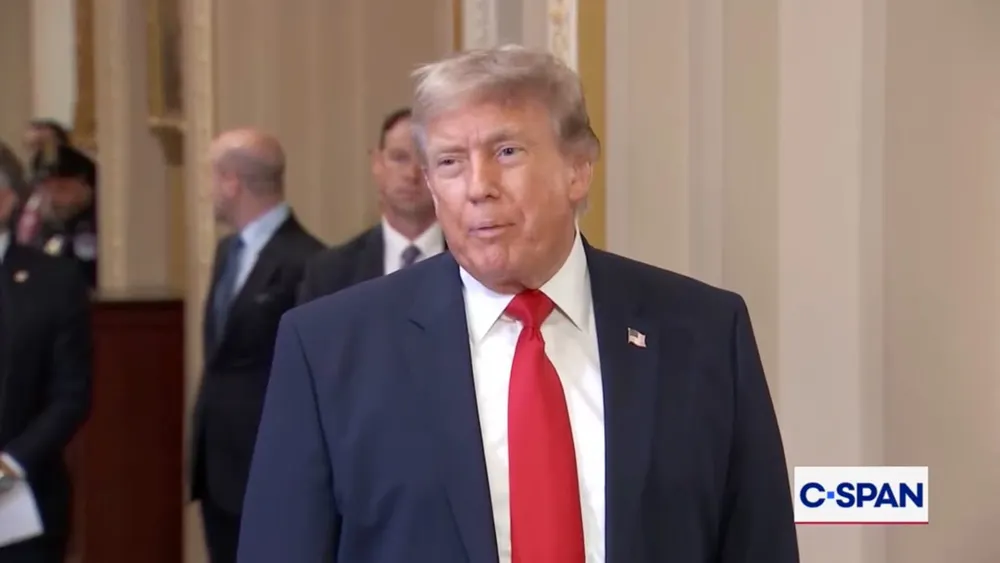
In a stormy luncheon meeting of Republican Senators on Capitol Hill on June 24, in which voices were raised several decibels, U.S. President Donald Trump berated certain Senators and successfully pressured enough Republican Senators to switch their votes that, in a second vote held later that day, the Senate voted down the War Powers Resolution by a vote of 50 nays, 47 yeas, and 1 present (abstention).
On June 3, 2026, the U.S. House of Representatives had voted 215-208 to pass a resolution invoking the War Powers Resolution (H.Con.Res. 38). The War Powers Resolution, a 1973 law, requires that the President notify Congress within 48 hours of committing armed forces to military action, and forbids troops from remaining in conflict zones for more than 60 days without a formal declaration of war or specific statutory authorization. If invoked, this would require the U.S. President to withdraw U.S. Armed Forces from hostilities with Iran. On June 23, 2026, the U.S. Senate voted 50-48 to adopt a concurrent war powers resolution directing President Trump to remove U.S. armed forces from Iran. The LaRouche Organization and the Schiller Institute had, through their organizing, played a significant role in the passage of the War Powers Resolution in both Houses.
While the Resolutions are non-binding without other features, they indicated the deepening opposition of the U.S. population to the Israel-U.S. irrational pre-emptive war in Iran.