Pope Leo XIV began a seven-day Apostolic Journey to Spain on June 6, where he would encounter “a deeply polarized European society in the nation of Spain,” in the words of Vatican News Editorial Director Andrea Tornielli. “The Church in Spain, called to bear witness to a polyphonic unity in this age of polarization and confrontation, has endured, together with the entire Iberian people, the tragedy of civil war during the last century. Some of those wounds have not yet fully healed,” Tornielli wrote. On top of Spain’s civil wars, in the current century the issue of desperate migration to Spain (and Europe more generally) from impoverished and war-torn nations in Africa and Southwest Asia has been additionally divisive in an already polarized society—and Catholic Church—including all-too-frequent expressions of Islamophobia.
The Pope took the issue head-on during his visit to Spain, addressing both the most profound philosophical and theological questions about the nature of man, good and evil, and the One and the Many—questions that have fascinated and perplexed mankind for millennia—while also issuing a strong call for concrete action today to save the suffering world in the interest of the common good.
This double emphasis is beginning to be the hallmark of the new Papacy under Leo XIV, as intimated in his early focus on the central role of 15th-Century Cardinal Nicholas of Cusa and his method of Coincidentia Opositorum, his trip to Africa in April of this year, and his first encyclical letter, Magnifica Humanitas—a subject for later treatment in these pages.
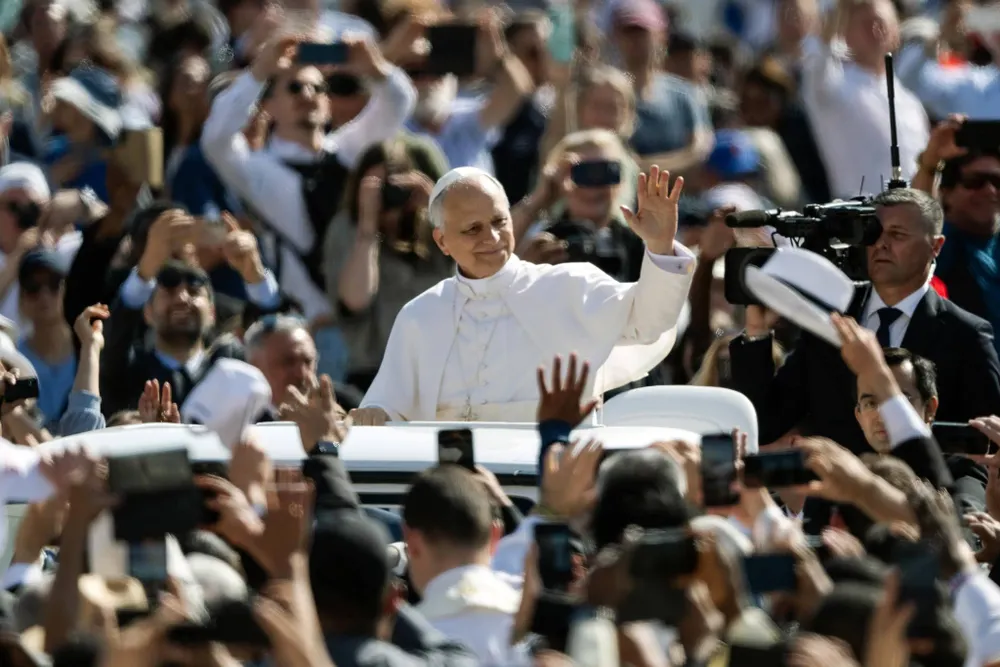
As the Pope stated in his homily during the Holy Mass celebrated before almost 1.5 million people gathered in the Plaza de Cibeles of Madrid on Sunday, June 7:
We too are called to be present in the realities and challenges of society, not shying away, but personally committing ourselves to the building of the common good…. Let us drink anew from this Eucharistic spring, which does not enclose us in private devotion, but sends us out to refresh our brothers and sisters, our families, the poor, the suffering, and those who have lost hope. Eucharistic grace transforms us and makes us protagonists of the transformation of history, a sign of hope for those we meet.