
The following is a slightly edited transcript of the remarks delivered by EIR Ibero-American Editor Dennis Small to the May 15, 2026 EIR Roundtable “The Iran War and the ‘Controlled Disintegration’ of the World Economy.” Subheads have been added. The video is available here.
The topic which I want to address today is the question of controlled disintegration.
Let’s jump right into this. We are suffering and we are seeing a massive dislocation of the world economy. There’s no question about that.
We are all aware of the fact that 20% of the world’s oil flows through the Strait of Hormuz, 20% of the liquefied natural gas, 35% of fertilizers, and so on. What happened when the Strait of Hormuz was closed—not by Iran; it was closed by the unprovoked war of aggression by the United States and Israel on Iran—was something that was fully predictable and known, and my argument is that it was also intentional.
Now, let me just take two extreme examples to get across the idea on this. Let’s look at India, extreme because it’s the largest country in the world in terms of population, with close to 1.5 billion people. It is the number-three oil consumer in the world. It imports 87% of its oil, and half of that comes through the Strait of Hormuz. In India, according to the reports I have read, the price of gasoline at the pump has not risen for consumers, whereas in the United States, it’s gone up 50%, as it has in other countries as well. Why?

Because the government of India has taken the hit. It has taken the brunt of this by subsiding the price at the pump. The cost of India’s imports of oil is expected to increase from $175 billion in 2025 to approximately $265 billion in 2026. Now, this is not something that is costless to India, because what we are going to be seeing—and this has been announced already—are balance-of-payments difficulties that India is clearly facing under the current international system with their oil imports.
This is going to open the door to very significant financial warfare against India. There will be a drive by the City of London and Wall Street to subject India to massive capital flight to try to force India into a position of submission. That is not going to be accepted lightly by India.
Now, let’s take the impact of this policy of “controlled disintegration” on the Honduran population, which has already been forced into major emigration to the United States because of the economic devastation that country has been subjected to over decades by Wall Street policies. Even before the current crisis hit, 11% of Honduras’s population had emigrated to the U.S.
Central America, including Honduras, imports 75% of the fertilizers that they use in agriculture. The price of those imported fertilizers has just gone up 50%. This is going to subject the situation in Honduras to unbearable pressure. 25% of the GDP of Honduras is remittances from foreign workers in the United States; 32% of the Honduran population is under 15 years old.
So just add it up and consider what is going to happen in Honduras. Take pharmaceuticals, which all of Central America depends on and has to import: India produces 65% of the world’s active pharmaceutical ingredients (API) which are used for manufacturing the antibiotics, the insulin, and the products which everyone needs. India depends on petrochemical feedstocks passing through the Strait of Hormuz to produce those API. There is going to be little-to-none of the needed pharmaceuticals available in Central America in the immediate future.
The same picture applies to Africa. I wanted to give you an idea of what this looks like in a really big country and in a really small one: What we are dealing with here is a physical economic collapse of the entire world economy.
The Physical Economy Is a Living Process
The economy of the world is not money. If it were only money, you can wipe out $2 billion or $2 trillion or $2 quadrillion, and it doesn’t matter. But you cannot do that with a living process like the physical economy.
You can’t simply cut off what is called a “supply chain”—which I think is a silly word, but you get the idea. You can’t simply wipe out 20% of the oil or a third of the fertilizer. This produces an irreversible process in the physical economy, like what would occur with a living being. You can’t simply cut out the heart from a person and expect the body to continue to live, just because the weight of the heart is less than 1% of the total body weight.
That is what we are facing today. We are looking at a massive physical and economic implosion of the sort that we have not seen since the New Dark Ages of the 14th Century. $4 trillion in monetary cost of the war? That’s the least of it. That’s just money.
What we’re really looking at is the destruction of the capabilities of sustaining up to one billion people planetwide as a result of what has happened so far. And this is just the beginning.
Now, the question that obviously comes to mind to all of us is, well, why is this happening? Didn’t they realize that this would happen if they closed the Strait of Hormuz? Are they that stupid or are they that crazy? Well, I have a very simple answer.
This was intentional. They knew it would happen, and they did it deliberately. And the question is not, “Are they that stupid or are they that crazy?” They are both. The real question is, “Are they that desperate?” And the answer to that is a resounding Yes.
Their policy is that of “controlled disintegration.” Now, let me just give you an idea of what this policy actually is, and where it began.
Let’s first talk about Paul Volcker. In a speech on November 9, 1978, Paul Volcker, who was then the head of the Federal Reserve, delivered the Fred Hirsch Memorial Lecture at Warwick University, England. (Hirsch had been the financial editor at London’s Economist magazine and senior economic advisor at the IMF, and more.) Volcker said the following: “A controlled disintegration in the world economy is a legitimate object for the 1980s.”
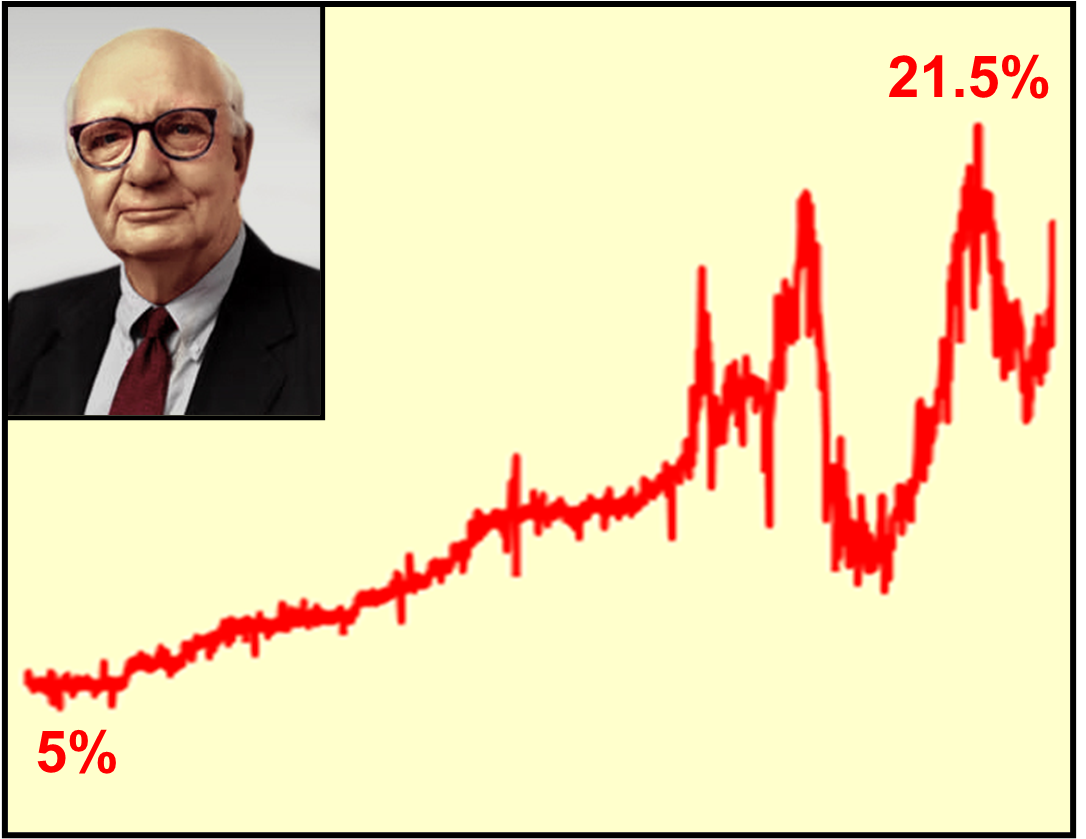
Figure 1 indicates what Volcker did when he was given the reins at the Federal Reserve. By December 1980, he had raised the prime lending rate in the United States to 21.5%. As is documented in a study prepared a number of years ago by my colleague, Richard Freeman, the effect of 21.5% interest rates was a collapse, on a per-capita basis, of U.S. machine-tool production by 45%, bulldozers by 53%, automobiles by 44%, steel by 49%, and so on. This was intentional, and it was controlled disintegration.
The effect of this on less developed countries, the so-called Third World, was a process which we have called “Bankers’ Arithmetic.” Interest rates were raised so high that the more Third World countries paid, the more they owed. Take the case of Brazil.
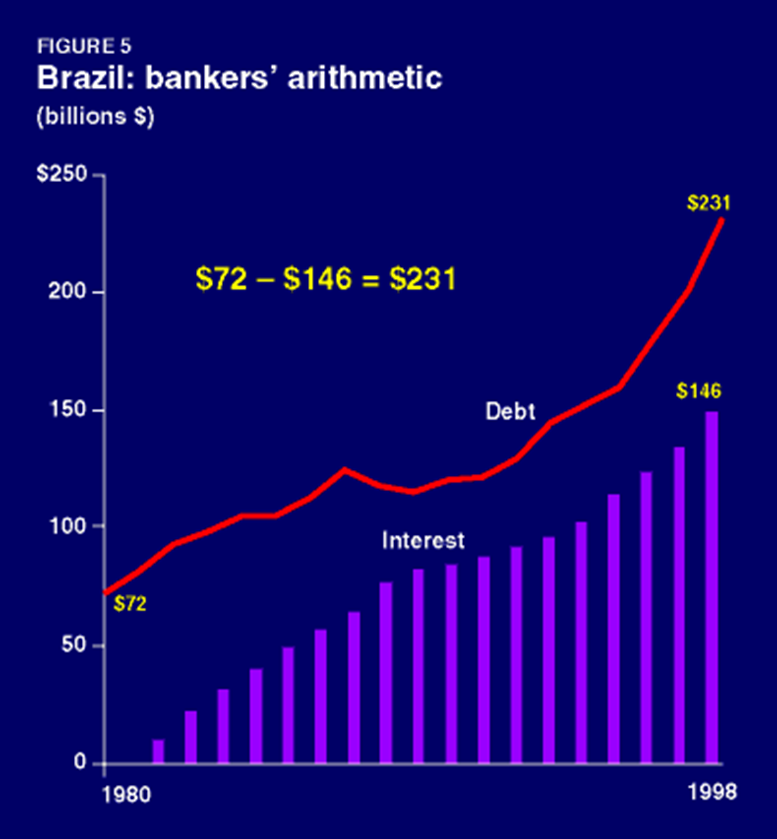
As Figure 2 shows, in 1980 Brazil owed $72 billion in foreign debt. Over the course of the next 18 years, through 1998, they paid $146 billion in interest payments alone. They paid more than double what they owed! And after that process was over, they hadn’t paid off the debt; rather, the debt had risen to $231 billion. In other words, $72 billion minus $146 billion is equal to $231 billion. That only happens under bankers’ arithmetic.
Now, where did this policy really come from? It didn’t come from Volcker. It came from a study that was prepared by something called the 1980s Project, launched by the Council on Foreign Relations of New York, which in 1977 published a 33-book series, one of which was called Alternatives to Monetary Disorder. The author of that book was Fred Hirsch, the same Fred Hirsch whom Volcker honored in his 1978 policy speech. And Hirsch is one of the key people who proposed controlled disintegration in that 1980s Project study, which became the policy of the Carter administration.
Controlled Disintegration and Malthusianism
Lyndon LaRouche had a thing or two to say about this whole policy of controlled disintegration. In an open letter to Congress written on October 16, 1979, just a few weeks after Volcker took over the Fed, LaRouche wrote:
I herewith submit a demand for the prompt impeachment of recently appointed Federal Reserve Chairman Paul Volcker…. In earlier public statements, Mr. Volcker has stated himself to be a supporter of a doctrine of “controlled disintegration” for both the United States and the world economy … measures which constitute an efficient effort to plunge the U.S. economy into misery, chaos, and confusion of the sort ultimately worse than the conditions experienced during the Great Depression of the 1930s…. A depression is not necessary. Any official who adopts a policy of “controlled disintegration” of the United States economy is engaged in a treasonous undermining of our nation’s overall security at this juncture.
Now, this policy did not come from the British in 1978. It came from way before, and it’s called Malthusianism. You may recall that Thomas Malthus wrote such comments as the following from 1791, where he encourages the reduction of the population, and if necessary, as he said, to “court the return of the plague” as a necessary means for reducing the population—intentionally.
We should facilitate, instead of foolishly and vainly endeavoring to impede, the operations of nature in producing this mortality; and if we dread the too frequent visitation of the horrid form of famine, we should sedulously encourage the other forms of destruction, which we compel nature to use. In our towns we should make the streets narrower, crowd more people into the houses, and court the return of the plague.
This didn’t stop with Malthus. Bertrand Russell said the exact same thing in 1951, which is one of the reasons Lyndon LaRouche called him the most evil man of the 20th Century. Russell, too, called for a Black Death to spread throughout the world.
War has hitherto been disappointing in this respect [population control], but perhaps bacteriological war may prove effective. If a Black Death could spread throughout the world once in every generation, survivors could procreate freely without making the world too full.
And more recently, Prince Philip, who you may recall was the father of King Charles III of the United Kingdom today, Prince Philip in 1988 said:
The more people there are, the more resources they’ll consume, the more pollution they’ll create, the more fighting they will do. We have no option. If it isn’t controlled voluntarily, it will be controlled involuntarily by an increase in disease, starvation and war…. In the event that I am reincarnated, I would like to return as a deadly virus, in order to contribute something to solve overpopulation.
Trump and the Mar-a-Lago Accord
Malthusianism is, unfortunately, an ongoing policy today. It was explicitly stated in Henry Kissinger’s National Security Study Memorandum 200, completed on December 10, 1974 but not made public until much later, which stated: “We have to provide assistance for population moderation in various countries”—in other words, reduce the population. The countries that NSSM-200 names are India, Bangladesh, Pakistan, Nigeria, Mexico, Indonesia, Brazil, the Philippines, Thailand, Egypt, Turkey, Ethiopia, and Colombia. And I’m sure that since that was written, Iran has been added to that list, de facto. And what the document says, in their own words, in Kissinger’s words:
The real problems of mineral supplies [which the West needs—ed.] lie not in basic physical sufficiency, but in the political-economic issues of access….
In the extreme cases where population pressures lead to endemic famine, food riots, and breakdown of social order, those conditions are scarcely conducive to systematic exploration for mineral deposits or the long-term investments required for their exploitation.
I’ll translate that for you into plain English: “They have the minerals. If we let their population grow, they’re going to want to use the minerals. We’re not going to let that happen. We want those minerals. Therefore, we will reduce their population.”
But it didn’t stop with Kissinger. It’s not just the 1980s Project studies of the Council on Foreign Relations. It’s not only Parson Malthus and Russell and Prince Philip and so on.
Stephen Miran, the top economic advisor to President Trump—he was head of the Council of Economic Advisors until a few months ago, when Trump put him on the Federal Reserve Board to try to ram through a policy of lower interest rates—developed a policy proposal in 2025 which he called the “Mar-a-Lago Accord,” modeled on the 1985 Plaza Accord which Kissinger and others had pushed through. Miran is a Harvard graduate, and also comes out of Fidelity Investment and the Hudson Bay Capital Group. So, he’s a representative of the speculative groupings, otherwise known as the Epstein class. He had a four-point policy proposal. Tell me if any of this sounds familiar.
First, have a forced devaluation of the dollar to deliberately deflate the debt of the United States. Because if you have big inflation, the dollar is worth much less. And if you devalue the dollar, $1 trillion today is worth $1 billion tomorrow. So you devalue the dollar and deflate the debt. Well, that hasn’t really worked too well. The last time I looked, the government debt was $39 trillion. Now, I admit that was last week, so it may well have reached $40 trillion by now.
Second, raise tariffs to the rest of the world very substantially, with the idea, Miran said, of increasing manufacturing in the United States. Because if we don’t let foreigners send their stuff in, we’ll have an increase in manufacturing here, he argued. Well, how’s that one going? The tariffs have gone up and up—and were later declared illegal by the Supreme Court. But as for manufacturing in the United States, over 11 of the last 12 months, employment in manufacturing in the United States has dropped. So, manufacturing is collapsing as a result of this brilliant policy.
Third, Miran said, since the dollar will become so dominant worldwide, what we should do is sell Treasury bonds with a term of 100 years—what he called Century Bonds. Now, who in the world is going to invest in any country’s century bonds, let alone the United States’, under this crisis? Miran figured that this way he could stretch out the Treasury debt for 100 years so that you don’t have to worry about the rapidly rising payment of interest on that debt—which, by the way, is now more than a trillion dollars a year. Well, how did that go? Not so good. Because what’s happened with the Treasury debt, is that the United States has been forced to sell shorter and shorter-term Treasury bills, because of the speculation in short-term Treasuries that has been unleashed by the Trump administration’s GENIUS Act, which opened the floodgates to speculation in so-called stablecoins and other forms of cryptocurrency.
And fourth, Miran argued that the strength of the U.S. military, and not the markets, is what is needed to ram through these changes. The modern system, he asserted, is “transactional” and not market-driven. Sound familiar?
Two Concepts of Man
My conclusion from all of the above is that we are not facing an accident or a mistake in the current wars and economic collapse. We are not facing a resource war. We are looking at a population war with a policy of intentional demographic destruction to maintain control over the $2.4 quadrillion global speculative bubble.
Just compare the following two statements. First, that of Prince Philip in 1988, where he said that “human population growth is probably the single most serious long-term threat to survival. We’re in for a major disaster if it isn’t curbed.” And then what Lyndon LaRouche wrote back in 1983, which is the exact antithesis of this entire Malthusian approach:
Man differs fundamentally from the beast…. Man has the potential of reason, the power to make creative discoveries which advance his scientific knowledge, and to convert such scientific advances into advances in technology…. If at any time we stop technological progress, the society sufficiently too foolish to do such a thing, will condemn itself to die.
That concept, I propose to you, is the basis for resolving the current crisis, the population wars that are underway, of which Iran is one representation, and to reverse the policy of controlled disintegration along the lines of the policies and programs which Lyndon LaRouche and Schiller Institute founder Helga Zepp-LaRouche have previously identified.