HARLEY SCHLANGER: Hello and welcome to our weekly dialogue with Helga Zepp-LaRouche, the founder of the Schiller Institute and the initiator of the International Peace Coalition, which has had a Zoom conference call every Friday for the last three years to discuss the fight for peace in the world. You can send your questions and comments to Helga via email to questions@schillerinstitute.org or you can post them on the chat page.
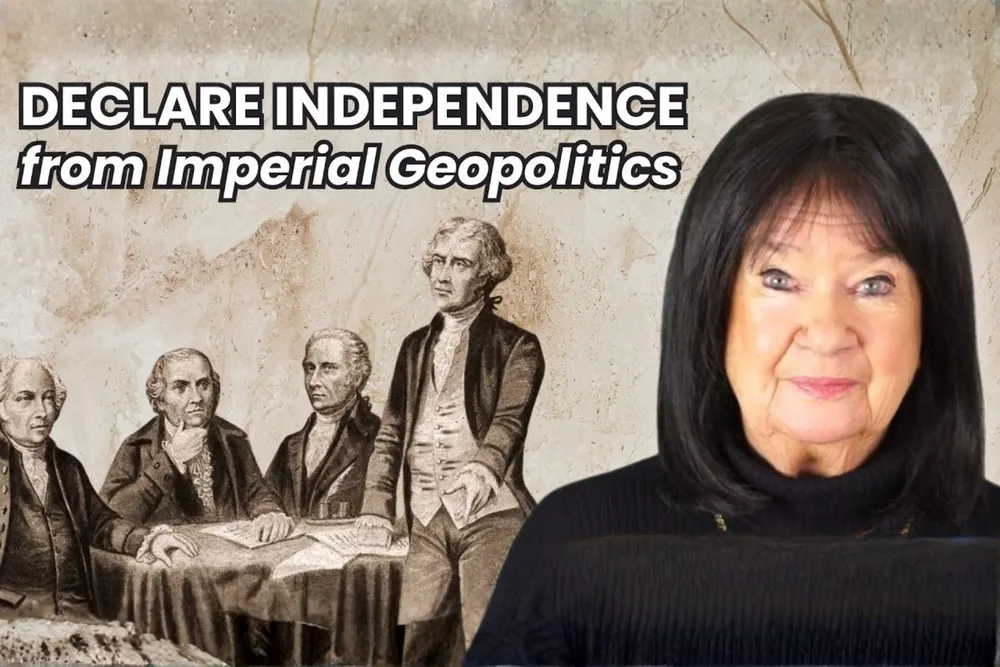
Now, Helga, today the title of our dialogue is Declare Independence from Imperial Geopolitics, which is a reference to the commemoration on Saturday of the 250th anniversary of the ratification of the Declaration of Independence by the United States from the British Empire. And we'll be discussing this in the course of the dialogue today.
But now as we enter the hot phase of the summer, we're moving toward an increasing hot phase of a world war. And this includes an intensified effort to feed the flight forward fantasy of Zelenskyy in Ukraine with the belief that they can defeat Russia and the on-again, off-again commitment of the Trump administration to enforce the terms of a memo of understanding to end the conflict between the United States and Israel and Iran. So I'd like to begin by asking for your perspective on where things stand today, both in the war drive and in the efforts to negotiate a lasting peace.
HELGA ZEPP-LAROUCHE: Well, unfortunately, I think that both theaters of war are worsening dramatically, or are in the process of worsening. To start off with the Middle East, well, I think that the fact that Rubio signed the agreement between the government of Lebanon, of Aoun, and Israel, and backed by the United States, is total approval of the Greater Israel policy. And obviously, given the fact that Lebanon is the number one item in the MOU between the United States and Iran, this is completely incompatible. That means, you know, if Trump is not dramatically intervening, which I don't see any sign of him doing, then the MOU is a dead letter. Because, you know, this is basically American approval for, you know, Israel trying to eliminate Hezbollah in Lebanon. And if the Lebanese government is agreeing to that, it means civil war in Lebanon. And I think the signs from Hezbollah are that they are totally determined to fight. They're not disarming. There's no sign of it at all. Why should they?
So that means that the whole situation is dramatically worse. Because, you know, the strikes between the U.S. and Iran resumed. The talks in Doha are really not going anywhere. So I think this situation looks really very, very sinister. And the situation in Ukraine, I don't know which one is worse. Probably Ukraine is even worse than that. Because due to massive Western backing of military production inside Ukraine, for example, in the drone production, there have been significant attacks, drone attacks into the territory of Russia. Refineries have been hit, Crimea, both inside Crimea, as well as the Kerch Bridge have been targeted. So as a result of all of that, you have now gas rationing in Russia, which is not yet devastating, nowhere close to that, but it means rationing in some regions. And, you know, it just means that the whole continuous war of the West against Russia, which among other things, includes British attacks on Russian tankers, practically everywhere in the world, in all the oceans of the world.
I watched the speech given by President Putin in front of the party day of the United Russia Party Day. And not only was his speech very, very serious, he said that Russia is under an unprecedented attack by the Western establishments. And basically there is no way that the existence of Russia will be allowed to be threatened. So there are many commentators and it's very difficult to verify all of that. But they are basically saying that Russia will respond to this. Scott Ritter may be the most outspoken, who thinks that Russia will shoot the mad dog Europe in the head. I don't know. You know, I'm sitting in Europe, it's a not so nice thought to think about that. But in any case, Russia will act against some of the countries who are backing Ukraine. I mean, it is not so easy because obviously there has been a continuous policy by some in the West to ruin Russia, to have an endless war against Russia.
It is not entirely clear where this should lead, but what is clear is that President Putin is probably the mildest and most patient of all possible presidents you could have. All alternatives to Putin would be very, very much hardliner, a much stronger response of the type Sergei Karaganov represents, who famously said that it is necessary for Russia to use a nuclear weapon against Europe, because they're not taking the deterrence seriously. If that happens, we could be in an escalation to World War III in no time, because the idea that you could have a tactical nuclear weapon used and then stop, I don't adhere to that philosophy at all. So, you know, it could very well be, and there are signs that Russia will do something decisive against some of the countries which are perceived to be backing the Kyiv regime completely, and it would be self-inflicted. Where that will then end is an open question.
I think we are closer to World War III than at any time before, because I think the biggest strategic change which has occurred, apart from the fact that Trump's promises in respect to the MOU seem to mean very little, the biggest change is that it seems clear that Moscow has dropped any perspective that the talks between Trump and Putin in Anchorage meant a serious effort to normalize relations between the two largest nuclear powers, and that the Anchorage process is dead, at least concerning Trump, and that therefore the one element which could have meant a stabilization in terms of discouraging the war faction in Europe, the so-called Coalition of the Willing, that seems to have been abandoned, and you have now practically a U.S. backing of the war against Russia, which I think is so dangerous that it tends to rob my sleep in the night.
SCHLANGER: Well, on the war in Europe, there was an op-ed in the {Financial Times} on June 25th by Canada's Prime Minister Carney and Luxembourg's Prime Minister Frieden, where they called for the creation of a new bank in the trans-Atlantic financial system to be named the Defense Security and Resilience Bank. And the bank's sole purpose, from what I can tell, is to fund the militarization which they say is necessary to prepare for war with Russia.
So we have a question from our colleague Ulf Sandmark in Sweden. He said, "Isn't Carney's and Frieden's proposal just a new attempt to display the financial power of the West, while lacking both physical production capabilities and the support from the youth to actually wage a war against Russia? And isn't the Carney-Frieden plan just another last monitor's gasp to throw up a mountain of paper against the challengers to their system?"
ZEPP-LAROUCHE: Well, yeah, I mean, I have stated earlier that this is a complete copying of the policy of Hjalmar Schacht, financing the war machine of Hitler with MEFO bills, because this so-called new bank by Carney, essentially, which is supposed to be fed with $1 trillion per year. So it would be a gigantic hyperinflationary bubble. And I mean, I think this whole situation is so incalculable, because given the fact that the European economies are collapsing, the German economy is collapsing, the number of insolvencies, the VW will eliminate 100,000 jobs, other major car makers in Germany are eliminating similar amounts. And I do not think that the investment in the war economy will compensate for the loss of real assets in the real economy. And it could very well be that we are heading towards a complete collapse into a depression, especially if you think that the continuous blocking of the Strait of Hormuz is adding to that basically at an exponential rate; because the effects of the lack of energy coming through the Strait of Hormuz is only felt several months later. So the full impact will only hit starting probably in August.
And these various processes, if you have several processes on a course of exhausting themselves, there is no prediction where sort of an omega point will be reached, where all of them reinforce each other's collapse. So I think that the continuous effect of the war in the Middle East, the continuous effect of the war in Ukraine, which among other things is depopulating Ukraine and reducing Ukraine to basically a launching pad of drones against Russia.
But what happens to the people? And the people of Ukraine seem to be of no concern to those in the West who are pushing the Ukrainians to keep that role. So I think that there are so many incalculable aspects in this whole thing, that this whole thing may end in a complete tragedy of civilization, where you have a collapse of the West, a collapse of the financial system, a deep depression, and then some uncontrolled war scenarios which could flare up in many parts of the world. So we are looking at a potential collapse of civilization triggered by five, six, seven different points.
So I think the only answer to that is people have to wake up and say, stop, as the Pope had basically said in one of his speeches, stop, repent, return, turn around. And I think that is the war cry everybody should have in terms of this insane idea to ruin Russia, to eliminate Russia from the face of the Earth. In the final instance, Russia is a nuclear power, they have a nuclear doctrine, where it says very, very clearly that if Russia is attacked by a non-nuclear power, which is however backed by a nuclear power, and the existence of the Russian Federation is threatened, then the first use of nuclear weapons is legitimate. Now, if people cannot read, that may be their downfall, but unfortunately, they take everybody with them.
SCHLANGER: Well, and some people that I've been speaking with said that these are not signs of strength, this kind of proposal for a bank, but a sign of desperation. And of course, we've had President Trump warning that he doesn't want to be seen as the new Herbert Hoover, based on the effects of the oil embargo or oil shortages. You're listening to Helga Zepp-LaRouche from the Schiller Institute. This is our weekly dialogue.
I got a question from a reporter in Lebanon, who asked if you can explain how the U.S. can be demanding strict adherence by Iran to the Memo of Understanding, while supporting the phony Israel-Lebanon treaty, which violates the Memo of Understanding itself, which has a provision, as you mentioned before, that Israel must end its intervention in Lebanon, and that this will likely trigger a new bloody phase of a civil war in Lebanon. How is this a peace process?
ZEPP-LAROUCHE: Well, I think the key problem is that President Trump, in the beginning of his second term as President, you could give him some credit that he wanted to be the peace President, that he wanted to end endless wars, that he didn't want to start new ones. He did go to Anchorage; he did have discussions with Putin. So, in the beginning phase, you could have some hope that he would bring some of these promises into reality.
Unfortunately, I think he has lost almost all capital. I cannot see how anybody can trust him now, given the fact that he kidnapped President Maduro. He is basically now treating Venezuelan oil as U.S. property. He has started the war against Iran the second time, in the middle of very promising negotiations in Geneva. The MOU doesn't seem to carry much weight. Nothing is being done to stop the efforts of Israel to implement Greater Israel. Reports are that the genocide in Gaza fully continues. The atrocities against the Palestinians in the West Bank continue. The Lebanon thing continues. Israeli attacks in Syria continue. So, there seems to be absolutely no effort to end any of these policies.
So, I think that there must be something preventing Trump from doing it. And what it is will maybe remain a question for the historians, if there are any ones left after we are through this. But is it the power of the donors who have financed Trump's campaign? Is it the Epstein files, where there is something maybe contained which prevents Trump from deviating in any way? Is it any one of these factors? Is it just his very unpredictable moods, which change from moment to moment?
I don't know if it's a combination of all of these or still another option. In any case, the result of it is that I think the Trump Presidency is already a lost cause.
SCHLANGER: You asked some of the right questions there. We don't know the answers yet, but we're looking for them. Now, on this same question, we're seeing a blowback against the policy in the United States. Last week we had the Democratic congressional primaries in New York City, in which three New York City, two Congressmen and one favored candidate, who are supported by AIPAC, the American-Israel Public Affairs Committee, they lost. And they lost to people who made the U.S. support for Israel and Greater Israel the main issue. The same thing happened yesterday in Colorado, in the first Congressional District, where Diana DeGette, a 30-year incumbent, who is very close to AIPAC, lost by about 10% to a 29-year-old lawyer who said the main issue is ending the wars and stopping the injustice against the Palestinians.
So there was a question from a Jewish journalist from California, who just said that she's opposed to what AIPAC is doing. And she said that she's seeing for the first time a real reaction against this. And she wants to know if this is possibly a way that the situation could change in the United States. Doesn't this play into the question of the people can change it if they actually have their voices heard? So she was just asking, how do we do that? How do we get their voices heard?
ZEPP-LAROUCHE: Well, I think on Saturday, as you mentioned, is actually the 250th birthday of the U.S. Declaration of Independence and the American Revolution. But I can only say that the importance of what we are doing needs to be put on the highest platform possible. That is that one day later, Diane Sare, who is an independent Presidential candidate, a LaRouche candidate, will conduct a historic meeting in Philadelphia, where basically the 250th anniversary will be celebrated. There will be many historians speaking, historical researchers. There will be a fantastic program of classical music, upholding the true history of the United States.
Now that I can only tell you from an international standpoint, it is one of the most controversial issues. Because there are many people, both evil people like King Charles, who had the audacity to appear in front of the Congress, actually two houses of the Congress, to make a speech in which he flattened out the entire history of the United States. By basically saying the history of the British Empire and the history of America are practically the same history, the same tradition, the same philosophical groundings. We had some tensions here and there, but it's now a beautiful, special relationship. I did not want to believe my ears when I heard that. Anyway, so that's King Charles. I mean, the British Empire has one interest, to iron out the significance of the American Revolution, which was a revolution against the British Empire. I mean, this was a groundbreaking development, whereby Republican networks from all over the world, but especially from Europe, they all contributed in the emergence of the idea of a republic, which was absolutely, in terms of values, against everything the British Empire stood for, ranging from the philosophers, or philosophers, if you can call them that, of the ideologues of the British Enlightenment, like Locke and Hobbes, and all the things which go with it, Adam Smith, Bentham, Mandeville, all of these people who have an image of man, defining man as a beast, defining man as having no rights; only the nobility has rights.
I mean, this was a terrible system. And the American revolutionaries and Founding Fathers set up a Constitution against that, which was devoted to the common good for the first time of any major constitution. There were some other little efforts earlier, but that was the first major constitution in history, defining that the representative system represents the only possible model where the individual can participate in the government; that government is only legitimate if you have the consent of the governed. These were groundbreaking new developments, and especially, naturally, the Declaration of Independence's life, liberty, and the pursuit of happiness. The pursuit of happiness, not of the oligarchs, but of the people. So this was a major development.
Now, you have some people who are ironing out the difference between the British Empire and the U.S. for evil reasons, but you have also a lot of people, especially from the so-called left, or people who are generally against genocide, who also have the view that the entire history of America is just one uninterrupted story of genocide, of exploitation, of foreign wars, of slavery, of all of these things. Now, that is, in one sense, even worse, because for those who know history, they know what the British Empire was and is, to a certain extent. The 80 million people killed in India, the many atrocities in Africa. So what the British Empire is, is more clearly established, especially by the countries in the Global South.
But if you eliminate the potential that America represented, for example, the American System of economy. If you only leave British free trade, well, then the industrialization would never have been possible. And the famous Manchester capitalism is not a good example of industrialization; while the system which was developed by Alexander Hamilton, the idea of the sovereignty of the country over the issuing of its own credit, and the need to devote that credit to investments which would increase the productivity of the economy by furthering the creative potential of the individual. That is uniquely in the tradition which became known as the American System of economy. It goes back to Leibniz, it was continued by the Cameralists, it was picked up by Friedrich List, the Carey father and son, Count Witte in Russia.
So there is a completely different tradition of that American System, which has a completely different definition of what the source of wealth is. The British system says the source of wealth is to buy cheap and sell expensive, and you can take the profit out if you control the trade system. And that is to the present day how colonialism is being continued, while the American System of economy, which by the way has been picked up by Count Witte in Russia, and there are many traces of it in the present Chinese model of economy. So to iron that out is really devastating, because then you confuse what is actually the basis of a functioning economy.
So I think this event on Sunday in Philadelphia will do a great deal to clarify that issue, and also the newest issue of our cultural magazine in the United States, {Leonore}, has many, many beautiful articles on the real history of the United States. So anybody who does not like what I'm saying, and I know there are many people who disagree with it, please get a copy of the {Leonore} and then let's have a debate on the sources, because these are all absolutely documented sources, which unfortunately are not so known anymore, because as America has been taken over by the British establishment—who after they realized that they could not defeat the American colony militarily, which happened in the Civil War, they decided to convince the American establishment to adopt the model of the British Empire and rule the world based on that. The latest effort of which was the unipolar world effort after the end of the Cold War.
And as always, the winners of war determine the interpretation of history. That's why most people have very poor knowledge about what I just referred to. But this is provable; it's a fact. Just look at the speech of John Quincy Adams, which he gave on the 4th of July in 1821, where he not only re-established the Declaration of Independence by reciting it, but he blasted the British Empire in no uncertain terms. And it's just due to the present historical ignorance that people have forgotten these differences.
SCHLANGER: Now Helga, you're becoming a bit of a wizard because you're anticipating these questions, but I want to just read you this question because you just basically answered it, but it shows people are starting to think in this way. This is from someone from the United Kingdom who said, "We're about to have our seventh prime minister in 10 years. The problem has been that since the 1980s, the economic policy of all parties in Britain has been Thatcherism, privatization, deregulation, and so on. And when Labour candidates campaign, they call for dumping Thatcherism. Then when they get an office, they adapt it. So he writes, now Burnham, the probable new prime minister, sounds like Starmer did when he ran, saying we have to move beyond Thatcher, but no one believes him." So he asks, "What is the alternative to Thatcherism for the UK?" So I'll refer him to your answer to the previous question, because I think you hit it right on the head. But do you have anything to say about that, the situation in the UK?
ZEPP-LAROUCHE: As far as I can see, the present prime minister is the same in all crucial points; continue the eternal war against Russia, back up Israel. So I think it's a real problem. And the Labour Party, unfortunately, has been taken over by the Blairites, and people like Corbyn have been pushed to the side. I don't know if that can be remedied within the Labour Party.
Maybe the idea of Great Britain should be rethought. Maybe Wales and Scotland, there's another option, other than Great Britain, you could have small Britain plus a couple of other places. Or you could start to think if the monarchy is really the adequate rule for the 21st Century. I mean, these are all legitimate questions. But since I'm not a British subject, I leave it up to you.
SCHLANGER: Well, I think the last point you made is something that they're trying to sell as a policy by breaking the country up into small cities. This is what Burnham is talking about. And they call it devolution. And it's just another way of destroying the central government. So it's a different approach to Thatcherism.
I have a couple more questions for you. One on China's Global Governance Initiative. The person wrote, "The proposals include reforms to international institutions such as the UN, the World Bank, and the IMF, to give more influence to emerging nations. This will be resisted by the old colonial powers. How likely is it that such reforms—which are desperately needed if these institutions are to retain any credibility and overcome historical injustices—how likely is it that this will happen? And is the Global South developing the capabilities to make these demands?"
ZEPP-LAROUCHE: Well, I think that while it is also clear that all the BRICS countries and all the countries of the Global South are under enormous pressure at the moment because of these attacks, I think that there is a level of suffering which, once crossed, may just lead to a world rebellion. And one place where that could erupt already is the upcoming UN General Assembly. Because I think that the Chinese government is planning to introduce this new Global Governance Initiative proposal into the debate in the UN General Assembly. And while in the past these debates have been highly instrumentalized and controlled and manipulated, I think the time is ripe, because the fact that Africa does not even have a seat in the UN Security Council is just untenable. You know, the continent of the future is Africa. By the year 2050, they will have 2.5 billion people, and their not being represented in these institutions is completely unthinkable.
Likewise, some of the old aspirants for a seat in the UN Security Council, like Germany, have no great chances; which was just demonstrated in the effort to even have a two-year term, which was voted down in favor of Portugal and Austria. And likewise, I don't think Japan will have a chance to have such a privilege. And that has all to do with the fact that the countries of the Global South have looked at the naked demonstration of imperialist and neo-colonial attitudes from the side of these countries. So, I think there's a good chance that the UN General Assembly this year may become a turning point, because I think the Chinese government keeps putting an enormous weight on the UN and on the reform of the UN. I think there is a good point to it, but a reform is urgently needed. So, I think the best you can do is just help to spread the content of this new White Paper and the four global initiatives of China, because of all the governments in the world, I think China is the one who is by far way ahead in terms of presenting a governance conception, which would really solve all problems of the globe.
SCHLANGER: While we're talking about problems in Germany, let me note that Germany got bounced out of the World Cup early, and some were saying it's because the coach reminds them of Friedrich Merz.
I have a last question for you, Helga, actually a two-part question on the Declaration of Independence. The Pope will be receiving an award, I believe it's Friday, and it's expected that he'll make some comments on the Declaration of Independence, as he already has. And someone wrote in and said, "In this era of greed and egoism, does the voice of the Pope echo out above the simple-minded pleasures people are looking for?"
ZEPP-LAROUCHE: Well, I think this Pope is really a gift from heaven, because it may be divine providence that he is the first American Pope in history. I mean, first of all, he is very, very grounded in the theological debates of the history of the Church. I mean, several times in his sermons and also other written documents, he sided with the most beautiful and progressive tradition in the Church, clearly bidding the Crusaders goodbye. He emphasized Nicolaus of Cusa against the Crusaders. He clearly is taking the side of the poor and the downtrodden, and he reminded people that Christians are supposed to take the side of the underprivileged and not be the oligarchical class sitting on top, squeezing out the last bone and shoes out of the poorest people. So I think he is definitely an extremely powerful voice.
I think he upholds the social doctrine of the Catholic Church very powerfully, giving it new actuality. So I'm confident that, I actually think that this Pope, Leo XIV, is apart from President Xi Jinping, President Lula, President Putin, and a couple of other outstanding leaders of the world, this Pope by far is the outstanding political influence in the world. So, I'm actually very happy and hopeful that he's receiving the—he already received the medal a couple of weeks ago, but officially the act will be on Friday, coinciding with the IPC. So I'm sure that we will discuss this on Friday at the IPC meeting, because I do think this Pope has political significance which is going far, far beyond all the religions in the world. He may be the one element which could tilt the West to a more moral side.
SCHLANGER: Final question for you from a neighbor of mine who has been following these dialogues regularly. He asks, "Helga, as a fellow German, I would like to ask you what the U.S. Declaration of Independence means to you?"
ZEPP-LAROUCHE: Oh, it means a lot. When I founded the Schiller Institute in 1984, I was thinking what kind of a charter or founding document should I use? And I looked at many documents, the UN Charter, many other documents, and I came to the Declaration of Independence. And I said, this is exactly what is needed for our effort. The purpose of the Schiller Institute was to recover and rediscover the art of statecraft, to apply statecraft to the political process, to establish a just new world economic order, to emphasize the highest traditions of every culture. So then I said, oh, well, it's for the American people. But then I changed in the original Declaration of Independence, maybe five, six words, where it says the American colony, I replaced that with the developing countries; where it says the financial powers of Great Britain, I changed it into the financial powers. I don't have the details now in mind, but only six words or so, with the following intention. I wanted to make sure that the Americans would be reminded that the principles of the American Declaration of Independence are not just for them, but they're the basic right of all people in the world, as John Quincy Adams emphatically stated.
But also at the same time that people in other parts of the world, once they would be given the same rights of the Declaration of Independence, would then look at America more from the standpoint of that is the tradition they have to hold the American people to and hold their feet to the fire on these principles. So like a vice versa, reciprocal pedagogical device to remind people of what are the human rights of everybody on the planet. And naturally the Declaration of Independence is very much echoed in the Rütli Oath of Wilhelm Tell; and the Schiller Institute naturally likes Schiller, otherwise we wouldn't have chosen his name. So the beautiful Rütli Oath, if you compare the text of the Declaration of Independence and the Rütli Oath, it's almost the same language. So it means a lot to me.
SCHLANGER: Well, thank you for that. I think my friend will be very happy to hear that. So let's remind people Friday morning, the weekly IPC call, the International Peace Coalition call. As you said, we'll probably be discussing the Declaration of Independence. Anything else?
ZEPP-LAROUCHE: No, but I think we will for sure discuss this pending danger of an escalation and the potential reaction by Russia to these continuous provocations. And as Dmitri Trenin recently said, it's very hard to say when the point of no return will be, but you may reach the point of where it's one provocation too many. And I'm afraid we are awfully close to that point. So that will be a topic for sure.
SCHLANGER: Okay, Helga. Well, thanks for joining us again today, and we will see you on Friday.
ZEPP-LAROUCHE: 'Til then.