KYNAN THISTLETHWAITE: Hello and welcome to today's webcast with Schiller Institute founder Helga Zepp-LaRouche for August 12, 2026. My name is Kynan Thistlethwaite and I will be your host for today. For those of you who are watching and have questions for Helga throughout the course of discussion, you can email to questions@schillerinstitute.org.
So with that Helga, there is a lot of uncertainty regarding the current strategic situation whether you're talking about the U.S.-Israeli war with Iran or the NATO-Russia war, which is being held in Ukraine. And what has certainly become clear is that because of the economic breakdown that you see going on in the United States and of course in Europe, there's an increasing inability to wage war on both fronts. In the U.S. for example, you have reports of the shortage of munitions which is now occurring when President Trump is seemingly delaying his plans for a large-scale bombing of Iran.
So what's your sense of the strategic situation right now? Is it something that will go in the direction of chaos, or is there the possibility of averting it by replacing this chaotic structure of nations that you see right now with a New Paradigm?
HELGA ZEPP-LAROUCHE: Well, I think I would be very hubristic if I would pretend to know the answer to that question, because what is going on is so enormous and has so many factors involved that it is very, very difficult to say. Because on the one side, we do see disintegration of the old order as it developed first of all after the Second World War and then how it was reshaped after the end of the Cold War. And that order is definitely gone and it will not come back. It is characterized by many aspects—the increasing rift between Europe and the United States so that the collective West is not so collective anymore. Then you have naturally the tensions between the North and the South. You have the emergence of China which some people regard as a threat which it really is not if you look at Chinese policies. They are not aggressive at all; but naturally one could argue that they threaten the unchallenged dominance of the Anglosphere over the world system.
So all these things are going on. Then as you say, you have the effect of the many decades of monetarist policies now affecting even the ability to conduct war. Then on the other side, you have the emergence of a new system which is however very difficult and it's under a lot of attacks. That's the BRICS system. These are countries of the Global South who actually represent 85% of the world population, which are trying to get a new system which allows them to overcome the remnants of 500 years of colonialism. So this is a very complex process.
Therefore you see on one side an absolutely crazy, insane re-militarization of Europe which is not backed by any real threat. It's just the demonization of Russia which has no substance, because Russia is not planning to attack Europe contrary to the propaganda you can read in all the mainstream media every day in Europe or at least in some countries in Europe. So it's very difficult to say. It could end up in the short term in a catastrophe because wars do not necessarily come about because every planned detail is being affected and realized the way the planners were thinking. There's always the element of unpredictability, human error, miscalculation; but we are inching step-by-step closer to the idea of nuclear war is thinkable. And if you then look at the policies of, I think he's the Undersecretary for Policy in the Pentagon, Elbridge Colby, who is also the author of the National Security Strategy Paper, he is muting the possibility of the use of tactical nuclear weapons. These are all increasingly worrisome developments.
Then on the other side, you have clearly the effort by many countries in the world that actually represent the majority trying to create a system based on equality on the Five Principles of Peaceful Coexistence. And which side will win out is very difficult to say. I have been saying for the whole time, which is very difficult for some people to even imagine, but if the West, including the United States and European nations would just say, "Let's stop the pretense that we will dominate the world forever," which is ludicrous given the fact that the entire Western population represents about 12% of the actual population of the world. For them to want to remain the dominant force forever, which if you look back in history, they have not been over the centuries. So that therefore, if the Western countries would just say, "Let's stop this overblown self-importance arrogance that we are better than the other people and therefore we have to be the dominant force," and just say, "Let's move from confrontation to cooperation," I tell you, in a day, all these conflicts would vanish. Because I know for a fact that all the BRICS countries would welcome such a change. That includes Brazil, South Africa, India, and China and Russia.
So I think it is really the question, can we in time bring the voice of reason into play to avoid a catastrophe? But how it will end up, I think is impossible at this point to say for the reasons I said.
THISTLETHWAITE: And you mentioned of course, the danger of nuclear war; you referenced Elbridge Colby's remarks in which he was saying that, we could consider tactical nuclear weapons as a possibility. And of course, as you know, and as Dr. Ted Postol also knows, there is no such thing as the use of a singular nuclear weapon. This will lead to general thermonuclear war. And in that respect, I wanted to mention an assessment by Colonel Larry Wilkerson, whom you know, who has spoken at various events of the Schiller Institute and the International Peace Coalition. For those who don't know, he's a retired U.S. Army Colonel and the former Chief of Staff for U.S. Secretary of State Colin Powell. He recently did a podcast with Nima Alkhorshid who's in Brazil, in which he spoke about Israeli Prime Minister Netanyahu. And he said Netanyahu is determined to keep his position in regard to Gaza, the West Bank, Lebanon, and naturally Iran. That of course will mean more people being killed daily in those areas; but Iran he said poses a problem that some of these other places don't for Israel. He said Netanyahu is determined to unseat the regime in Tehran and that Donald Trump must be seen as helping him. He said the only way that they can do that is with nuclear weapons. That of course is Wilkerson's own view, but Helga, I wanted to know your thoughts on his assessment.
ZEPP-LAROUCHE: Well, I mean the fact that the United States, which is the strongest military power on the planet, at least if you take the totality of all the armed forces conventional and nuclear, in addition with Israel which is also a very strong military power; that they were not able to defeat Iran in five months of war and are now running out of munitions, and then if you look at the reports which are coming from at this point Iranian sources but they're being backed up by many other reports from people related to the soldiers, the Marines in the military in the Gulf. On the aircraft carrier USS Lincoln, apparently there was a fight where seven Marines got killed and many wounded because a fight broke out when the commander made a speech and people started to have knives out and a brawl started over the question of the treatment of the Marines in terms of food, in terms of being treated badly. I mean, we had earlier reports that the toilets did not function on some other aircraft carrier. Basically, these troops have been on deployment in their mission for more than 500 days in a row without vacation, or more than 360 days or a long period, much longer than one year and there were many reports from families, from parents of these soldiers who said that they were writing letters back home that the food was unbearable. One soldier had lost 20 kilos.
So I mean, that is not exactly a glorious picture, and the signs are all that the military is overstretched; a lot of assumptions did not function. The missile defense systems did not function in the first place very well, and now they are basically out of enough Patriot systems and THAAD systems. So it reaches a point where actually you would say that any reasonable decision would be to say, "Okay, let's stick to the agreed deal. Let's walk away. Let's just try to find a new chapter in history. Unfortunately this was not a very glorious one but let's move on."
Now the problem is that no matter what Trump may do or not do, he has not proven efficient to rein in Netanyahu in the past, and because of the very complex situation in terms of who finances what campaign in the United States, it's not very clear that he will have the ability to impose his will and that of the United States on the Israeli government. So naturally, the worry expressed by Colonel Wilkerson is obviously well-founded. Israel officially does not even admit that they do have nuclear weapons. They are not part of the Non-Proliferation Treaty. And part of the reason why Iran could even want to have nuclear weapons is because they feel that they have a threat from these Israeli nuclear weapons. And it is a principle of indivisible security that you have to always take care of the security interests of everybody. If you have an imbalance where one side has nuclear weapons and the other one doesn't; but then Iran has proven conventionally to have won this war. I mean, this is a real big change in the situation, because here you have the strongest military power and a very strong military power together were not able to defeat a middle-sized power, Iran, and they have won the war. This has an enormous strategic implication, because anybody who looks at that and says, well, what is the record of the United States having been involved in so many wars actually for a very long time, but especially in the recent period, they have not won one. They did not win in Vietnam. They did not win in Afghanistan. They did not win in Iraq. They definitely have not won in Ukraine, and now they have lost Iran.
So, this creates an insecurity which is extremely dangerous. And actually Netanyahu has his own rationale, which he shows every day in Gaza and the West Bank and Lebanon. So it's an extremely, extremely dangerous situation which the world is in right now.
And I can only say the only thing which counters that is that I think that there are a lot of voices of reason, and one can—contrary to the propaganda in Germany, for example—be happy that President Putin is the President of Russia, because he has proven to have extremely strong nerves and patience, contrary to some other voices in Russia who have called for a much stronger action already.
But the sum of all of these considerations is we are sitting on a powder keg which, if it goes wrong, could lead to the annihilation of the human species. And if there are some hotheads who can think strategically, who think that the use of tactical nuclear weapons is a possibility, I think we are all in trouble. And what I think is even more worrisome is that it seems that people are not getting upset about it. Now here, some people in positions of power are playing with the fate of mankind. I've said many times, if this goes wrong, there will not even be a journalist to investigate what happened or a historian who would investigate the reason how it could come to that; because there would be no more journalists and no more historians because everybody would be dead. And that's what we are looking at.
THISTLETHWAITE: Absolutely. You mentioned that there are some voices of reason in the world; and of course, you are one of them. Another one is, of course, Pope Leo XIV. And we had an EIR Roundtable at the end of July discussing the significance of the Pope's encyclical, Magnifica Humanitas. And I want to counterpose that to Wilkerson's assessment, which is, of course, much more on the pessimistic side, but he has a reason to be concerned given the gravity.
But just to look at some of the Pope's most recent remarks: On Sunday, the Pope made a very impassioned call for diplomacy as part of his Angelus message at St. Peter's Square. He spoke with concern of the situation in Sudan, calling for an immediate ceasefire. And he also shifted gears to Ukraine, calling for an end of hostilities on both sides. And there were also remarks that he made last year on the issue of nuclear weapons. And this was for the 80th anniversary of the Hiroshima and Nagasaki bombings. We have, of course, just passed the 81st anniversary of this, but in those remarks, he had referenced a survivor from Nagasaki I believe. His name is Dr. Takashi Nagai, who had said that "The person of love is the person of bravery who does not bear arms." And indeed, the Pope then said, after quoting this, "True peace demands the courageous laying down of weapons, especially those with the power to cause an indescribable catastrophe. Nuclear arms offend our shared humanity and also betray the dignity of Creation whose harmony we are called to safeguard." So in that regard, Helga, you've referenced the Pope's commitment to the idea of the magnificent sense of humanity as the title of his latest encyclical. Why do you think that it's important people read that encyclical today? And what do you think of his role in preserving diplomacy and preventing war?
ZEPP-LAROUCHE: Well, I think Pope Leo XIV impresses me a lot. I'm not an expert in church history or theology or anything like that, but I have followed the recent popes, both when they were in office and what they were writing. And I must say he is extremely profound theologically. I think he always argues from the standpoint, I think he's really a scholar of Nicolaus of Cusa because he had the method of thinking of always approaching every topic in the most elevated possible way. He is for sure the voice of reason in the world right now. And I think he is an American is also important. Not so much, I mean, he was asked about that, what he thought that he was an American pope. And he naturally answered to say that he represents the universal world church first, but then he started to actually appeal to the Americans that they should stick to the principles of the American Declaration of Independence; showing that he has both the knowledge about the world, but also that he is an American referring to the best tradition of the United States. I stated that in an article I wrote that if we get out of this world danger—and we are all working hard towards that end—it probably will be the voice of this pope which will have played the most important role. Because it's very easy for people in the United States or in Europe to dismiss Xi Jinping or Putin or Lula or some other leader of the Global South, because they will immediately say, "Oh, this is communist," or "This is Russian," or whatever. But the pope, especially when he takes the highest point of view, is in one sense an unquestionable moral authority.
And the people in the West who claim that they are Christians and even Catholic, they should listen to this pope. Because when he says that nuclear weapons should be gotten rid of, and that war is no more a method of conflict resolution, and that people have to have love for mankind, these are the most important words. And I think that if there are people on the planet who take these words seriously and become instruments of the divine providence by acting like that; and there are some people in the American Pax Christi right now which I think are doing a very laudable job in trying to pull the population and the Catholic population behind this pope. Then I think that can become the most important moral influence, which is above parties, it's above the normal kind of controversy around politics, and it establishes the highest ideal of mankind.
So I think the Magnifica Humanitas encyclical is so wonderful, it's like a bath for the soul. So I can only encourage all our viewers and listeners that you should really take some time out and you can download it on the internet very easily, you just have to put in Magnifica Humanitas and you find it in all languages. I think this is one of the most important things for the soul, because our present culture is so degraded, and so you always have to put on spectacles which protect you, like when you have an eclipse, you have to protect your eyes. And you have to protect your soul when you go through life, because the TV, the fashion, everything around you is so ugly and pulls you down so much that you have to do something to protect your soul. And one of the things which helps is to go to great writings, I always go to Cusanus, Nikolaus of Cusa, to Friedrich Schiller, naturally to the writings of my late husband, Lyndon LaRouche. But I must say this encyclical is also one of these things which gives you an inner strength to cope with a lot of other things. So that would be my advice.
THISTLETHWAITE: You know, continuing in that vein, and you did mention the Pax Christi initiative of Jack Gilroy writing a letter to Archbishop Wester, maybe we should say some things about that towards the end, but you've just spoke about the Pope's connection to Nicholas of Cusa, someone who you have studied incredibly extensively. And I have sort of a particular question. What is the role of Cusa today? And what role did he play in his time?
He was very essential to the negotiations leading up to the Council of Florence, which temporarily united the churches of the East and the West. And he was an incredibly important diplomat in his own time. So can you tell us exactly what this Cusan form of diplomacy is, and its importance for statecraft today or reviving statecraft?
ZEPP-LAROUCHE: Well, because he developed a method of thinking, which at his time was completely new, and he was aware of it. And he consciously and self-consciously said, I'm now saying something which no other human being ever was thinking before me. This refers to the Coincidencia Oppositorum, the Coincidence of Opposites, which is the method of thinking which he discovered, so to speak. This was when he came back from Constantinople bringing the Orthodox delegation. And this was a trip which took several weeks, astoundingly, but it took quite some time. And he had this sort of divine discovery. And what this is, is he came to the conclusion, this was a theological reasoning, that the One is of a higher magnitude than the Many. So naturally, in his argumentation, it is God which has everything created, folded in him; and the process of Creation is the unfolding of that higher one into the many.
He basically said that men always, you see the many, you see this and that, and you see the contradictions between that. But he denounced that method as Aristotelian. And he actually, in the defense of Dr. Ignorantia, this was a little writing he wrote in an answer to a criticism of his writings. He denounced Aristotelianism as the people who just have their nose on the ground and don't see anything beyond that. I'm now using my words. And he contrasted that with the Platonic view, this method of the Coincidence of Opposites, where human creative reason has always the ability to conceptualize the higher one, which overcomes the contradictions of the lower level where the conflict arises.
Now, this is extremely important, because I have applied that method in my thinking now for several decades, because I find it very useful to not get drawn into this side or that side, or this contradiction or that contradiction, but to always think of where the higher level is where the solution can be found. And this is so important, because right now you have very much prevailing a philosophy where you always have to have an enemy. I mean, President George W. Bush famously said, "You're either with me or against me, or you're with us or with ..." That kind of needing an enemy is what causes war. That's one of the axiomatic problems when people always think they can only have an advantage if somebody else goes down, and that the whole world and politics is a zero-sum game. The winner takes all, the loser loses everything. It is that mindset, which is the cause for fights in the family, for fights among friends, for the cause of... I mean, it's a disease.
And this method of always thinking the higher one is where you find a solution which satisfies the interest of all participating parts. And it is the beauty of the human mind that is uniquely capable of doing that. No cat, no dog, no donkey, no camel can do that; but human beings are capable of creative reason and hypothesizing a higher level, which gives you a solution for every problem in the world.
Gottfried Wilhelm Leibniz, for example, who was the author of the principle of the happiness, which is in the Declaration of Independence, which says there is the right for life, liberty, and pursuit of happiness, that Leibniz, he had a similar view. He said, the universe is made in such a way that every evil gives room to create an even better and more stronger good. So the universe is not static; the universe is dynamic. And it is that ability to always come up with some higher conception, which subsumes previous contradictions and drives the development further. Now, obviously, this is a method of thinking which Nikolaus of Cusa applied in his beautiful dialogue, De Pace Fidei, about peace in religion, where he finds a way of finding a dialogue in overcoming the differences between different religions. And what makes it so very important, Pope Leo XIV, in his sermon on the 25th of October last year, applied that same method to the political situation. And I was so happy when I read that, because it's one thing if you study these conceptions as philosophical academic issues, but if you find a pope who uses that knowledge, because he said, the method of Nikolaus of Cusa is a way of bringing forces together, which normally you never find together. And so he applied that same idea to the present, very torn apart world.
And I think this is something that's worth to be studied, and Nikolaus of Cusa is having a sort of renaissance internationally, but a lot of people still don't know him. But he is for sure the most important thinker of the 15th Century, and he has laid the foundation for everything you can call modern times. He was the father of the sovereign nation-state, because he was the first one who formulated the idea that government is only legitimate if it has the consent of the governed. I mean, this was a big breakthrough, because before that, everything was oligarchical, and nobody would bother if the underlings would agree with what the government would say. So this was a big breakthrough in respect to the evolution of a republic. And naturally, he developed the thinking which allowed modern scientific thinking to emerge.
So he's extremely important. He's a watershed between the Middle Ages and modern times, but his philosophy is extremely actual for today.
THISTLETHWAITE: Yeah, as you were going through Cusa's method, there's a lot of people opposed to war, but they don't have a method for actually resolving it. And I actually just brought up real quickly your Ten Principles for a new security and development architecture. And I was looking at the ninth principle in which you say, and I won't quote the whole thing, "In order to overcome the conflicts arising out of quarreling opinions, which is how empires have maintained control over the underlings, the economic, social, and political order has to be brought into cohesion with the lawfulness of the physical universe."
Now, it's kind of hard to grasp your mind that there is such a thing as lawfulness in the physical universe, right? But in respect to that, someone who was very along the lines of Cusa's method of thinking as to actually how to resolve problems was your husband, Lyndon LaRouche, speaking of unacknowledged Americans, right? His science of physical economy, physical economic development, represented this higher order ecumenical approach to peace. So if you could say something about the importance of your husband's works today in relation to Nicholas of Cusa, and then I think we can go to conclusion.
ZEPP-LAROUCHE: Well, I mean, there are probably millions of people, at least thousands of people who would agree that the world is in a complete chaos, a mess; that the society doesn't function anymore, that we are looking at economic breakdown, collapse of infrastructure, war, even danger of fascism. But my husband made the prognosis more than 50 years ago as a matter of fact, when he recognized the decision by President Nixon to move from fixed exchange rates to floating exchange rates. He said, if we continue on that path, meaning introducing monetarism again, after the Bretton Woods system had led to a relative period of stability in the post-war period, at least for the industrial countries. He said, if we move now back to monetarism, meaning profit maximization, where you would basically neglect the common good, and go in the direction of money makes money, profit for profit's sake, he predicted that this would lead to a new depression, the danger of a new fascism, and even the danger of a world war. And he modified and adjusted that prognosis every time the financial powers went one step more in this direction. So there are a total of nine famous prognoses, which were absolutely groundbreaking. And if you look at some of the TV speeches he gave, half-hour programs during his presidential campaigns, or other such video material, which is still available in the many, many hundreds, thousands of articles he wrote, it is amazing.
He predicted everything which is happening right now in principle, naturally not the day-to-day accidental things, but fundamental things. And people should start to think that there is a method of thinking which enabled him to do that. Now, why was he able to forecast with absolute scientific precision everything which is happening right now? Because he was aware of the axioms of thinking, in other words, what caused people to make wrong decisions and how to rectify it. He not only analyzed what was fraudulent in the evolving system, but at each step of the way, he offered solutions and ways to overcome it and replace it with a functioning system. And if people want to get out of the present crisis, you cannot just trust the many, many so-called economists who have been misleading everybody for all these decades.
I can only say, you have to go back to the sources. And the source at this point is the writings of Lyndon LaRouche. If you want to find out why the world is in such a mess and what can be done to overcome it, then that is the best and actually irreplaceable reading material for everybody.
THISTLETHWAITE: For sure. And of course, one of those resources that people can go to to get access to LaRouche's works is Executive Intelligence Review, eir.news, which you can look up. So I think we can start to wrap up now.
There is, of course, the IPC meeting this Friday at 11 a.m. That includes some of the initiatives that the Schiller Institute is leading. Of course, there's Jack Gilroy's letter to Archbishop Wester, going through Pope John XXIII's role in sort of managing tensions between Russia and the U.S. during the Cuban Missile Crisis, and calling on Pope Leo XIV to do the same today. That's in rapid circulation. People can assist in doing that.
There's also the Presidential campaign of Diane Sare in the United States. So how can people make themselves active, Helga?
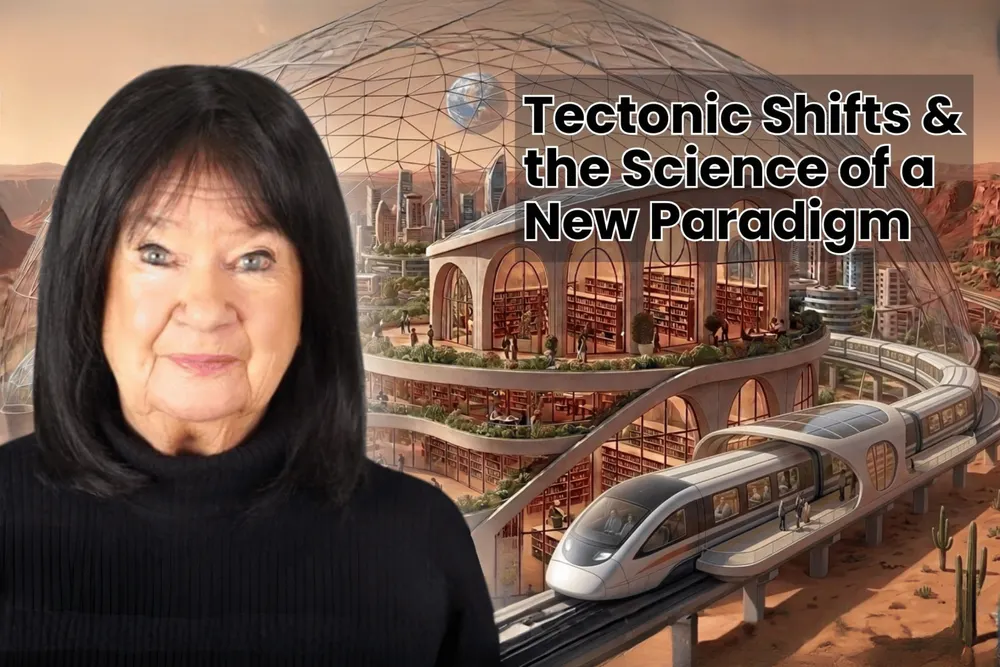
ZEPP-LAROUCHE: Well, I think the most important thing is that you start to think about yourself as being absolutely crucial in making the difference in this unbelievable tectonic change. I mean, we have periods where for decades politics actually moves smoothly forward; you know, not very exciting, but going back and forth between the different parties, but nothing big changes. This time, everything changes. We have a breakdown of the old order and the emerging of a new order. What we don't know yet is if it will be World War III or a New Paradigm of the cooperation of the nations on this planet in a peaceful way? And the question is, I would say, to the 90% or more determined, are there enough people who mobilize themselves to actually put an alternative on the table? Because in periods like this, the subjective factor is what may make the difference; because it may tilt the situation in one way or another.
So please sign this letter to Archbishop Wester, because it has already, you know, ever since Jack Gilroy issued this letter, which is fully supported by the Schiller Institute, many organizations and individuals have signed already. And what we want to accomplish with that is, not only that all religions back this up, the idea that the Pope should call a peace conference like the intervention of Pope John XXIII during the Cuban Missile Crisis, where that intervention by the Pope was an absolutely decisive factor, which was admitted by Khrushchev afterwards. So we need the Pope to intervene right now, and therefore not only religious leaders should support this initiative, but we are also calling on everybody else, industrialists, trade unionists, civil societies, people who have some standing because of their life work in this or that field. If we would be able to generate internationally a real revolution demanding this, it could be the uniting factor actually in the tradition of Nikolaus of Cusa, because the Pope would represent in his person that higher unity around whom everybody can unite. So please sign this letter, and this will also be discussed at the upcoming IPC meeting this coming Friday. So join us then and get active with us.
THISTLETHWAITE: Wonderful. The chat moderator will put that link in the chat for people to read and circulate the letter. So thank you, Helga, for today's discussion. I think you've given us a lot to think about.
Make sure to check out eir.news and get a subscription so that you can stay above rather than below the level of events. And there's the IPC meeting this Friday at 11 a.m., people can find the Zoom link for that on the Schiller Institute website. Thank you very much for tuning in. Thank you, Helga, and we shall see you soon, hopefully.
ZEPP-LAROUCHE: It's so good to see you. Till soon.