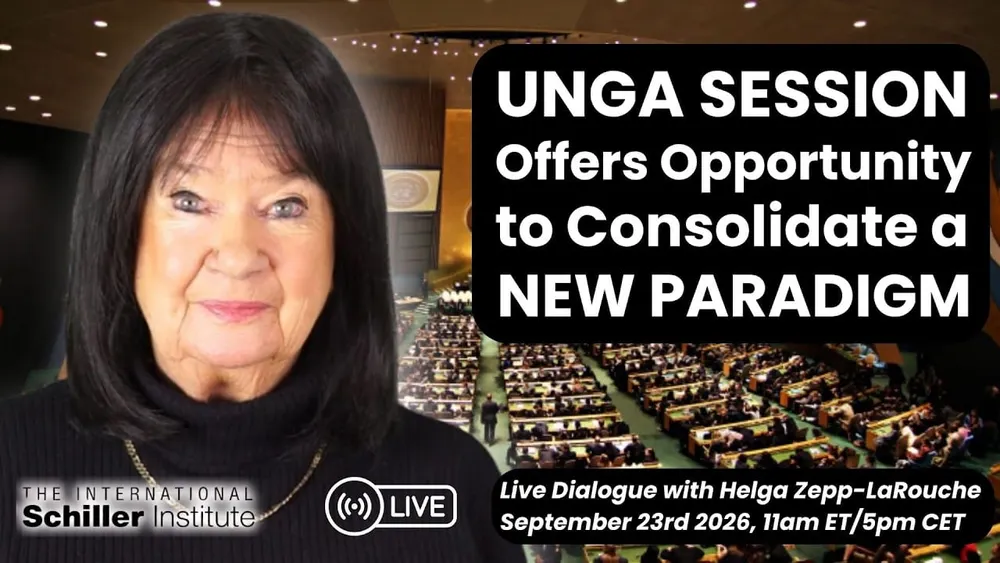
HARLEY SCHLANGER: Welcome to our weekly webcast with Helga Zepp-LaRouche, the founder of the Schiller Institute and the initiator of the International Peace Coalition Zoom call. Today is September 23rd, 2026. I’m Harley Schlanger and I’ll be your host. You can email your questions and comments to Helga to questions@schillerinstitute.org or post them on the YouTube chat page.
Helga, let’s begin with your intervention into the United Nations General Assembly meeting which opened this week in New York City. You wrote an open letter to participants in which you wrote of the importance of the United Nations as an institution which, while it’s not perfect, at least allows fundamental issues to be addressed, specifically now the matter of war and peace as the world has entered a difficult transition period in which sticking with the old paradigm means war. Your letter has been distributed to delegates and is being circulated by the Schiller Institute to a broader audience. Give us a summary of what you wrote and why you decided it was necessary to write it.
HELGA ZEPP-LAROUCHE: Well, because right now there are two fundamental approaches to security problems, the issue of war and peace, geopolitical questions in general, and the two different approaches are the one side proceeds from the idea of geopolitics, that is, that it’s completely legitimate that one pursues one’s own interest, that of the nation or group of nations one belongs to, with whatever means are deemed necessary against another group of nations. That is what we see right now in different varieties playing out in the Middle East, in Ukraine, in Greenland, for that matter, and many other so-called crisis regions in the world. It is very clear that this geopolitical approach has the implication that it could escalate into a regional war or even a global war.
And then you see on the other side a whole group of nations sort of rallying around a new principle, and that is the idea of partnership, of diplomacy, of coexistence, of the idea that the new name for peace is development, and to rule out war as a means of conflict resolution by basically saying that only diplomacy and negotiations are legitimate. And I think between these two approaches there seems to be a widening gap; and that is why I wrote this short letter to the heads of state and delegations. The United Nations is the place where you would address the idea that you need a completely new paradigm of indivisible security for all, the idea of a new paradigm of a new security and development architecture based on development, on taking into account the interest of every single member of the human family of nations. That idea, which is heavily being discussed among the countries of the Global South, needs to be put forward as a concrete proposal to hopefully be discussed at the UN General Assembly.
Now, I made such a proposal immediately following the beginning of the special military operation in Ukraine, because it was clear to me then that we were heading towards a major geopolitical showdown, and I called it the New Security and Development Infrastructure Architecture. And the only government which I have seen in the meantime come up with a proposal along the same principles is China. Xi Jinping has proposed four Global Governance Initiatives, the Global Development, Global Security, Global Civilizational Initiatives, and then finally last year the Global Governance Initiative, which is the only proposal other than what I have been saying as a private organization, coming from a government to propose such a new architecture. And I think hopefully there will be somebody who will discuss it at the UN General Assembly, because I think that is in one sense the only way you can overcome all these regional conflicts and prevent them from going haywire.
SCHLANGER: Well, in his opening address to the Assembly, Brazil’s President Lula addressed some of the same points you made, especially the idea that there’s a battle between two contrasting paradigms—the collapsing imperial model and the emergence of a new architecture.
Now some see what the BRICS represents and what you’re proposing as a threat to the Western nations, especially to the dollar and the hegemony of the petrodollar system. A reader of the EIR sent in a question, “Why can’t they see that the present system is fatally flawed as a result of their policies?” And he added that it’s clear to him that this is behind the wars they are fighting, but asked if you can explain it to those who still don’t get it. What is the relationship between this economic failure and the perpetual wars that are being waged?
ZEPP-LAROUCHE: Well, on the surface, naturally, you have the military-industrial complex, the weapons producers, and unlike other consumer goods, you need wars to consume weapons. So if you have peace, then these people think that this is bad for business, therefore, let’s keep the wars going. I mean, that’s on the surface of things very easy to understand.
More fundamentally, I think that the idea of continuously maximizing the profit for an ever more rich class of speculators and profiteers at the expense of the common good of the billions of people—I mean, this is the system which has been emerging since August 1971, when Nixon replaced the fixed exchange rates with floating ones, which my late husband, Lyndon LaRouche, at that time absolutely prophetically recognized as being the fatal mistake leading to potentially a new world war. So this forecast of the 15th of August ’71 by Lyndon LaRouche, I mean, that in one sense, people should recognize a man who would understand the absolute qualitative unique importance of that step. I think if people just go over it and slide over it and say, oh, that’s just one prognosis, no, that was the prognosis of the century. Because people would have listened to him because he repeated and deepened that prognosis throughout his lifetime; each time when the financial forces went one step further in the direction of deregulation of the markets, of eliminating Glass-Steagall, first lowering the impact of Glass-Steagall, then finally in 1999 eliminating it, then going for complete deregulation. That was the road which absolutely necessarily meant this new system would eventually blow up, and we are very close to that point. Then you have some people who say, well, if the system is collapsing, then let’s have another war, a splendid little war, as the British Empire used to say. Only this time it’s not going to be such a splendid little war, it’s the danger of global nuclear weapons. But that is what is, in one sense one could say, the final stage of capitalism, if one would argue it with Marxist terms. But it’s not completely wrong because the final way of trying to enforce the integrity of useless debt is through military means, but that has then the consequence of war.
SCHLANGER: You’re listening to Helga Zepp-LaRouche. We’re talking about the UN meeting going on now. There’s a question on Trump at the United Nations from a German contact who asked, “Are Americans not embarrassed by the danger and incoherence evident in President Trump’s speech?” He said, “The Germans are finally rejecting such foolishness in Chancellor Merz and his war and austerity policies, but are Americans still blind to the danger of a President who threatens to obliterate civilizations one day, then speaks of negotiations with phantoms of those civilizations the next day?”
ZEPP-LAROUCHE: Well, I can only say that if Trump feels that he can expose these views to the world without it having a consequence, I don’t think that that is going to happen. I mean, people may not say something immediately because of the power of the United States and the power of the military-industrial complex, and people may be worried about what happens to them if they speak out against it. But this was such a demonstration of, I would say, lack of international law, and I’m being very diplomatic. The whole world is there to judge.
And I just saw before we came to this discussion a few moments of the speech by Iranian President Pezeshkian, and I think people should compare the two and then make their own judgment. I think all the propaganda falls apart if you compare these two speeches.
To the German questioner, I however want to caution, you know, well, the German voters may have voted against Merz, but Merz doesn’t care. He just keeps doing what he was doing before. He has obviously decided that he discounts the vote; he doesn’t care. You know, the German voters can vote whatever they want. Merz will do what he wants. I think that’s a different nut we have to crack, don’t you think?
SCHLANGER: Well, I have another question on the German situation in a moment, but I want to bring up the conference that you participated in, in China. You were invited there. You and others are comparing it in significance to the annual Munich Security Conference. What was the theme and topics of this conference and what was accomplished?
ZEPP-LAROUCHE: Well, I think it is definitely maybe the most important security conference in China. It took place for the 20th anniversary, 20 years ago it started, and it was huge, more than 2,000 delegates. I think 60 defense ministers were present, most of them spoke; many other heads of organization, the head of SCO, the head of ASEAN, and it was quite an enormous concentration of leadership and power. I think the key difference to the Western security conferences is that it was absolutely based on the idea of development, security being development. You could not help to get it out of practically every speech which was given by the Westerners, and this came out also in some of the discussions. Western conceptions—that is the U.S., European Union, NATO idea of security—are that you have to have a lot of security training, bases, equipment, hardware, all kinds of weapons systems, and that that way you somehow cement security. Well, the idea of security which was mentioned by many, many of these speakers is the idea that, no, we need to create conditions where people can peacefully live together in harmony, in partnership, with respect to the sovereignty of the other nation, that you solve all conflicts through dialogue and negotiations.
And I think the second model is so much more reasonable and so much more attractive that I think that provided that we will not end up in nuclear war in the short term—which is a real danger—I think this more human conception of living together in partnership, working things out together, will work out to be superior; because it simply represents the interests of everybody, rather than having some dominance by the most powerful ones, and the weak ones have to live with it. I think that barbarian conception is outlived and will not determine the future.
SCHLANGER: Since we last spoke, there have been two more elections in Germany. One in Mecklenburg-Vorpommern, in which Merz’s party, the Christian Democrats, did not win a single seat. The question everyone is asking, as we referred to earlier, is whether Merz has the good sense to step down for the good of the country, and while his party still exists. But the other question is who from the CDU or his coalition partners could replace him? And is there anything real about the rumor that a desperate party might call for the return of Angela Merkel?
ZEPP-LAROUCHE: Well, I’m not a big fan of Angela Merkel, but compared to the present leadership, she almost looks like paradise. And I would have never thought I would ever say this, because with Merkel, the road downhill to mediocrity was unfortunately fully underway already.
No, I think Merz did not have any shame. He did not even wait until the vote was counted out, and he already took the microphone and declared he would stay on, that he had backbone and courage and all kinds of other ingredients. In a certain sense, I think it’s not understandable, because the CDU vanished, was wiped out in Mecklenburg-Vorpommern. He did not only get no seat, but there were 11 voting districts where the CDU did not give one single vote. I mean, that means they are wiped off the plate. But this did not bother Merz at all. And when somebody behaves like that, you ask yourself, from where do they take the inner authority to do that? It’s a question one has to think about. Obviously, the voters don’t want him. The CDU is in a rebellion, and I don’t think that that is over yet. I think there are rumblings going on in all kinds of gremium institutions within the CDU.
So the only explanation one could come up with, or I could come up with, is that there are some other authorities he is feeling loyal to, like, for example, his previous boss of BlackRock in the financial institutions, because the voters don’t want him, but he stays on. So how come? I think this question is not settled. And the longer this goes on, the worse it gets. And the country is unfortunately suffering, because we are in a terrible economic condition, where jobs are being lost, the living standard is collapsing.
I think this may lead to a rebellion in both the CDU and the SPD in the short term, because they cannot cut the pensions and all the other entitlements the way they do without having… I mean, the Social Democracy is threatening to disappear completely. Why would anybody vote for an SPD, which is a traitor to the workers? They’re all voting AfD now. So I can imagine that this is going to lead to a hot autumn.
SCHLANGER: Speaking of leaders in trouble, there are two questions on Ukraine. A Ukrainian in exile in Germany asks, “Is there any chance that Zelenskyy will be ousted while there are still some Ukrainians alive?” And he also asked, “What do you think of the European Union banning Zelenskyy’s former press secretary, Yuliia Mendel, from speaking in Brussels before an AfD meeting?”
ZEPP-LAROUCHE: Because they’re obviously afraid of anybody bringing in something else than the NATO narrative. I mean, the signs are that there is no more freedom of expression, speech, press, opinion in Europe. I mean, unfortunately, they are mounting all the time. And I think this is just one expression. I think the situation for the Ukrainian people is tragic. I think if this thing is not resolved quickly—there are apparently some negotiations between the Trump team, Witkoff, Kushner, and some Ukrainians, I think some Russians, I don’t know exactly, in the context of the UN General Assembly on the sidelines. But Ukraine is looking towards a horrible winter. A lot of equipment and infrastructure has been destroyed. There is no way this can have a good end.
And it’s very clear that the Russians are determined to settle this militarily. That’s also an opinion which has been expressed, and unfortunately I have to agree with him, by John Mearsheimer, the professor from Illinois, who basically says there is no diplomatic solution possible because both the Russian side and the Ukrainian side have demands which are irreconcilable. And therefore, it cannot be resolved diplomatically. If that’s the case, then it will be terrible. It will be terrible for the Ukrainians. But with the present government, I don’t think there’s anything else possible.
SCHLANGER: The other thing that keeps coming up is the Western media is filled with stories about the collapse of Putin, that Putin is in trouble. The Atlantic Council had a series on the question, “Is Putin’s regime cracking?” But Putin’s party won re-election in what observers report was a fair and clean election.
At the same time, the BBC is writing, are the British people prepared for war? So how do you see this thing evolving?
ZEPP-LAROUCHE: Very badly, because the Coalition of the Willing countries—that is the Germans, French, British, but also the Baltic countries, some of the Scandinavians—are obviously preparing for war. I mean, the British press was full of orders to the population on what has to be done to prepare for war in the short term. It’s a hype, which I can only imagine that they really plan to do this. And unfortunately, the situation is extremely dangerous.
I think people in Germany, for example, are completely, almost paralyzed. We had a discussion today among some of our members in Germany, and they were all reporting from individual discussions they had with people. They’re either completely paralyzed, or frenzied; the discussion of where to emigrate is being asked repeatedly. So I think we are sitting on the top of a powder keg. And I can only say the more quickly institutions of these countries get their act together and replace the leaderships, which are these warmongers, the better.
SCHLANGER: That brings me to a question that’s sort of a broad one on the question of denial. Dr. Omar Bartov spoke at the IPC meeting last Friday, and spoke of the denial of genocide committed by Israel, and how that is a factor in Israel’s policy, but also in the West. In the last three years, there have been three movies that are emotionally powerful movies, award-winning movies that are from Israeli or Israeli related filmmakers, No Other Land, The Voice of Hind Rajab, and now one called NAZA, which means collateral damage in which they are interviewing soldiers and intelligence people with their faces blacked out, but who talk about how AI weapons are being used to target civilians. And what they do is they track a phone of a child to find out if the father’s at home, the father being a Hamas member, and then blow up the home. And one of the people interviewed said, “Yes, we are killing these children intentionally.”
So the question I have for you, as someone who studied this question of psychological warfare and brainwashing is, how powerful does this censorship have to be to keep people from turning away from that? In Israel, there’s a huge reaction against this movie. Netanyahu and his Culture Minister have called for the two filmmakers to have their citizenship revoked. So what does this say about a society when the denial is that profound?
ZEPP-LAROUCHE: Well, I think there is something in the human psyche, which tends to want to go with the crowd, to adapt. And the only antidote I can say is you have to be conscious about it, you have to be aware of it. Because I looked at this many years ago; what caused the German people to adapt to Hitler. And it was a very slow process, where okay, there were some supporters of Hitler from the beginning. But then there was a larger crowd of people who were absolutely horrified. But as the power of the Nazis became stronger and stronger, and more crucial figures started to collapse, people adapted and almost forgot that they had the opposite view only a short while ago.
I think this has to do with the fact that unfortunately, the number of people who are self-thinkers, so to speak, is relatively small. I mean, if you look at the behavior of people, they want to go with the fashion of the season, they want to have the car which is in demand, they go to places on vacation which they think makes them popular—all of these things. I mean, how many people do you know, who appreciate their own mind, and the self-perfection of whatever they have set out to be the task of their life, as more important than all of these sensuous pleasures and entertainments and so forth?
Sure, there are people who are scientists, there are musicians, there are artists of various kinds, but they are few. And even among them, you know, it is not everybody who is independently minded. This is one of the reasons I called the Schiller Institute, Schiller Institute, because Friedrich Schiller, the German poet of freedom, was somebody who appreciated freedom as the highest good. And not only the outer freedom, he said the greatest piece of art is the building of political freedom. But even more than that, he said it is the inner freedom, that which makes people to be self-directed and makes them really free, that is what is the most important. And that you can develop and cultivate by developing your mind and your emotions to not be a sheep going in the herd to the slaughterhouse, but to think for yourself.
And I think that that is a quality which is increasingly vanishing. If you look at the media addiction, the digital addiction, and now even artificial intelligence being practically the replacement for thinking. I’m not against AI, I think it has absolutely useful functions. But if it replaces thinking then the ability; for example, in Germany, among the 15 year old pupils, there is an alarmingly large number of people who may still be able to write their name with letters. But if you give them a one page text, you know, of some new content, they cannot comprehend it. You know, they cannot decipher the meaning from these letters. And I think this is where this whole thing is going, which is why we absolutely have to have a renaissance of great Classical cultures and a dialogue among cultures and civilizations, because this is a, I think this cultural offensive is as dangerous as all the other things we touched upon today.
SCHLANGER: Well, I would urge people to look for these films, because they are incredibly powerful. They were prize-winning films, but they’ve been subjected to limited distribution.
Helga, on Friday we have the next International Peace Coalition conference call. What do we have on tap for that?
ZEPP-LAROUCHE: Well, I think we will for sure have a lively discussion about the UN General Assembly. I mean, first of all, we have a whole team of people deploying around the United Nations, not in the United Nations, but around it. And you can always meet a lot of interesting people, diplomats, top government people. So that will be one big component. Then for sure, there will be a discussion on the situation in Southwest Asia, because depending on which of the options Trump is pursuing—he mentioned three—one is the complete annihilation of Iran, the second one is continuous economic suffering, or thirdly, to make a deal.
I mean, that will become a little bit clearer, because remember that we are at the end of September. When we discussed this in July, we said, if the situation is not resolved by September, the world will run increasingly out of energy resources. This will have an effect on world starvation, which is definitely increasing around the world, especially in the poorer parts of the world. And now with the additional crisis around the Red Sea and the Bab el-Mandeb, you know, the strait there, the effect on the oil market, on the energy market is becoming absolutely devastating. All of these things will be discussed. So absolutely come to this event and be part of the international peace movement.
SCHLANGER: And also your letter is posted on the Schiller Institute site. People should take that and read it and discuss it, and get discussions going. So thanks for joining us today. I know you’ve got an extremely busy schedule, and we’re happy that you could spend the time with us that you have.
ZEPP-LAROUCHE: Okay, I hope to see you on Friday.