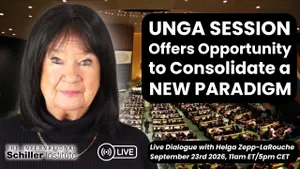
HARLEY SCHLANGER: Hello and welcome to our weekly dialogue with Helga Zepp-LaRouche. She’s the founder of the Schiller Institute and the convener of the weekly International Peace Coalition Zoom call. It’s September 30, 2026. I’m Harley Schlanger and I will be your host. You can send your questions and comments to Helga via email to questions@schillerinstitute.org or post them on the YouTube chat page.
Helga, in an open letter that you drafted that was distributed to delegates attending the UN General Assembly meeting in New York City, you wrote of the importance to engage in dialogue through the United Nations to make it through what you called the tumultuous transition period. You pointed to the meeting between Presidents Trump and Xi as a potentially hopeful sign. In particular, you noted Xi’s comment that the U.S. and China should be partners and not rivals, as well as a statement that as partners we could avoid falling into the Thucydides Trap. When I reported this in several interviews, there was skepticism about avoiding superpower confrontation with a so-called win-win approach. One reporter asked me to ask you to explain how a win-win approach can work in an already supercharged period of geopolitical confrontation.
HELGA ZEPP-LAROUCHE: Well, I think the answer is actually surprisingly given by the army of the Republic of Iran, the Revolutionary Guard. They wrote an open letter to the American people. I have not yet read the full letter, but the portions I read were basically saying that the American people should consider that all the many foreign wars of the last several decades only brought economic harm and misery to the American people. And I think that that is an overriding reason why it would be time to go to a reasonable relationship of partnership, because it’s so obvious that the two largest economies can do an enormous amount of damage to each other in a lose-lose, you know, one against the other operation. And on the other side, they could have enormous benefits to both if they would agree on a win-win.
So, I think objectively, there is no reason why this conflict should exist, except the ideology of some of the people who have vested their interest to the military-industrial complex and the extreme speculation and profit maximization policies of the present system at the expense of the real economy and the well-being of the people. So, I think that we are—you know, for me, the whole outcome of the history of this present conjuncture, which you mentioned that I called it a transition period. And indeed, it is a transition period, because it’s so clear to everybody, unless you are completely blind, it’s so clear that we are at the end of an epoch. This is not just an election cycle or some little change. This is the end of an epoch of 500 years.
Around 1500, European colonialism really started to take roots. And the entire period since then, which is a little bit more than 500 years, has been characterized by a complete suppression of the global South, the so-called colonial period. And in the recent period, these countries were able to start to overcome that colonial dependency; in very large part because of the rise of China. The fact that China was able to develop from a very poor developing country in about 40 years to probably the largest economy in terms of buying power, in terms of inventions, new patents, number of scientists and engineers being produced every year. Because of the rise of China, which is unprecedented in all of history, whereby they were able to lift 850 million of their own people out of poverty, and now are an amazingly modern nation, which shocks and flabbergasts everybody who travels to China.
And China has reached out to the countries of the Global South, offering them cooperation based on win-win cooperation. Now, that has completely changed the international landscape. And now everything depends on the fact, will the countries of the West—that means Europe, but also the United States—adjust to that change and just leave the idea of dominance, that they have to be the rules-based order, kings of the valley, and agree that they should be equal partners? If the countries of Europe and the United States would just say, we agree this is a transition, we are no longer the dominant power in the world, we are reaching out to the Global Majority and agree to be partners; all problems could vanish in no time. It’s so much within reach that it is absolutely amazing that some people don’t want to see that.
So, that is why I think that everybody who wants to have peace and avoid a total catastrophe of a global nuclear war—the danger which is still very, very high—should work towards convincing institutions and individuals of goodwill to just turn the paradigm on its head. That’s all that is required.
SCHLANGER: We have several other questions on this basic issue. Ending the war with Iran was on the agenda at the United Nations. Unfortunately, President Trump put forward his proposal, the three options, one of which was to annihilate Iran. Then the Iranians offered a new peace plan, which Trump immediately rejected. So, then you have this intervention by the Revolutionary Guard Corps in the letter they sent. And in it, the Brigadier General Hossein Mohebbi, who’s the spokesman for the IRGC, did specifically address this question that you just mentioned that instead of putting funds into war to put them into development projects.
So, a questioner asked, “Could this be an opening to discuss cooperation with Iran on the Extended Oasis Plan? And what do you think would happen in the United States and in Israel if the Iranians made an offer to help fund the Oasis Plan?”
ZEPP-LAROUCHE: Well, I think the subsequent developments, at least as reported by some sources, were that in the meeting between President Xi and President Trump, President Xi told Trump that there was an off-ramp. And that was that he very simply would go back to the Memorandum of Understanding, which Trump himself had signed with Iran previously before the new outbreak of the military conflict. And then after two days, Trump supposedly rejected that, which was taken, you know, very badly by the Chinese, who think that this was very rude behavior.
So, it seems that we are now back to an escalation. We will find out today, because today is the 30th of September, and that is the date when the ultimatum is running out, which Iran had given to the United States in mid-August, where they said that the U.S. had 45 days to stop the blockade of the Iranian ports. That is running out today, so I don’t have any updates yet, but we will see. If that ultimatum is not met, I’m pretty sure that Iran will try to pursue its interests, including militarily. Simultaneously, you also have the Red Sea being blocked, and the Houthis are on an offensive against Saudi Arabia.
So, we are sitting on a complete powder keg, where any continuation, any prolongation of this conflict is risking to throw the world economy into a deep depression, and having the potential of leading to a blowout of the financial system as a consequence. So, I would not be surprised if the countries who so far have formed the Mecca Alliance, you know, that if they want to survive, they better go in the direction of the Oasis Plan. The only way a country like Saudi Arabia, for example, I mean, they are sitting on a hot seat. They cannot count on the United States for their defense. I mean, it has not come in the last year, so why would it come now? And they are actually in a very fragile situation. Pakistan, on the other side, has a vested interest to continue to play the mediator in the conflict. They do have a security partnership with Saudi Arabia. And then you have Turkey, who also has all kinds of security problems, including an increasing one with Israel.
So, there is a good reason why these countries would decide that security in these times does not come from military means alone, but it comes from winning friends, winning trust, and doing something for your own population. These things will be much more important in terms of guaranteeing security in the coming world, if there is one, than reliance on brute force and military suppression of your opponent.
So, I think the situation is very, very ripe for something like the Oasis Plan to be put in the equation. And we are from the Schiller Institute and our organization is working on many fronts to try to inject that idea into the present Middle East situation as the basis for peace. And peace is development; that is the dominant idea among the Global Majority countries, and it’s only really the countries of the West which still think security is just military. The majority of the world has understood that security is development.
SCHLANGER: Now, sticking with Southwest Asia just a little bit more, there’s the story coming out in the last couple of days from the New York Times, from the Times of Israel, the Wall Street Journal, confirming the report from Ha’aretz that Netanyahu, the Prime Minister of Israel, had received an advanced warning of the October 7th attack from Mohammed bin Zayed, the President of the United Arab Emirates, but that he did nothing to act to prepare for it. Now, he recently made a quick trip to the UAE where it’s reported he met with bin Zayed and that this was seen as a sign of desperation. Now, the election in Israel is set for October 27th. A contact in Los Angeles who’s very much involved in the peace movement wrote, “I have very little faith that any of the opposition candidates running against Netanyahu will change the policies of Israel. Their opposition is to Netanyahu, but not opposition to the killing of civilians in Gaza, the West Bank, and southern Lebanon, which is continuing. Why do the majority of Israeli citizens still support the genocide policy of its government?”
ZEPP-LAROUCHE: I cannot answer that question. I think that there are some reports coming from usually extremely well-informed people like Colonel Wilkerson, who basically thinks that the conflict will escalate and the nuclear weapon will be used either by the United States or by Israel against Iran. And he basically thinks that that will, as a consequence, lead to the complete elimination of Israel.
Now, I hope he’s wrong, because if that happens, I do not believe that a nuclear conflict can be limited. I think that the various scenarios which have been developed even on our program or the IPC meetings by Professor Steven Starr or Ted Postol, two eminent nuclear experts, each of whom have demonstrated that once you use one nuclear weapon, all weapons will be used within a matter of days. Now, I don’t know if that will happen, if there would be the use of a tactical nuclear weapon in Iran, because I think all the countries involved know that that’s the end of civilization.
So, I cannot answer the question if that for sure will happen in this case. But the danger is so big that anybody who is in their right mind should absolutely avoid that. Now, I think that the only hope for the Israeli future would be that there are enough citizens in Israel who understand that they have a geographical location in the Middle East, in Southwest Asia, which will be there for eternity. There’s no way you can change that. So, either you start peaceful relations with your neighbors, or else you risk continuous horror for your own population and everybody else. So, I can only hope that such reason eventually will prevail.
SCHLANGER: You’re listening to Helga Zepp-LaRouche of the Schiller Institute, who’s been a tireless proponent of the development of a new paradigm based on a new security and development architecture.
Another major concern you’ve been addressing is the discussion of the danger of the military-industrial complex and the war hawks in the United States talking about modernizing nuclear weapons. There is similar talk in France and Germany, and then also including the use of tactical nuclear weapons.
Yesterday, the United Nations sponsored a day-long event on the elimination of nuclear weapons. What was the outcome of that session? Is there an agreement and motion towards some kind of solution, or was it more of a stalemate?
ZEPP-LAROUCHE: Well, I think there’s an overwhelming majority of countries in the world who have joined this movement to ban nuclear weapons completely. And also Pope Leo XIV has come out repeatedly demanding that nuclear weapons be eliminated. And anybody who has an inkling of understanding of what the effect would be of the use of such weapons would agree.
So I can only emphasize to people who are concerned about the danger of war, to join the International Peace Movement. On October 3rd, which is the day of German unification, there is going to be a huge demonstration. I hope it’s going to be very huge in Berlin and in Stuttgart, where 260 organizations have called for participation. Given the number of organizations who have made this call or signed that call, one can only hope that a lot of people follow it, because it is so absolutely clear that if it ever comes to the use of nuclear weapons—let’s say in Europe, where some people are really playing with fire—that if it comes to that, Germany will cease to exist. So come to this event on October 3rd, go to Berlin, go to Stuttgart, if you have relatives or acquaintances anywhere in Germany, call them, tell them to participate. I think it has never been as important as now. If you think about the fact that we are close to destroying all of mankind, when we could instead start using all the technologies to really build a garden out of this planet. So please go to these demonstrations.
SCHLANGER: We have several questions that have come in related to this incident in the Fairford Royal Air Force Base in Britain. And here’s one from the UK; he said, “It looks like a false flag, which has received a lot of media coverage.” Someone else writes that this plus the alleged Russian drone found at the Leipzig airport, and then this incident in Fairford where they captured five alleged suspects and then released them.
There have been a number of warnings coming out now, including from some Veteran Intelligence Professionals for Sanity in the United States, warning of false flag attacks, including those related to the U.S. midterm election, that if there’s any indication of dispute that there may be a crackdown, they may use these kinds of threats. What’s the intelligence that you’re looking at on this?
ZEPP-LAROUCHE: Well, in the case of this British incident, it looks really like a joke, because why would you immediately release the suspects, if there was only a shred of evidence that they were indeed involved? I think the issue of a false flag is very, very high in terms of history. If you go back many times, the principle of false flag was being used, leading to actual wars. So I think that this is definitely something to have in mind. And I think the very idea of the midterm election being sabotaged is very much in the discussion. So we should be really on high alert for that opportunity and danger.
SCHLANGER: Now, there’s also a report in the United Kingdom of just nonstop warnings that the Russians are hacking into communications, hacking election data, that they are engaging in cyber warfare against the country. And the British set up a new agency called the National Center for Information Defense, which this one correspondent says, it sounds like an effort to expand the surveillance state and censorship. And he then brings up the question of how this seems like a repeat of 9-11. How often do they think they can pull these things off? And is there not yet? I mean, doesn’t this point to the importance of fully declassifying all the documents from 9-11?
ZEPP-LAROUCHE: Yeah, that would be a good start. I mean, there are many documents which need to be declassified, including the assassination of John F. Kennedy, Martin Luther King, the documents behind the illegal operations against my late husband, Lyndon LaRouche.
I mean, if you look at the entirety of the history of the United States after the assassination of Kennedy, it’s one big, you know, cesspool of dirty operations. And I think a new approach would be very necessary. But unfortunately, President Trump, who had promised that he would, you know, do something in the meantime, Tulsi Gabbard basically was driven out.
And right now, it seems that the same Deep State seems to have very much control over many aspects of the policy of President Trump. So, I think what is needed is a real people’s movement, which I can see is happening. It’s coming to the surface in many parts of the Western world. For example, the French students are on an upheaval. The German students demonstrated against the draft. In the United States, there is a lot of popular protest against the two-party system. One can only hope that the independent candidates like Diane Sare, our presidential candidate, that people rally around these forces; because I think what we are seeing is that the existing establishments, for reasons which are a case of a clinical study, are absolutely incapable of correcting their policies. So, they keep doing what they have been doing the whole time. And I think they are not going to leave their posts by free will; and therefore, the danger that they resort to such tactics remains extremely high. And the only thing against that is an educated population, which doesn’t let that go through.
SCHLANGER: Now, we have a question from Thomas B., who often sends us questions on finance. And it’s about the National Bank proposal of the LaRouche movement, the National Credit Institution. And he asks for a clarification. “Would the National Bank, as has been proposed by your husband, exclude private funds, such as hedge funds, equity funds, and others, having controlling interest in the National Bank?”
ZEPP-LAROUCHE: Yes, absolutely; that’s the whole point. I mean, remember that my husband, on the 15th of August 1971, made what was probably the most prophetic forecast he did of the many, many ones which were excellent, where he recognized that that particular decision by President Nixon to abandon the old Bretton Woods system, which had regulation, replace fixed exchange rates with floating exchange rates, that that put the whole system on a pathway to a new depression and a new collapse. And that is exactly where we are today. If you look at the last several decades, first you had the undermining of Glass-Steagall, and then eventually, the abolishment of Glass-Steagall in 1999. Then following that, there was the absolute limitless deregulation of the financial sectors. And the amount of speculation, hedge funds running the world financial system in nanosecond intervals; you know, the whole speculation is now being done by AI, it’s done by algorithms. I mean, if you imagine $2.4 quadrillion outstanding debt of the derivatives market is run by machines, in a sense, once you start to comprehend what danger we are sitting on, with that, people should really understand that when we are asking for a reregulation, by going back to the standards of Glass-Steagall, exactly as Franklin D. Roosevelt implemented it in 1933, that is the only safeguard against an uncontrolled blow up of the financial system. Now, what we propose is an orderly reorganization where all the legitimate debt and the legitimate entitlements and assets are protected. If you have an uncontrolled collapse, that’s not the case.
So, I think the discussion of how to get out of this bubble, rather than going to war to protect it, would be a very important topic. But it’s very much absent in the columns of the media. And, you know, I think people like you should help us to confront elected officials that this is what needs to be put back on the agenda.
SCHLANGER: Now, this is a follow-up to that someone wrote in. This relates to the Epstein cover-up, that when you’re talking about this coordinated artificial intelligence tech sector coordination, this was something Epstein was working on, but also the whole shift in the financial system from August 15, 1971 to the present. This includes people such as Leon Black, Wexner, Larry Ellison, Paul Singer; these are the Zionist billionaires. “Why is it that they’re able to protect these people who were very much involved in shifting the economy from the American System to this speculative bubble, which is collapsing now? How do they get away with that?”
ZEPP-LAROUCHE: Well, because it’s a plutocracy. I mean, I think the Western democracies have long stopped being republics. Republics are where representatives are elected by the governed and they are in turn responsible for the government and vice versa, representing the interests of the government to the people and vice versa, where you have a reciprocal system which functions through the representatives. I mean, that’s a republic.
Now, that has been replaced very, very clearly through a plutocracy, where if you look at the number of honest Congressmen and Senators in the United States, for example, or in Europe, for that matter, you are probably getting along with fingers of one hand or maybe two hands, but not much beyond. While the majority are people who owe their position due to millions if it’s a Congressman and raging into two-digit millions if it’s a Senator, and if you run for President, you know, then it’s nearly billions. So, you know, that is obviously how it functions.
And you can see this by the behavior of President Trump. I mean, he started off his second term by promising to be a President of peace, to end all wars and never start a new one. And now look where we are. Why is that? Is it Trump deciding what’s good for his place in history as a peace President? Obviously not. It’s good for the military industrial complex. It’s good for people who still think that they have to own and control the financial system. So I think we are really at the point of, you know, America, is it a republic or is it becoming an empire? And I think the answer to that is unfortunately not a very happy one.
SCHLANGER: Well, on that very point, we just got another question in. Someone reports that the Schiller Institute has been talking about the role of Rubio and the people he works for, these financial billionaires, moving to establish right-wing governments in South and Central America, partly to keep the Chinese out, but also to control raw materials and traffic. And now they’re targeting Lula with the Brazilian elections coming up.
And he writes, “Isn’t this an example of imperialism? You take away the sovereignty of Venezuela, Brazil, even target Mexico. And as we approach the end of the imperial domination that you’re talking about, doesn’t this prove that they’re still trying to protect it and in fact extend it?”
ZEPP-LAROUCHE: Well, I think it’s very clear that there are members in the Cabinet of President Trump who clearly think about the U.S. running Latin America as a backyard—the so-called Don-roe Doctrine. If you look at the list of individuals who are now on the sanctions list, it’s almost a one-by-one. People who have defended the Chancay Port in Peru or are in favor of the bi-oceanic railway or in some other way think that Latin America should have a sovereign policy working with China, because the interest of Latin America would be to have economic cooperation with Asia; which is right now the only rising and economically sound part of the world.
So I think the problem of President Trump obviously is that he has lost control over his Cabinet. I mean, if you look at what he promised at the beginning of the second term or what he tried to accomplish in his first term, being derailed at that time by Russia-gate and something which has been turned out to be a complete operation of British intelligence, I think he has lost it. I cannot see how President Trump is able under the present circumstances to recapture his Presidency.
SCHLANGER: Well, on that point, we’re coming toward the end, and I’d like to take an opportunity to discuss the importance of the International Peace Coalition, which you launched, I guess it’s 174 weeks ago, which has a weekly Zoom call. The last two of these meetings were extremely important. Two weeks ago, we had Dr. Bartov, who’s a Holocaust expert, and Jonathan Kuttab, a Palestinian human rights activist, who engaged in an in-depth discussion of this whole question of the Southwest Asia crisis. And then last week, we had Professor Marandi, the former President of Guyana, Donald Ramotar, and U.S. journalist Garland Nixon. And these kinds of discussions are crucial to give people an in-depth understanding of what the fight is. So can you give us a preview of what will be the discussion this Friday of the IPC?
ZEPP-LAROUCHE: Well, given the fact that today is the end of the ultimatum to the United States to clear out the blockade of Iran, we will know what will happen and it will determine if we go into an escalation with a turn into a depression in the short term or not. So I’m absolutely sure that we will have top speakers from the Middle East to discuss the implications of where we are. And then we will for sure continue to discuss the initiative for the appeal to Pope Leo XIV, which is gaining momentum practically every day.
Just today, we had a very important reprint of this appeal in a newspaper in South Korea. So, you know, it is spreading worldwide and the motion for Pope Leo XIV to convene a summit of the key leaders of the world, President Trump, President Xi, and President Putin, and move the world into a new paradigm. That appeal is gaining massive momentum. There are many organizations like Pax Christi, not only in the United States, but we have now Pax Christi people, I think, from Germany, from France. Other individuals are starting to really understand that we need a worldwide movement to unify around the idea that we do not want war, we want peace. And since Pope Leo XIV is such an absolutely outspoken pope on the topic of world peace—he just had a marvelous intervention into France—we will have for sure a report about that, because our organization in France was present practically at every occasion, with the exception of Lourdes, but we were in Paris, in all the different events with the pope. We had people in Metz, and we distributed many, many of these appeals. So, you will get a lively report about the impact of the Pope’s visit in France, which is right now coming at a very interesting moment, because while for a long period of time people said, oh, Christianity is dead in France, it’s a secular state, religion doesn’t mean anything anymore; now you have a huge revival of young people wanting to be baptized. And not everybody is of the conservative variety. Many are really supporters of Pope Leo XIV, because young people regard him as a sign of hope. So, that will be an important part of the IPC meeting.
So, you should absolutely be there to get news you cannot get anywhere else, and make up your mind what part you want to join.
SCHLANGER: Well, Helga, thanks for joining us today, and I’ll definitely see you on Friday, and I hope a lot of our viewers will join us and organize others; because for those of you who want to do something, the easiest thing to do is to insist that your friends and family members and colleagues go to the IPC Zoom call and get informed, and not just informed, but get challenged to think critically on their own.
So, thank you, Helga, and we’ll see you Friday.