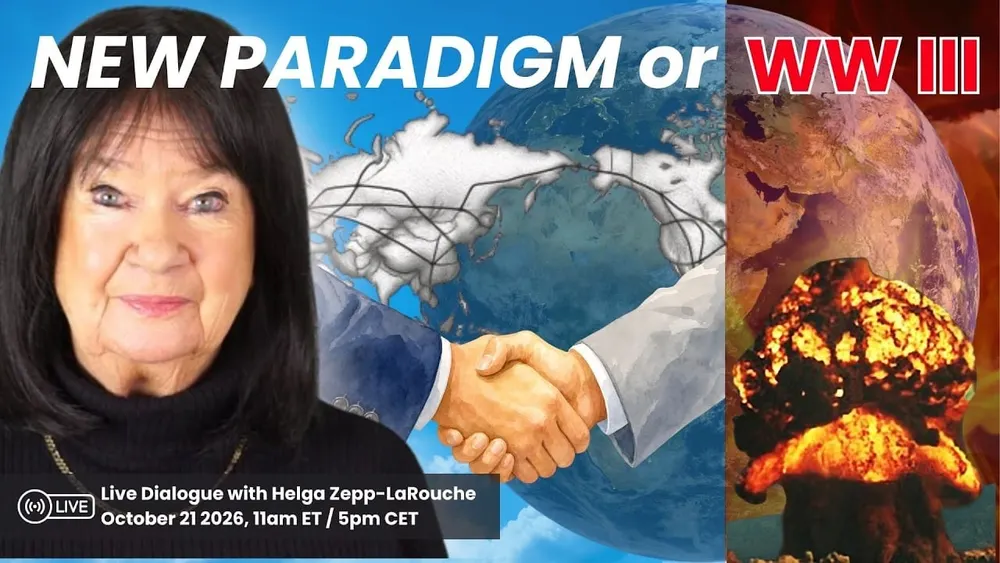
JASON ROSS: Hello, welcome. It’s October 21, 2026, and you’re watching the weekly webcast with Schiller Institute founder Helga Zepp-LaRouche. To open with, Helga, you had said on Monday that the world is facing a choice of either a new paradigm or World War III, and that the period of decision is not going to drag on forever. There are several branching points coming up just in the next two weeks. The run-off election in Brazil on Sunday, the Israeli elections on Tuesday, the mid-term election in the U.S. the following Tuesday, as well as the conference for peace, “Unarmed and Disarming Peace” being held in Assisi from October 25th through the 27th, at which two Schiller Institute representatives will be present. My question for you to start off with would be, is the world closer to war than it was a week ago, closer to a new paradigm? Where are we today?
HELGA ZEPP-LAROUCHE: Well, I wish I could say that with scientific certainty, but I’m afraid that both options, the new paradigm and the total degeneration of the strategic situation are both within reach. And since there are so many complex factors working into each other and depending on each other, it is very difficult to say. One thing one can say for sure is that the long stretched out process of the liberal system becoming more bankrupt has the tendency to go for the profit maximization of a few. That process, which has been going on for literally more than half a century, is coming to a close. The fact that you have more and more billionaires, multi-billionaires, wannabe trillionaires, and billions of people just not being able to make ends meet, especially naturally in the Global South, but increasingly also in the Global North; that process cannot be stretched out forever. And the war drive, which is unfortunately very visible, especially in Europe, is clearly nourished and fed by the realization of the powers that be that they are running up against increasing difficulties to keep the system together financially.
So armament and warmongering seem to be the way to distract the population, and even prepare for war. I think the utopian idea that you can win wars, even tactical nuclear wars, that you can have a limited nuclear war, that mental disease has been going on for such a long time that I’m afraid that many of the world leaders upon whose decision it depends if there will be war or peace, do not really understand these questions. They do not understand that there is no such thing as a limited nuclear war, because they have never made the effort to think it through. So I think that that is definitely something which should worry everybody, and I think there are many more people worried increasingly about the danger of a nuclear war. But the only thing which gives you hope is that there are many countries in the world and leadership in these countries who are clearly concerned about that possibility and are working towards trying to safeguard against it.
So how this will play out, I cannot say. All I can say is that in a period like that, when it’s very clear that the old order is no longer functioning, and the new order is not yet shaped, you have certain tendencies, but not yet any structure, any new framework; that it is this kind of period where the activity of the individual acting as a world historical individual together with other such individuals is what makes the difference.
ROSS: Well, in terms of what some of these individuals might be doing, looking a little further ahead, later this fall, China is hosting an APEC meeting in Shenzhen. A few days ago, the Wall Street Journal reported that Putin was expressing interest in a trilateral meeting between him, Trump, and Xi Jinping. Since your last webcast, Trump was asked about this, and he said that he would be eager or willing to sit down with Russia and China to discuss, among other things, disarmament. You’ve said that if Trump and Putin are interested, it would be hard to imagine China not taking the opportunity as the host to make such a trilateral meeting happen.
My question for you is, what would need to happen between now and that APEC meeting in Shenzhen? What would you hope to see happen by that time to make that meeting more than a photo op or more than perfunctory?
ZEPP-LAROUCHE: Well, I think on the side of the forces who are working to try to get to a new paradigm of peace, you will have, very importantly, the Assisi religious leaders meeting next week, which is organized by the Community of Sant’Egidio, and Pope Leo XIV will participate despite his medical problems. He has invited all the religious leaders, not just of the Christian faith, but also other religions. So this would be a world gathering of religious leaders who all will basically follow Leo’s call to mobilize for peace. I’m pretty sure of that. So that would be an important intersection point, because if all the political parties would listen to the religious leaders they are supposedly close to, we wouldn’t have this problem. The problem is that many of these political leaders are not listening. But that would be a major inflection point.
Then, naturally, China is organizing all kinds of meetings internationally on the Global Governance Initiative and other such approaches to really put together on the agenda the new framework of international relations. Also, there will be several conferences in the meantime.
So I’m moderately optimistic that if the temptation coming from certain circles to escalate against Iran, to possibly reignite a big war between the United States and Israel and Iran, if that can be avoided, and if the present efforts by the United States, represented and explained by Kirill Dmitriev and Witkoff meeting with Putin today in St. Petersburg, if these things go well, meaning that they will have to establish a new dialogue, rather than having war, to have dialogue to solve problems, there are certain steps which are hopeful. So that’s why I’m saying between Scylla and Charybdis, we have to somehow get our ships through a very narrow street.
ROSS: Yes. So the Israeli elections, October 27th, this comes a little more than a week after Netanyahu’s October 18th press conference, which I think was the first public press conference he had given since October 7th. He talked about the need to have a doctrine of preemptive action, not just containment of Iran. Secretary of Defense, or Secretary of War, as Trump likes to call him, Pete Hegseth, made a somewhat secret visit to Netanyahu, it’s been reported. Trump said he endorses Netanyahu. And we have Colonel MacGregor warning about the potential of nuclear war. The threat level is clearly very high. What do you see as the opportunity for people, let’s say, in Western countries in particular, but people around the world? What action can people take to reduce the risk of this exploding into a general nuclear conflict that could end civilization?
ZEPP-LAROUCHE: Well, I think that the first thing is to mobilize people and wake them up to the danger. Because, you know, if people are sort of sleepwalking into the catastrophe, then there’s not much you can do. I think the first thing is to really get people more reality-oriented, you know, to pay attention to what is happening in the strategic situation. Now, that is not so easy, because there is such a thing as cognitive warfare. It is very clear that there are certain circles in the West, maybe elsewhere too, but in the West, I know for sure, because I listen to certain of these media every day, and they are trying to create a narrative, like the war with Russia is inevitable by the year 2029, or maybe even next year, or maybe it takes until 2030.
And there is a complete barrage of supposed news items that are convincing the population that Russia is about to attack Western Europe, which is completely ludicrous, as was argued by many competent military leaders. Now, I think that therefore, the question is, how do you find out what is going on in reality? And there I can only say that people should learn who to respect and trust. One of the persons who goes in this category you just mentioned, Colonel MacGregor, who is a very conservative American military official, who just put out on his substack a very ominous warning about the danger of the use of a nuclear weapon, or what he calls the mother of all bombs, the massive ordnance air blast bomb, short MOAB, which some people have now called mother of all bombs. This is a conventional weapon, a very heavy load of explosive material, which, once it’s dropped, can cause tremendous damage. It’s not a bunker buster bomb, but it cannot be transported easily. So therefore, if somebody would decide to bring this weapon to be used in Iran, the question is, what would be the aim of it? It’s not a bunker buster bomb. So therefore, you cannot hit the nuclear facilities, which some people say are a thousand meters underground in massive granite rock. So what would such a bomb be used for, to throw it over a population concentration like a city, that would be an absolute nightmare. So, the fact that even such a possibility is mooted, or the use of a tactical nuclear weapon, which MacGregor thinks is eminently possible, given the constellation in Israel, given the constellation that the U.S. has de facto lost this war.
Anyway, I would suggest people should start looking out for such news sources. There are certain people of the VIPs, the Veteran Intelligence Professionals for Sanity, Ray McGovern, Scott Ritter, Colonel Wilkerson, Larry Johnson, and Dennis Fritz. I mean, there are several people who come from a military intelligence background in the United States, and who I have found to be extremely trustworthy.
Naturally, we ourselves are putting out a Daily Alert. It’s a newsletter in which we have a very carefully analyzed strategic picture every day. This is the result of a news service which my late husband started more than half a century ago, the Executive Intelligence Review, which many people have regarded as the best private intelligence service in the world. And that is why I think people should just subscribe to it. It’s only $10 a month or €10 for the German version. But that is something you should use to just start to educate yourself. Because if you’re not trying to develop a source you can trust, you’re only bouncing back between propaganda from one or the other. And I think that is the first requirement. I know that there are some people who are doing that, but unfortunately, the vast majority are not doing it. And that’s why they are such absolute victims of cognitive warfare.
Now, naturally, that’s only the first step, because then you have to find out where the solutions are to eliminate the root causes of all of these problems. And, you know, there is our slogan if you want, “peace through development.” Without development, none of these conflicts can be solved; but that’s a larger topic.
ROSS: Well, what you had brought up about the development of sources that you can trust and about having an idea of what the future should bring. You know, this is one of the things that really struck me about the LaRouche movement when I was first learning about it as a young man, and there were a lot of movements I was checking out. And many sort of limited their focus to identifying problems and sort of complaining about them in a way that implied that somebody else should figure out how to actually solve it. It’s enough that you’re bringing attention to an issue. And when you said people need to be reality oriented, you know, there’s the actuality part of reality. Where are we today? And then potential; I mean, that’s a real part of the reality of where we are today, is where could we be?
And that’s something that eir.news brings that you’re really not going to find from a purely news source. It’s an orientation towards the future. So as Helga said, you can sign up for $10 a month or €10 a month at eir.news. You can also, if you want to just check it out, you can sign up for a free preview version where you’ll get some of the content delivered to you every day.
So let me actually go from that, Helga, to some of the ferment that’s taking place in France and elsewhere in Europe, where these protests have sort of taken on a broader scope than the educational issues that prompted their initiation a little while ago. What do you see as what’s missing from these protests, if anything?
ZEPP-LAROUCHE: Well, there is a common denominator. You have street protests in France, in Spain, in Portugal, in Italy, in Albania, in Belgium, in Germany, in India, in Brazil, in Argentina. So, there is a common denominator. And despite the fact that all of these protest movements have specific causes. In France, it is the miserable condition of the schools. In Spain, it was the lack of cheap apartments. In Italy, it’s a mixture of all of these things, the price of free diesel. In Albania, it’s the fear of the country being bought off by foreign billionaires. In Brazil, it’s obviously the question that if Lula would not win the danger of Brazil withdrawing from the BRICS. And many people are realizing that that would be a catastrophe for all of Latin America.
So, you have all of these specifics. But I think what is the common denominator is the fact that people have the feeling that the governments are not trustworthy. In Germany, the government has 10% support of the population. Macron is probably less than that by now. And they feel the leadership is sacrificing the common good of the people for the interest of somebody—either the armament industry or the speculators or whatever. In any case, the population is being deprived of their rightful access to a livelihood, to a decent living standard, a health system, education, all of these things.
So, that’s the symptom of a breakdown of the entire system. And if you ask what is lacking, it is that all of these movements have to make the step from lamenting over an intolerable condition to making themselves knowledgeable about what is the alternative. Now, this is not an easy question. I’ve written Ten Principles for how to get to a new system, which you can access on this website. But I think, you know, the problem is you have to recognize that this present financial system is hopelessly bankrupt. And you have to have a form of reorganization to make credit available for investment again, reachable for every country on the planet. And that requires cooperation between the countries with the Global South. Now, this is a complex question. But the challenge is that people have to start thinking, what would they do if they would be President, if they would be Chancellor, Economic Minister, Education Minister, and have they qualified themselves to know exactly what needs to be done better? And that comes a little bit short. You know, it’s very easy to throw Molotov cocktails, but it’s not so easy to get an economy going.
So, my challenge would be, I mean, that’s what, again, we have been working on for many, many decades. How do you fix a broken down economic system? How do you get rid of the enormous derivatives bubble? You know, the outstanding derivative debt is about two quadrillion dollars. I always use this image, where you have a tiny little dog, smaller than a chihuahua, and you have a gigantic flea already having absorbed the blood of many, many, many, many people and dogs. The flea is about a thousand times bigger than the little dog, and the dog should support the flea. It’s clearly an impossibility. So, you have to get rid of the flea, and then the puppy can live in good shape and grow.
ROSS: Well, you had brought up earlier in the discussion the sort of competing interests between, you said, people, the billionaires, people who would like to be trillionaires, who may have a certain view of where the world ought to go, versus the interests of the vast majority of people in terms of where the world ought to go. The question would be, is this unavoidable in human society? Is there a potential human identity, or a potential concept of self-interest in which these competing orientations, these competing ideas of where to go would coincide? Is that a possibility for human society?
ZEPP-LAROUCHE: Well, there are many original thinkers in history who came to the conclusion that mankind can give itself a form of governance in which interests coincide in harmony. For example, Confucius for the Chinese 2,500 years ago; his whole philosophical outlook is that you have to have, and can have, a harmonious development of all. Leibniz, likewise, had the idea that if countries from the furthest parts of the world work together in joint interests, everything will work out to the best interest of everybody. Henry C. Carey had the idea that you have a harmony of interest of the different groups as long as they develop. And I could expand that.
Nicolaus of Cusa, the famous theologian and father of the modern nation-state and modern science of the 15th Century, had the idea that harmony in the macrocosm is only possible if you have all microcosms developing. So, it is an absolute possibility, and I do not agree with the Manichean view that good and evil will always coexist. I think that’s a fundamentally wrong idea, and I have proposed in one of the Ten Principles that all evil is the result of a lack of development and the good thing is that therefore it can be overcome by development.
For example, I believe that every human being potentially is good, that every baby, if it has the right nourishment in terms of family, love, orderly conditions of growing up, access to universal education, and all of these things, then I do not think that there is necessarily something intrinsically evil in people which has to come out. I think it’s probably the number of people for whom you could say that they are evil, it’s probably 0.00-something percent and in these cases it’s either that they had some traumatic experience in their childhood, or that they have some kind of a disease which medicine has not yet found a way to resolve. But the potential of human beings is that we are the species of creative reason, and once we have unlocked that inside ourselves which makes us joyous over growth, over discovery, over beauty, then we are on the right path.
The problem is that most people in the present society are denied having that key to unlock their potential and then they become gangs or clans or whatever. But I don’t think that that is the natural condition of man; and since it’s such a prevailing view that man is evil and therefore you need a strong state and you need terrible police to whip them into shape, that is the oligarchical view that you need a Leviathan, a strong state which suppresses the evil people. That is a view coming entirely from the oligarchy and in that case in particular the British oligarchy but that is an ideology that is not the reality.
ROSS: You know there’s a lot of discussion about education and about focus on say STEM to various degrees of success. The education of the emotions is, at least not in western countries that I’m more familiar with, not a major component of education. There’s no AP exam on morality or goodness. Maybe there should be.
Helga, I know your time is limited today, so let me just conclude by asking you this. If someone listening right now does one or two things before the Assisi conference, if they want to take action this week, what should they do?
ZEPP-LAROUCHE: Well you should definitely come this coming Friday, like every Friday we have at 11am U.S. East Coast time and 5pm Central European time, a meeting of the International Peace Coalition. And that is a unique opportunity every week to talk to relevant political leaders, religious leaders, other experts. And this coming Friday there will be a very important preview of the Assisi meeting. We will for sure discuss the danger of—some people are discussing bringing in the police force big time in France. There is such a discussion in Italy. The military is supposed to be deployed in Milan. There are ominous references to the views expressed by the former Prime Minister of Italy, Cossiga, who said that basically one has to—I’m now putting it in my own words—that you have to unleash agents provocateurs who infiltrate these demonstrations and then commit violence and then let them rage and rave on for two weeks, burn down shops, plunder, and then have the ambulance sirens drown out the police cars. And by that time the population is so tired and sick and tired of it that they will endorse it when the police come down with hard measures and then everyone will end up in the hospitals and in the jails and that’s the end of it. I’m paraphrasing it in my language. This was an interview given by Cossiga, the former Interior Minister and Prime Minister of Italy, who was Prime Minister during the time of the Red Brigades in his country.
This is very revealing because there are now more and more people who are aware of the fact that these methods are being used to quell legitimate protest. So that will be for sure discussed. We will have a very prominent speaker from France who will discuss the conditions of the situation in France. Then we will have for sure a discussion about the ongoing appeal to Pope Leo XIV to convene a summit which is in parallel to the summit you mentioned taking place in China in November.
We will have for sure a discussion about the dangers of the Middle East situation escalating, the effect on the economy with the energy price and so forth; as well as what needs to be done in terms of economic development plans like the Oasis Plan and similar conceptions.
So that’s one thing you can do; and otherwise get active with us because it’s right now a period in which one should not sit on the fence but take sides and try to try to bring humanity into a new paradigm where hopefully these dangers are put behind us for good.
ROSS: There you have it; a lot of opportunities to be involved with the LaRouche movement through the IPC, through our institutes, through the electoral campaigns in the United States of Jose Vega who’s running for Congress, Diane Sare running for President, both of whom consider themselves LaRouche candidates. I would encourage everybody to tune in again next week. We’ll be able to come back and get Helga’s views on what takes place with the Brazil elections, the Assisi meeting, the Israeli elections. Those are all going to take place before next week’s webcast.
So please come back and if you are not already signed up for eir.news, let me encourage you to do so with Ray McGovern’s quip about it. “If you don’t get it, you don’t get it.” Thank you, Helga.