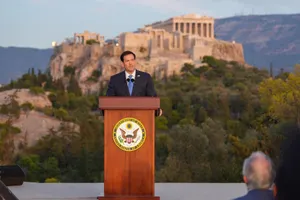
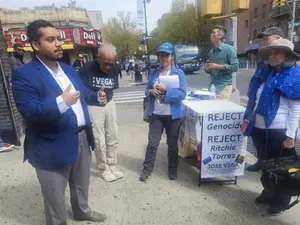
July 15—The most notable aspect of the June 2026 presidential elections in Peru is not the victory of the unpredictable Keiko Fujimori, but rather—and most importantly—the resounding defeat of the favorite candidate of U.S. President Donald Trump and the American neoconservatives: the former mayor of Lima, Rafael López Aliaga, who did not even make it into the June 7 runoff. The loss of this financial speculator and member of Opus Dei, nicknamed “Porky” for his girth, reveals the growing rejection of Trump’s thuggish imperialist stances toward the peoples of Ibero-America.
Rafael “Porky” López Aliaga, a personal friend of U.S. Secretary of State Marco Rubio, had promised to serve as a loyal agent in the region in implementing the so-called “Donroe Doctrine” proclaimed by the current U.S. President. During his campaign, López Aliaga had announced that he would oppose any construction of transcontinental railroads: “only highways” will connect the Peruvian coast with the country’s interior, he said during his lavish campaign for the Peruvian Presidency. But what posed an even greater threat to national sovereignty was his proposal to “legalize” the “extraction” of (alleged) narco-terrorist leaders from Peru by U.S. special forces, while backing the establishment of more U.S. military bases in Peru along with expanded agreements between the FBI and the Peruvian police.
That dual policy—blocking the transcontinental Atlantic-Pacific rail project, the single most important project for the development of the entire South American continent, while placing those nations under direct U.S. military control—is the premise which underlines the Trump administration’s National Security Strategy (NSS).
The NSS, released in December 2025 just weeks before the invasion of Venezuela and “extraction” of its President, Nicolás Maduro, by U.S. special forces, declared that Russia and especially China must be driven out of the hemisphere. As long as those two nations are present, offering to the nations of the region an alternative for sovereign cooperation in building the infrastructure and industrialization projects these nations seek, the Malthusian militarization program espoused in the NSS, which serves only the interests of Wall Street and the City of London, will never be secure.
Of the many presidential elections in Ibero-America over 2025-2026, the Peruvian and Brazilian presidential elections will be decisive as to the future of Ibero-America. Brazil, Peru, and China have once again begun to actively discuss the construction of the “bioceanic” railroad connecting Chancay, the modern, deepwater port China’s COSCO company built on Peru’s Pacific coast, to Brazilian ports on the Atlantic. The brazen Trump administration interventions into both the now-concluded Peruvian elections and the upcoming Brazilian election in October aim to crush all work towards that project.
U.S. Ambassador Redeploys
When Marco Rubio’s buddy, Porky, lost in April’s first round of Peru’s presidential election, the boorish U.S. Ambassador to Peru, Bernie Navarro, launched a fallback operation to try to politically capture Keiko Fujimori, one of the two candidates contending in the final election round, as a vehicle for Trump’s so-called Donroe Doctrine policy.[1] The ambassador—a Cuban-American businessman who, before he could be approved for the post, had to reach an out-of-court settlement with the Federal Reserve Bank of San Francisco on charges that he illegally pocketed more than $680 million while managing a $4 billion loan program for small and medium-sized businesses during the COVID-19 pandemic—appointed himself an “observer” of the elections, without anyone having invited or requested him to be one.
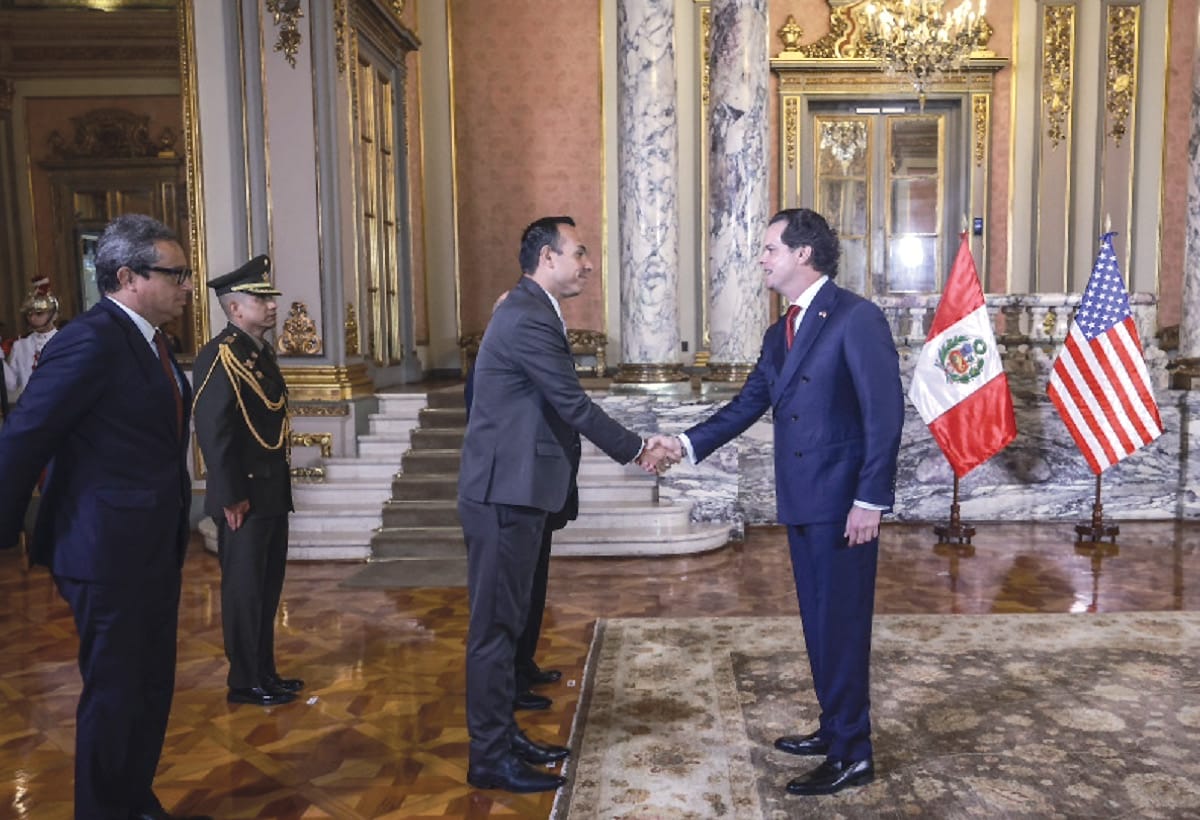
His boorish behavior intensified during the drawn-out vote-counting of the results of the June 7 runoff election, when the arrogant ambassador visited Peru’s National Office of Electoral Processes, supposedly to ensure that no fraud was committed against candidate Fujimori. During one such adventure, the ambassador told the Peruvian press: “While my embassy monitors electoral transparency, China is concerned with controlling Peru’s critical infrastructure.”
Between the first and second rounds of the election, the U.S. Embassy brought Carlos Díaz-Rosillo into Peru to campaign for Fujimori, and parade around as her big foreign policy advisor. Díaz-Rosillo, who has served in U.S. national security and military posts in Washington, D.C., is the founding director of the Adam Smith Center for Economic Freedom at Florida International University, where Keiko Fujimori was one of its Distinguished World Leadership Fellows.
Who Is Keiko Fujimori?
Although Keiko Fujimori holds liberal economic views, she is not, unlike Porky López Aliaga, an open advocate for the interests of the American neocons. As she stated in a recent CNN interview, when asked what would happen with Chinese investment in Peru, she said: “The United States and other countries had the opportunity to invest in the Chancay Port, but it was only China that did so…. [Peru] will allow all types of foreign investment, regardless of its origin.”
What is critical to know, is that Keiko Fujimori has come to power thanks to Fuerza Popular, the political movement founded by her father, former President Alberto Fujimori. The movement is a mixed bag, with elements of different outlooks, among whom are many firm defenders of national sovereignty. It is also the country’s largest political force, which has been the victim of fraud in two elections. The most recent operation was in 2016, when a U.S. DEA official—just two weeks before the runoff election between Keiko Fujimori and Boston banker Pedro Pablo Kuczynski—accused Fujimori of being involved in a $15 million drug deal. Without any substantial basis or evidence, the accusation nonetheless spread throughout the country. Later, the DEA recanted the accusation, but the damage had already been done, paving the way for the victory of Wall Street’s Kuczynski.
Alberto Fujimori has been vilified and slandered, his alleged “history” as a “dictator” written by the Wall Street powers which were challenged when he was President. Fujimori defeated the narco-terrorism of Shining Path and the MRTA through a constructive policy in alliance with the Peruvian armed forces. With the famous Military Engineering Battalions—a proposal advocated at the time by Lyndon LaRouche and his movement in Peru—he built roads, schools, hospitals, and police stations in remote parts of the country, thereby drawing Peruvian peasants away from Shining Path.
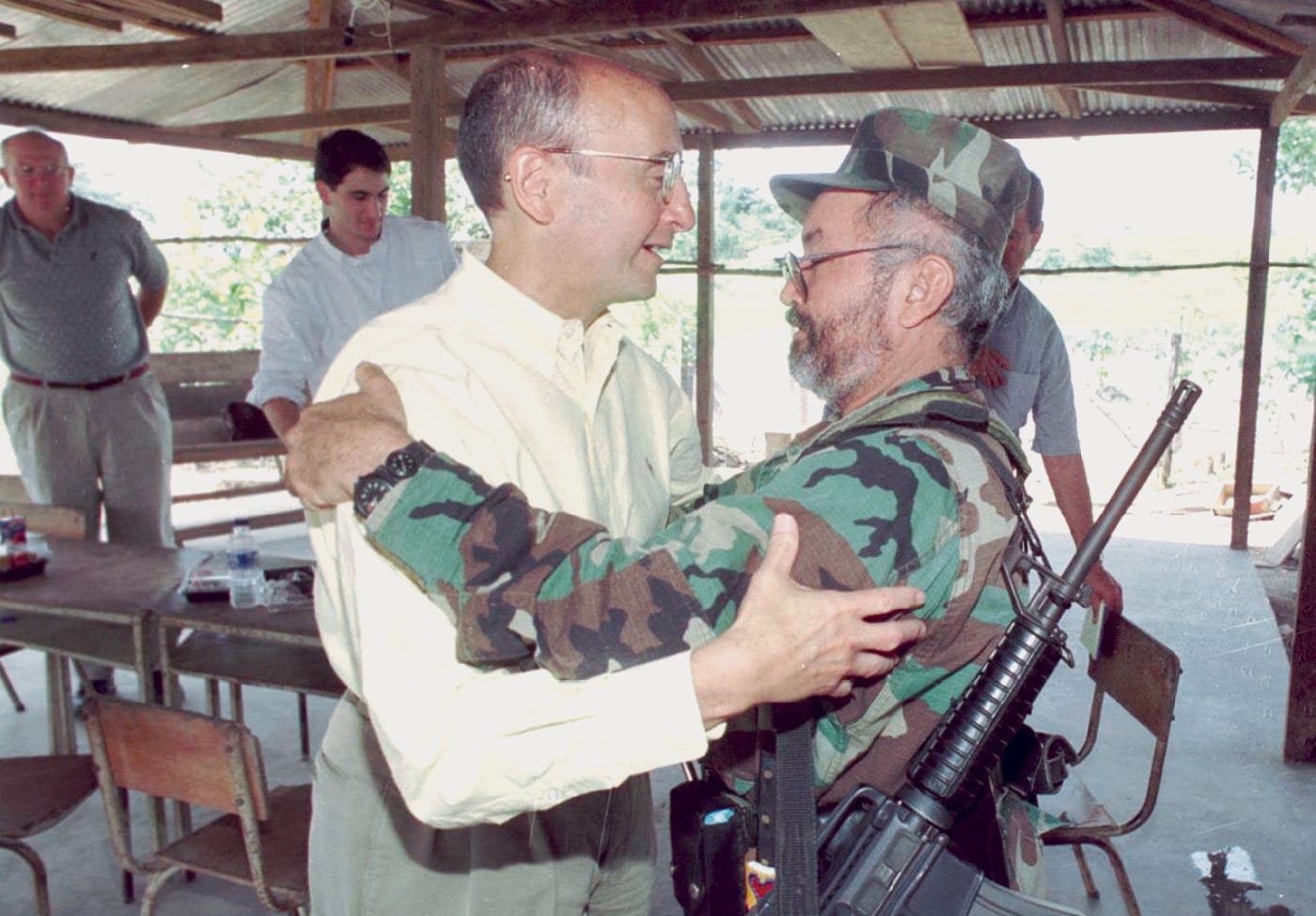
Although Fujimori accepted the brutal neoliberal austerity measures imposed by the IMF for most of his Presidency, he did not allow globalism to destroy the Peruvian nation-state. He refused to declare Shining Path a belligerent force and grant it control over a piece of national territory, as demanded at the time by the Organization of American States (chaired by former Colombian President César Gaviria), U.S. Secretary of State Madeleine Albright, and Henry Kissinger’s long-time advisor and agent, Luigi Einaudi. The model demanded of Peru was that of the infamous “Grasso Abrazo” organized by Albright for Colombia, where the narco-terrorist FARC were handed sole control over a 42,000-square-kilometer area in the jungle, the Caguán, where the FARC imprisoned the leading national figures and ordinary citizens they kidnapped. It was to that Caguán hellhole that the then-head of the NY Stock Exchange, Richard Grasso, traveled in 1999 to negotiate the future investment of the FARC’s billions in Wall Street—reporting before and after his trip to Albright’s State Department.
Bankers’ Boys Worry About a New ‘(Olive) Green Pact’
The financier globalists fear the potential for a Keiko Fujimori government to become a new iteration of that alliance between the executive branch and the Peruvian Armed Forces on behalf of national development. In a recent issue of the weekly magazine, Hildebrant en sus 13, a mouthpiece for the Institute for Legal Defense (IDL), Keiko Fujimori’s rise to power is described as a new threat of forging an “Olive Green Pact.” The IDL is an NGO run by Gustavo Gorriti, a long-time lackey of the notorious international speculator George Soros, who has been a fierce enemy and slanderer of Lyndon LaRouche in Peru for decades, and served as a key propaganda operative in the FBI–U.S. Department of Justice–run Lava Jato coup in 2014-2018 against Brazilian presidents Dilma Rousseff and Lula da Silva. Gorriti and Diego García Sayán, the long-time director general of the Andean Commission of Jurists (also part of Soros’s international drug-legalization apparatus), were the main architects of the lies and false accusations against Keiko Fujimori.
What is never reported about Alberto Fujimori, is that once his government and the Armed Forces of Peru had together largely defeated the multiple terrorist movements thrown against Peru, he then broke with the IMF’s neoliberal economic policy; and that he set out to help build the drive for unified continental development that was beginning to take shape in South America. On August 31 and Sept. 1 of 2000, the first-ever Summit Meeting of South American Presidents was held in Brasília. There, Fujimori stated that continental unity—especially of Peru and Brazil—would enable the development of the subcontinent. Brazil and Peru, he said, are similar nations, Siamese twins joined at the back; “their union will signify the continent’s economic power.”
In a beautiful speech to a working session of that summit, published in full by EIR, Fujimori contrasted the reality, that 200 million of the people of the region lived in conditions reminiscent of its colonial past, to the region’s great potential.
“Seen from a satellite, the South American subcontinent is enormous, more than 20 million square kilometers which contain resources which make us, united, the number-one mining, fishing, oil, and forestry power in the world,” he reminded his fellow presidents. “However, there below, in that so generously endowed portion of the planet, we also see great areas of coca or poppy cultivation, immense belts of urban misery, endemic diseases, precarious education, terrorist violence, etc., etc.”
He denounced the IMF financiers’ debt-trap mechanism for enforcing those conditions—“[a] sizable and heavy foreign debt weighing upon the shoulders of our peoples, and whose principal, according to conservative data, has been paid several times, over the course of these last 25 years”—and urged that the 12 nations of South America unify their efforts behind a development strategy based on physical integration of the continent capable of answering “our people’s longing for progress.”
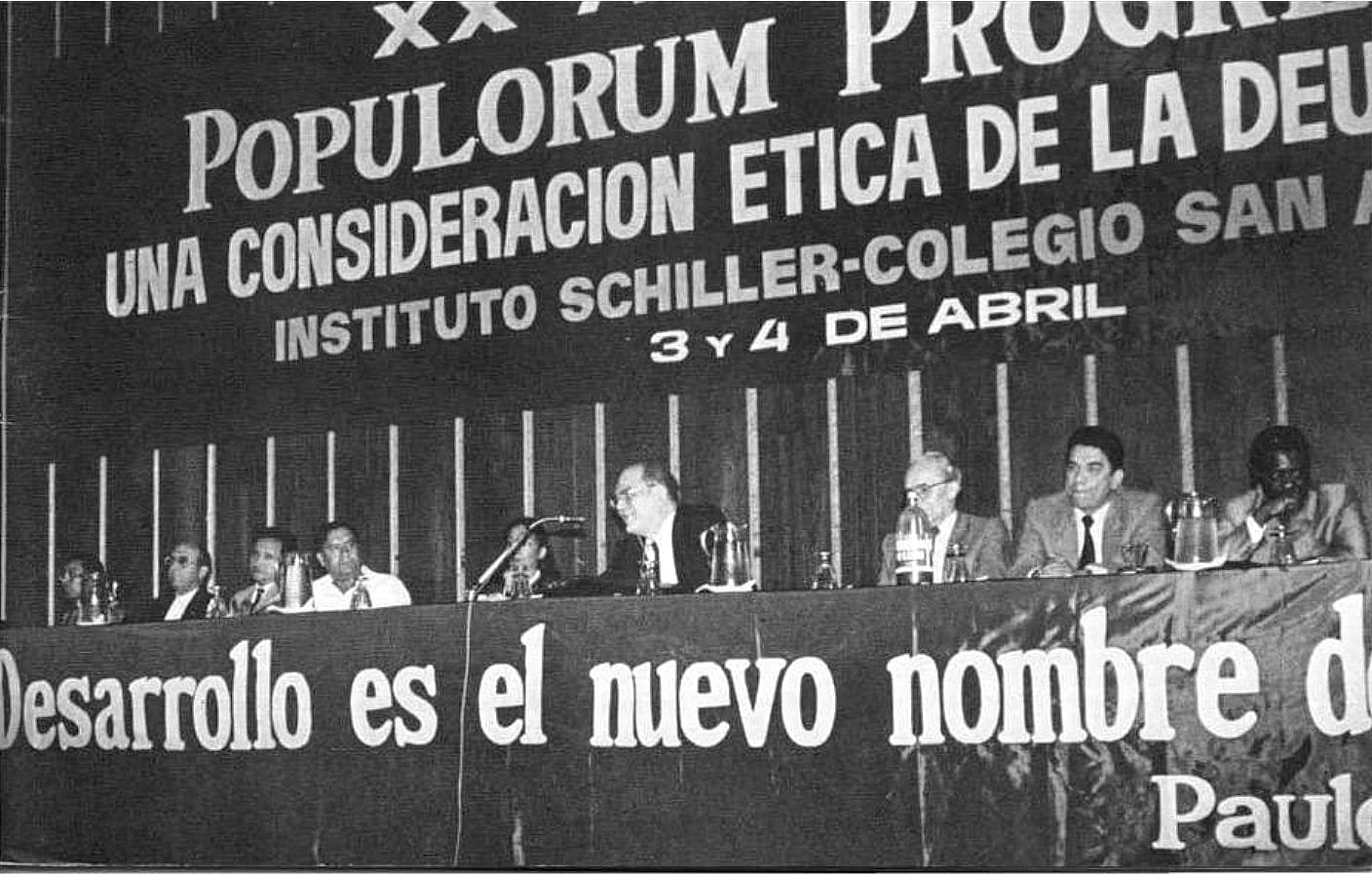
Nearly simultaneously with those remarks, the Peruvian military invited EIR’s founder, American statesman and economist Lyndon LaRouche, to deliver the keynote address at the ceremony commemorating the 50th anniversary of the founding of the Center for Advanced Military Studies (CAEM). LaRouche was scheduled to meet with the nation’s top civilian and military leadership, including those most active in coordinating with Brazil on the subject of infrastructure integration.
This was too much for the international financiers. On August 31, the first day of the historic South American summit, the Los Angeles Times signalled that LaRouche’s influence in Fujimori’s Peru was recognized as a strategic threat to the bankers. The Fujimori government “has hardened its tone with anti-U.S. diatribes and a strange affinity for the far-right ramblings of the U.S.-based Lyndon LaRouche movement…. His regime … could become the model for a trend,” a Los Angeles Times staff reporter wrote in an article on the Andean countries.
The process Wall Street feared was brought to a halt by the coup against Fujimori, which began in September and ended in November of that same year. The coup was a joint operation of Madelaine Albright’s State Department, the CIA, and the George Soros apparatus.
The same duo of Soros agents, Gorriti and García Sayán, who this year sought to stop Keiko Fujimori in the just-concluded election, took the lead in campaigning against her father in the months before he was ousted in November 2000. While Gorriti was transferring millions of dollars to the presidential campaign of the drug addict Alejandro Toledo, García Sayán (who would be named a minister in Toledo’s government) was traveling throughout the U.S., accusing the Fujimori government of following the advice of Lyndon LaRouche.
Historic Processes May Emerge Again
Given the above history, and amid the Trump administration’s stepped-up pressure against China investing in Peru—most especially in the construction of that transoceanic railway linking the Atlantic and Pacific coasts and reaching the port of Chancay—Brazilian President Lula da Silva’s recent congratulatory letter to Peru’s President-elect, Keiko Fujimori, takes on great significance.
Lula greeted the Peruvian President-elect by recalling the ties between the two countries and expressing his hope that those ties will be strengthened during her term: “I wish you every success in carrying out your term of office and in the important task of uniting the Peruvian people around a common development project,” Lula wrote in his congratulatory letter. Brazil is ready to work together with Peru on “an ambitious bilateral agenda” for the benefit of both nations, he added, and concluded: “You can count on Brazil to work together to build a more prosperous, integrated, democratic, and sovereign South America.”
In the same vein of building a process distinct from the new imperial Donroe Doctrine, Chinese President Xi Jinping also sent a congratulatory letter to Fujimori on her victory. Xi emphasized that “China and Peru are comprehensive strategic partners and relations between the two countries maintain strong momentum for development.” He added that “high-level exchanges between the two sides have been frequent, practical cooperation in various fields has yielded fruitful results, and the friendship between the two peoples enjoys deep popular support.”
Xi also noted that this year marks the 55th anniversary of the establishment of diplomatic relations between the two countries. In that context, he affirmed that he attaches “great importance to the development of bilateral relations” and expressed his willingness to work with the President-elect “to promote the traditional friendship between the two nations and take the comprehensive strategic partnership to new heights, for the benefit of both peoples.”
Notes
- Trump’s Donroe Doctrine is the polar opposite of the widely-misunderstood Monroe Doctrine, drafted by the strident anti-imperialist, John Quincy Adams, then Secretary of State for President James Monroe. The Monroe Doctrine was based on the understanding that Adams expressed most beautifully in his July 4, 1821 address to the House of Representatives, known for its commitment that the United States “goes not abroad, in search of monsters to destroy.” Should it do so, Adams warned, “the fundamental maxims of her policy would insensibly change from liberty to force. The frontlet upon her brow would no longer beam with the ineffable splendor of Freedom and Independence; but in its stead would soon be substituted an Imperial Diadem, flashing in false and tarnished lustre the murky radiance of dominion and power. She might become the dictatress of the world. She would be no longer the ruler of her own spirit.” A fair description of what today’s United States has become! To set the record straight on the Monroe Doctrine, see EIR’s “The Monroe Doctrine Was Aimed at Britain.”