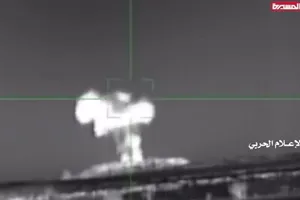
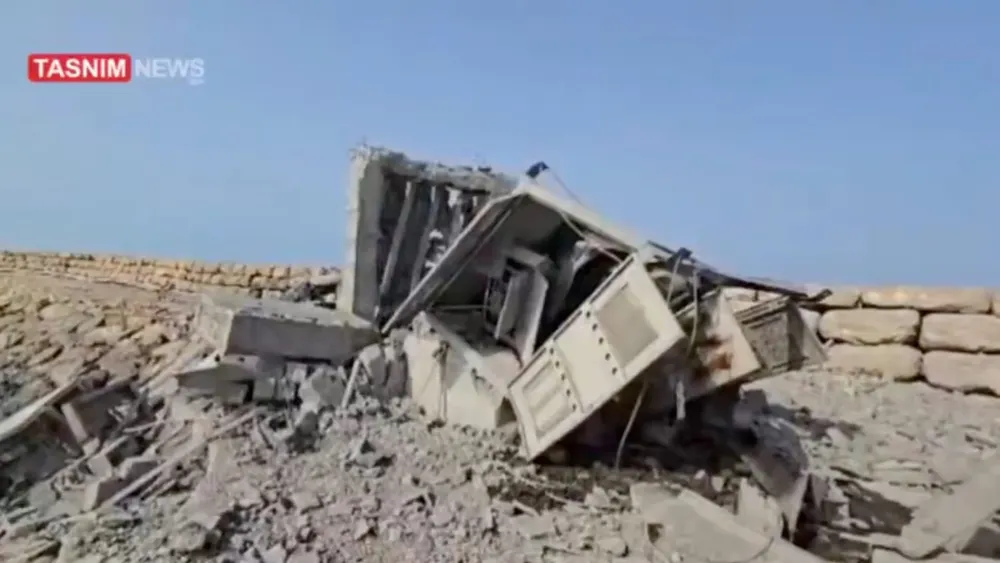
The United States struck Iran for an eighth consecutive night on July 18-19. CENTCOM claimed its targets were coastal surveillance, air defense facilities, maritime capabilities, and missile and drone storage. However, the actual targets tell another story. Iran’s Atomic Energy Organization reported July 19 that U.S. projectiles hit the under-construction Darkhovin nuclear power plant—a civilian power station which the IAEA confirmed was under active inspection before the recent aggressive U.S.-Israeli war against Iran began. The day before, U.S. strikes damaged a water desalination plant in Jask, Iran, cutting off water to 10,000 people.
These developments come only days after President Donald Trump told Fox News: “We’re gonna knock out all their power plants. We’re going to knock out all their bridges unless they get to the table and negotiate.” If Iran doesn’t make a deal, he warned, “You’re not going to have anybody left.” Such logic implies an escalation ladder that once begun is hard to reverse. Following the increasing strikes on Iranian civilian infrastructure, Kuwait has now reported damage to one of its power generation and desalination facilities for the second time in two days—this in a region where most freshwater supplies come from desalination.
Nor is any of this going well for the United States. CENTCOM has confirmed that unidentified remains were recovered at the Muwaffaq Salti Air Base in Jordan, where two American service members were killed by an Iranian missile strike and a third has been missing since. A fourth service member was killed in northern Iraq on July 18 during a controlled detonation of ordnance from a downed Iranian drone. As pointed out in a new article in the Wall Street Journal, these events point to the painful reality that Iranian missile capabilities are far more advanced than previously thought.
Where does this all lead? According to Trita Parsi of the Quincy Institute, Washington and Tehran are arriving independently at the same conclusion: that diplomacy is finished, and that only the military exhaustion of the other side can change anything. He names the hardening on both sides for what it is: “not an adjustment to reality,” but “a profound failure of imagination and statecraft.”
If that failure is not answered, no one is exempt from the consequences. This was the tenor of Helga Zepp-LaRouche’s remarks during a July 19 show on Pakistan TV. If this conflict continues, with the prolonged bottleneck in the Strait of Hormuz, then this could “throw the world economy into a depression,” she warned—not to mention the initiation a war between nuclear powers. Because of this, the effects of this crisis are reaching every country on the planet, which makes every country an indirect party to it—whether it wishes to be or not. “We are all sitting in one boat,” she declared, and noted that one factor which could play a major role today is if “the international community [raises) their voice much, much more, because they are de facto an indirect partner in the situation.”
The danger is not confined to the Gulf, either. On July 19, drones struck two oil tankers at the Caspian Pipeline Consortium’s terminal near Novorossiysk. This followed Russia’s overnight assault on Kiev and Odessa, among the largest of the war, which itself followed Ukraine’s massive strike on Russian retail distribution warehouses that killed eight and wounded more than 60. This region also threatens to expand far beyond its borders, including into Ukraine’s supporters in Europe.
Against this, consider what was heard on the evening of July 18 in the courtyard of the Apostolic Palace at Castel Gandolfo, where Pope Leo XIV was honored with a concert of Paganini and Bellini. The world is filled with ugliness, the Pope acknowledged—wars, violence, difficulty. But yet, things of beauty “reminds us that there is more than all of this. It reminds us that men and women, when we choose to, can join together to reveal a beauty that, from heart to heart, helps us to see and to lift our gaze toward heaven.” In other words, Pope Leo asserted that humanity is something other than what the war planners assume it to be—and it is the only ground on which the dead end Parsi describes can actually be exited.
Zepp-LaRouche put the same point in strategic terms. “I think we should not overlook the moral factor” in the current situation, she said. “We can draw up scenarios and say this and that will be the outcome. I say something different: I’m saying that through this unprovoked war of aggression—two times by Israel and the United States against Iran which did not provoke this with anything they did in the first place—the world opinion has dramatically shifted, and I would not underestimate that as a factor… I think the world population is clearly shifting in a way which will have consequences down the road.”
In concrete terms, that means acting on today’s failed neocolonial world paradigm itself, and putting in place a new security and development architecture that genuinely takes the interests of all into account, along with programs like the LaRouche Oasis Plan for the large-scale economic development of Southwest Asia. These topics will be the feature discussion at the July 31 EIR Roundtable event, “Solve the Immigration Crisis with Development; What You Need to Know About the Strategic Significance of Pope Leo’s Encyclical.”