
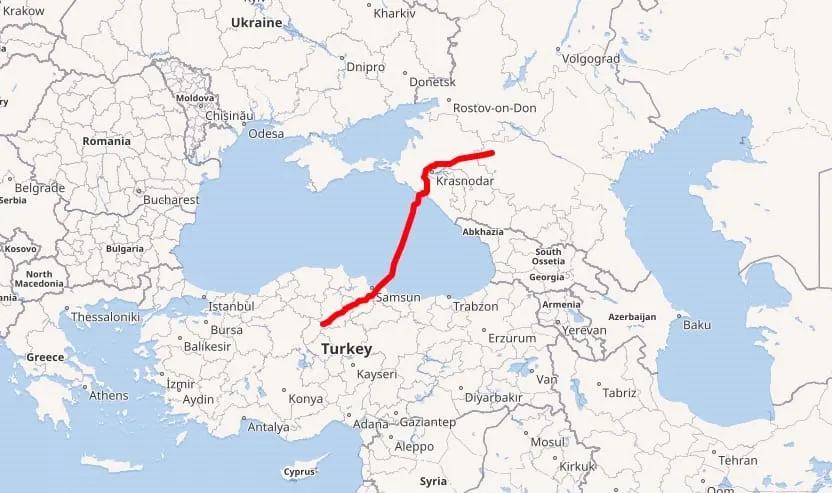
In addition to the unsuccessful attack on Moscow with 430 drones earlier this week, and the strike against the major Omsk oil refinery (which produces about one sixth of Russia’s gasoline and diesel), Ukraine also struck the Blue Stream pipeline to Türkiye with drones on Tuesday. The Krasnodarskaya compressor station in Krasnodar Territory, part of the 350-km above-ground segment of the pipeline, was hit. According to TASS, Gazprom is repairing the damage and disruptions to supplies to Türkiye have been avoided.
Speaking in Türkiye itself, Ukrainian acting President Zelensky crowed about the strike on Omsk, which is 2,500 km from the Ukrainian border with Russia: “Upgraded Fire Point drones have put Siberia within reach of Ukrainian precision. This is a significant blow to Russia’s oil economy and an important achievement for the Armed Forces of Ukraine,” Zelenskyy said.
Ukraine is also doing everything possible to stop the supply of fuel to Crimea by striking what they call Russia’s “shadow fleet” in the Sea of Azov, Reuters reported. According to the Kiev military, Ukrainian drones attacked a dozen tankers over the past two days. In an interview with Reuters last month, “Kyiv’s top drone commander, Robert Brovdi, pledged to effectively cut off Crimea from Russia through a campaign of systematic strikes.”
In an interview with the Swiss daily Weltwoche, Kremlin spokesman Dmitry Peskov said that European countries “actually [put] their satellites at the total disposal of the Kiev regime. They target the weapons, Ukrainian weapons, by their satellites.”
In comments to Sputnik, veteran Russian military analyst and National Defense Magazine editor-in-chief Igor Korotchenko stated that the Zelensky regime is merely “implementing plans developed with the active participation of the UK and NATO headquarters.” London is playing a special role “in the context of a centuries-long confrontation with Russia,” Korotchenko said, hoping to trigger “negative processes in Russian society by targeting critical vulnerabilities, with the ultimate goal [of] weakening it as much as possible, and ideally, triggering disintegration processes in our country.”
He added that “the means of air attack will be decisive in determining the balance of forces and resources,” and had a recommendation: “No mercy for the enemy—Ukraine’s entire energy and industrial infrastructure must be destroyed.”


